The Writing of Mark Halliday: Close Reading
“Each of us, as seen by the great anthologist in the sky, is like a short poem. I told my daughter, on a hot summer day, that I was failing to choose a book of poems to write an essay about. She asked, ‘What poetry has interested you most recently?’ I said I’d spent the morning puzzling over a short poem by my friend William Olsen, a poem I’d been drawn to for many years without fully understanding it. ‘Write about that,’ Devon said. I smiled— ‘A whole essay on one short strange poem?’ ‘Sure,’ she said, ‘you love close reading!’”—Mark Halliday
Speculative Friction
By Claire Bateman

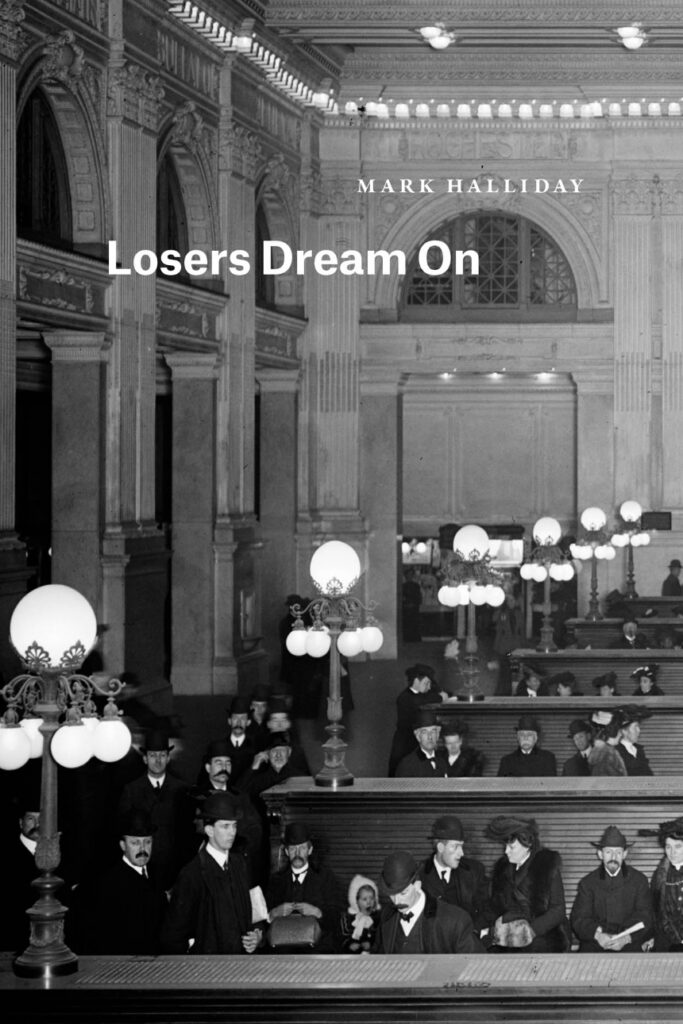
 GREENVILLE South Carolina—(Hubris)—November/December 2026—Poet, essayist, professor, and critic Mark Halliday’s seventh book of poems, Losers Dream On, was published in 2018 by the University of Chicago Press. His Living Name: Essays on American Poets appeared in 2025 from LSU Press. Since 1996, he has taught creative writing at Ohio University.
Process: “Coffee shop, unpredictable book or journal, wisp of idea, jotting lines in notebook, rough rough draft, type it on computer within a few days, semi-forget it, then notice it a few months later, revise for more insistent truth-digging, later maybe maybe maybe include it in a book manuscript.”

Floating Log
By Mark Halliday
I kind of like Denise Duhamel’s poem “Reading” in her book Scald,
or at least I like the first six lines and the last ten lines.
While I’m reading Duhamel I glance occasionally out the window
at the Hocking River which after four days of rain is
vigorously brown and sudsy and more dangerous than you’d think.
I’m not crazy about the associative jumps in the poem. I do like
how she starts by admitting how much she forgets of her reading
because of how her mind skips from idea to idea. But when she jumps
I want her to make sure I jump with her, kind of.
The whole middle part about an almost-car-accident seems
to throw me off track. I want there to be a track
as opposed to just a swirling. Because, see,
Nature and the brain do more than enough swirling
so let’s not over-imitate that? But then in the last ten lines
I like how she wonders why we keep trying to narrate experience
including the swirl of mental experience even though
hardly anyone is going to care. In the Hocking River
There’s debris that somehow floats in circles even though
the current is strong. A physicist could explain this but
I prefer to think in a clear way about what is forever unclear.
So I think Duhamel’s poem is sort of half good
and I will go on having these mixed responses until I die.
There’s a black log that keeps describing a bleak ellipse.
Do I want to understand the river’s current at all?
Is there a verb that would mean “encounter deeply”?
“He wanted to innerstand the current of life and so
he looked at the river and he read poetry
and his mixed responses were his life.”
Paperback Thriller 1961
By Mark Halliday
Clementi sips brandy from a tumbler, with cool confidence.
His dark jacket must feel smooth and soft because he never wriggles
or scratches or sweats. There is a question about politics
on the island called St. Cree’s. Why does Clementi care?
Because of power—power is alive in the ocean wind
and men have to care about power; Telemann cares—who is
Telemann? He is a secret agent. He knows secret things
and this is a form of power—and men have to care.
Clementi sips brandy and thinks about what Telemann may do.
There is something about the Laramandans who have tommy-guns.
Will they capture Sir Francis the Governor when he lands
and hold him hostage in a villa? Does Clementi want this?
I squint at the print. Men have to care about power
and I am a boy. Whose side is Telemann on?
Does he want to keep the Comingi from rebelling?
Or does he want to foment rebellion? Someone said
that Telemann controls the Kambles but are the Kambles the same
as the Comingi? Does anyone have a girlfriend on the island?
There was a scene in which Mr. Carr drank tea with someone’s wife
and she asked him to take her necklace and keep it safe—
something in that scene was unreadable by me in 1961.
Why do these men care so much about power on St. Cree’s?
Because they are men. But here is a more specific point:
there is oil on the island, under the sand. This is said
in a serious way—so much follows from the fact. Oil
makes things run. Men care. Make things happen! I squint at the print.
The book is called a thriller so why am I not thrilled?
When I’m older I will know to care about oil. Meanwhile
the Laramandans have tommy-guns and I hope they do
something very fast and loud and simple very soon.
Social Life
By Mark Halliday
The lake is chilly. Motorboats cross it every which way
kicking up a casual chilly spray.
We like you, more or less. In public situations—
meetings, conferences, receptions, parties—
we enjoy chatting with you, for maybe ten minutes
or occasionally even up to half an hour.
You have a nice understated wit, good for a dry counterpoint
to some loud talker’s rodomontade. And in fact
we think some of your writing is “really quite good.”
However, you are not our spouse
and you are not our sister or brother
and you are not among our few true friends.
We could live without you and barely notice it.
If you got sick and died, we might send a condolence
to someone who does apparently care about you
but our lives would continue without a glitch.
So keep that in mind before you develop some awful disease.
It’s a wide chilly lake. The motorboats
as long as they have fuel can kick up that cold spray.

Bleak Solace in a Poem by William Olsen
By Mark Halliday
Each of us, as seen by the great anthologist in the sky, is like a short poem.
I told my daughter, on a hot summer day, that I was failing to choose a book of poems to write an essay about. She asked, “What poetry has interested you most recently?” I said I’d spent the morning puzzling over a short poem by my friend William Olsen, a poem I’d been drawn to for many years without fully understanding it. “Write about that,” Devon said. I smiled—“A whole essay on one short strange poem?” “Sure,” she said, “you love close reading!”
I do. The effort of close reading expresses our belief that we may be able to find and appreciate the depth of emotion and of insight in another person, and that another person may be able to do that for us.
We don’t want to lose hope. Hope is endangered for us all now—we have to think of this every day in a hot summer of global warming. To say this sounds banal—because it is a truth too vast and too unremitting. It can make you miss the drama of the fear of nuclear war; nuclear war would have to come from the monstrous stupidity and evil of national government leaders—they could be disempowered, removed from office . . . But every one of us contributes to global warming every day.
But we need to hope. Without hope, meaning disintegrates. Without hope the days and years rush past us like an empty train.
William Olsen’s poem “By a Railroad Crossing” imagines radical loss of hope. The poem does not find an answer to or a recovery from this loss. Except that we can hope that the stoicism in the poem’s imagining is being offered to us and may give us courage.
“By a Railroad Crossing” does not refer to global warming. The loss of hope the poem imagines is a response to the even more fundamental reality of our living in time and space and contingency.
The poem appeared in Olsen’s book Avenue of Vanishing (Northwestern University Press) in 2007.
There are moments when each of us realizes that we are on the way to vanishing. Everything we care about will disappear from the universe. Normally we pull ourselves out of these moments and return to our lives of effort and hope. Olsen’s poem stays in its moment. From its title “By a Railroad Crossing” and phrases near the end of the poem we infer that the moment has come to the poet’s mind on a winter night, waiting in his car for a train to pass. His realization—his bleak epiphany—comes in twelve lines, six two-line stanzas.
One day our signatures will ascend from our wills
with all the rubbish of our little dusks.
Those first two lines make a declaration through a surrealism that is calmly decisive. Can we paraphrase it? In the infinity of change in time our careful formalized expressions of intention will eventually become forgotten paper junk divested of the ink of our individual identities which will have drifted up into the clouds—along with whatever else we foolishly cherished on our little desks in the brief after-sunset minutes of our absurdly small days.
And what will be our response to those losses?
We’ll give up on redemption, for the time will have passed
for waiting around like abuse for angels to board us.
We will know that it has become too late to hope for any fundamental rescue; the hope in religion will be exposed as delusion like the delusion of a person perennially expecting serious change in an abusive partner. We will realize that our lives are not destined to be like an express train—or a bus—guided by angels.
In the moment of this realizing, we will feel we have arrived at a silence beyond words; and at a radical isolation that has let go of even the idea of being with other persons. There will be no more thought of conversation; the ancient list of numbers called “the phone book” will have become detritus like our wills and other rubbish.
That instant after language and solitude
a page of the phone book will blow away, with a few more.
One page, another page, several pages—no matter how many, because none of the pages will have meaning anymore.
And a last human voice will argue
the unconditional terms of perpetual sadness.
The dictionary says that as a transitive verb “to argue” is “to put forth reasons for or against.” Either way, in this case the terms in question are recognized by the poem as unconditional—that is, the terms cannot be refused or even alleviated. Still, on the final occasion described by the poem, a human voice will articulate reasons for—or against—these unconditional terms. Whose voice will do this? I think of it as the voice of the protagonist who has stopped at the railroad crossing on a winter night; or perhaps it is the voice of any person experiencing the radical relinquishment of hope, any member of the “we” in line three. The assertion that “a last human voice” will recover language enough to reflect on—and to consider the meaning of—our inevitable ongoing sadness is as close as Olsen’s poem can come to affirmation of our dignity in confronting the void. The poem says we will have given up on redemption; but we may feel that a chilly kind of redemptive value persists in the human insistence on arguing here at the final crossing—and we can hope that Olsen feels this too.
The poem’s last four lines locate us there on the winter night, waiting for a train to pass. The strange phrase “our very first lives” seems to imply that more lives are to be lived by us—lives changed by the absolute realization that has come to us by a railroad crossing.
The white face of the earth, streetlight off snow.
One street, one train, one stoplight to go green.
This shall be the last night of our very first lives,
and what this means shall pass like empty berths.
The phrase “very first” calls to mind experiences that are new to a child— “her very first merry-go-round,” “his very first movie at a theater”—so the realization we will undergo at the railroad crossing will be a crossing to a life without the innocence of trusting in legacy (“our wills”) and redemption and relief from sadness. And yet the meaning of this loss of innocence will not be available to us; or, if we do see the meaning it will rush past us like a dark train without passengers.
A person listening to the poem rather than reading it would wonder if the last word could be “births” rather than “berths.” What is an empty birth? The phrase suggests the beginning of a life without meaning, without value. Olsen does not point toward the berths/births pun but he knows it will come to mind. As we play with words we are less crushed by what they refer to.
“By a Railroad Crossing” embodies the paradox of epiphany without revelation; “what this means shall pass like empty berths.” The poem is faithful to the radical bafflement of being human on earth. It can seem strange to say that you love a poem so bleak, so uncomforting. And yet many great poems stay faithful to radical bafflement; perhaps most do. “Fled is that music:—Do I wake or sleep?” “Much Gesture, from the Pulpit—/Strong Hallelujahs roll—/Narcotics cannot still the Tooth/ That nibbles at the soul—” “I must lie down where all the ladders start,/In the foul rag-and-bone shop of the heart.” “And forced the underbrush—and that was all.” We take comfort in our kinship with a great poet who digs down to radical bafflement.
Here is William Olsen’s “By a Railroad Crossing” as a whole:
One day our signatures will ascend from our wills
with all the rubbish of our little dusks.
We’ll give up on redemption, for the time will have passed
for waiting around like abuse for angels to board us.
That instant after language and solitude
a page of the phone book will blow away, with a few more.
And a last human voice will argue
the unconditional terms of perpetual sadness.
The white face of the earth, streetlight off snow.
One street, one train, one stoplight to go green.
This shall be the last night of our very first lives,
and what this means shall pass like empty berths.
Do I say it is a great poem? I say it is a poem of great integrity; it inhabits its vision with such intelligent cogency. And for me there is a solace in recognizing this—in 2026, 19 years after the publication of Avenue of Vanishing. Each of us can hope that we too, with our fears and our perceptions, may be unforgotten as we keep living on a hotter and hotter planet.
Note: This essay first appeared in Literary Matters, Issue 16.1, September 26, 2023. William Olsen’s poem “By A Railroad Crossing” was originally featured in a 2004 issue of The Georgia Review.


Claire Bateman
Claire Bateman’s books include The Pillow Museum: Stories (Fiction Collective 2); Wonders of the Invisible World (42 Miles Press); Scape (New Issues Poetry & Prose); Locals (Serving House Books), The Bicycle Slow Race (Wesleyan University Press), Friction (Eighth Mountain Poetry Prize), At The Funeral Of The Ether (Ninety-Six Press, Furman University), Clumsy (New Issues Poetry & Prose), Leap (New Issues), and Coronology (Etruscan Press). She has been awarded Individual Artist Fellowships from the National Endowment for the Arts, the Tennessee Arts Commission, and the Surdna Foundation, as well as two Pushcart Prizes and the New Millennium Writings 40th Anniversary Poetry Prize. She has taught at Clemson University, the Greenville Fine Arts Center, and various workshops and conferences such as Bread Loaf and Mount Holyoke. She lives in Greenville, South Carolina. (Please see Bateman’s amazon.com Author’s Page for links to all her publications, and go here for further information about the poet and her work.) (Author Head Shot Augment: René Laanen.)