A. E. Stallings’ Frieze Frame

“Stallings makes a claim that has grown on me though it is necessarily figurative rather than physical. She depicts, with much documentation from the poetry of Cavafy forward, that the Elgin Marbles and their counterparts in the Acropolis Museum are already united despite the failure (to date) of negotiations to deliver the former from London to Athens. They are united in a flowering of poetry and prose about them (I especially recommend Anna Griva’s poem), often speaking in their voices. The lone caryatid from the Erechtheion has been represented, even in British Museum labelling, as united by familial connection, affection, and ethereal communication, to her ‘sisters’ in Athens. And together, they are also united in exile from their places on the Acropolis; one in London, and others indoors at the Acropolis Museum, necessary to protect them from present-day climatic conditions. All of them, like international refugees today, have little choice but to take such asylum as is offered by their respective hosts. Stallings is one of the international army of the righteous which holds these exiles in its embrace.”—William Ramp
The Hubris Review
By William Ramp
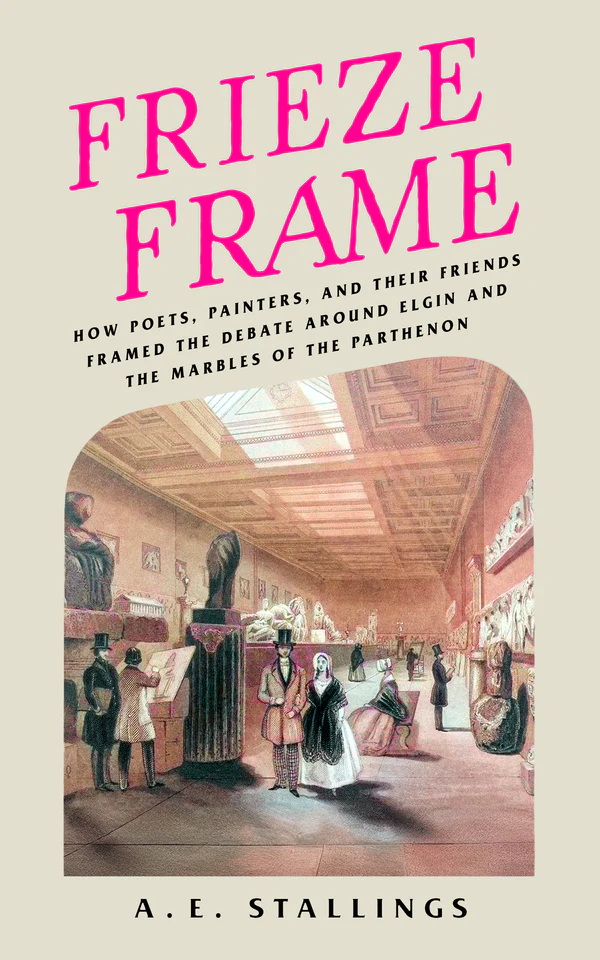
A. E. Stallings, Frieze Frame: How poets, painters, and their friends framed the debate around Elgin and the marbles of the Parthenon. Philadelphia, PA: Paul Dry Books, 2025. xviii + 233pp.
 LETHBRIDGE, ALBERTA Canada—(Hubris)—June 2026—I should note three things quickly before getting to the Parthenon marbles and a review of A. E. Stallings’ new book about them, Frieze Frame. The first two relate to the front and back covers. The third is more lengthy and biographical.
The book’s title contains a pun that manages both to be groaningly obvious and delightfully inspired. Stallings argues that the “freezing” of the British Museum’s Parthenon sculptures, both in their Duveen Gallery cella and in their capture by a certain kind of art discourse, has had consequences both for our understanding of classical Greek statuary and of terms like “civilization.”
The somewhat more lamentable back-cover blurb characterizes the book’s contents as “deliciously gossipy.” I suppose it’s a fair label: Stallings does include a gourmet supply of anecdote in Frieze Frame, and the one about Boris Johnson in his university days is not to be missed. But they all serve her narrative, not titillation. Admittedly, book blurbs are mainly a device to catch idle eyes, and “gossipy” is a more efficient catcher’s mitt than, say, “Stallings mines 200 years of poetry, journalism, diary entries, archival material, state records, art history, and art criticism to develop a vital new story of the wanderings, abduction, and detention of the Parthenon sculptures removed and taken to Britain by Lord Elgin.” The extended description is more accurate; among other things, Stallings is an award-winning poet, and I’ve never seen better use made of poetry as historical documentation. But gossip sells on bookstands.
The third nota bene is a pair of caveats. First, this is less a proper book review than a series of impressions, though this reflects something of Stallings’ own narrative device, which is to give what appears to be a series of impressions, each in its own short chapter, but which eventually beguile the reader into her narrative purpose rather than declaring it a priori. I do like that.
The second caveat is biographical: I’m not a trained expert in classical Greece, its history, literature, religion, or arts; nor in art history or the history of collecting (though I read much in the latter two subject areas whilst in pursuit of an enigmatic Victorian art collector, dealer, and forger who died in London’s Charing Cross Hotel impoverished by an obsession with the remains of his collection of Renaissance and Baroque art). But this lack of expertise means that I can treat myself as exemplary of a more general ignorance. I did an informal poll of acquaintances and family members for this review and only a few had any clear idea, without prompting, of what the terms “Elgin marbles” or “Parthenon marbles” referred to. For a long time, I too lacked a clear sense of either term and shared in some still-common misconceptions about the Acropolis and classical Greek sculpture more generally.
Likely, I first heard of the “Elgin Marbles” during my high-school or undergraduate years. The story I got, in fragments, was that a British nobleman, Lord Elgin, had removed various pieces of sculpture from the fabric of the Parthenon to London, where he generously donated them to the British Museum. I also came to understand classical Greek sculpture in terms of a narrative of civilizational ideals: that the Greeks in the 4th and 5th centuries BC had reached pinnacles in philosophy, literature, political organization, architecture, and the sculptural arts unrivalled before the Renaissance, and that their surviving examples still served as models for the world.
But I never read any of the major works of Graeco-Roman literature, though as an undergraduate philosophy major, I managed a passable acquaintance with Socrates and Plato, if not Aristotle. The Peloponnesian Wars remained a name only to me, as did Thucydides, I knew that Athens and Sparta had radically different political orders; that Demosthenes was an orator and Pericles a statesman and general gifted with a persuasive tongue. But that was about it. I knew the Acropolis was a world heritage site and location of the Parthenon, but I didn’t know until years later when Athens impressed it upon my burning legs that both were situated on a rock topping a hill and that the combination was several hundred feet high. I thought the Parthenon had been blown up by the Turks sometime in the late 18th or early 19th century—a full century off. I would have been unable to give a precise definition of a frieze, a metope, or a caryatid. I thought that all classical Greek sculpture had been white, a sign of its purity of form.
In my 30s, I was appointed a board member of a local community museum, and subsequently its chair. About this time, the museum hired a new director, who took stock of its holdings and discovered to his dismay that they included the skeletal remains of a group of Indigenous people and their associated grave goods, dating back at least 20 centuries before the present. These had been rescue-excavated by an archaeologist during construction of the town’s first major supermarket and parking lot and were donated after analysis to the museum. They were on display for a while but then were quietly relegated to basement storage. The director set about convincing the board that this situation was disrespectful to present-day Indigenous communities locally and in breach of a developing museological ethics concerning the handling of Indigenous artifacts by non-Indigenous institutions. He successfully persuaded us of the need to return these remains to their people.
This set off three years (1988-1991) of discussion with local Indigenous communities. The outcome was that the Curve Lake and Hiawatha First Nations agreed jointly to receive and ceremonially rebury the remains (at Curve Lake) in a process later known as the “Peterborough Precedent;” the first time such a return was undertaken in Canada. It also resulted in the one time my name was ever mentioned in the same document as the Elgin Marbles, when I was quoted briefly in a memorandum submitted in 2000 as an appendix to the Minutes of Evidence of the (British) Parliamentary Select Committee on Culture, Media, and Sport.
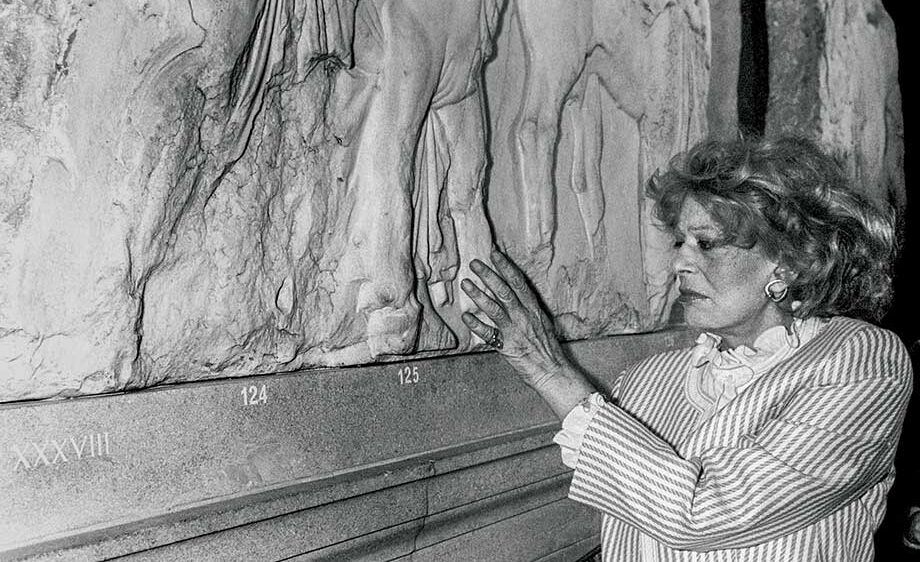
These events urged me into a long, difficult and still-unfinished revaluation of everything I thought I knew or had been taught about Indigenous peoples and colonialism in Canada and the United States. They also occurred a little less than a decade after Greece’s then culture minister, Melina Mercouri, put the issue of Britain’s claim to the Elgin collection of Parthenon marbles, and Greece’s assertion of a right to their repatriation, firmly in the international spotlight. In a 1983 address to British authorities, Mercouri described their meaning to her fellow Greeks this way:
“You must understand what the Parthenon Marbles mean to us. They are our pride. They are our sacrifices. They are the supreme symbol of nobility. They are a tribute to democratic philosophy. They are our aspiration and our name. They are the essence of Greekness.”
Following my participation in the ceremony by which ancestors of the Michi Saagig Anishnaabe were welcomed home, I became more attuned to news and commentary about the controversy surrounding the Elgin collection in the British Museum.
Still, aside from a handful of philosophical, theological and cultural terms (ekstasis, metanoia, oikos, telos, hubris), I still knew relatively little of Greece and its culture, classical, Byzantine, Ottoman, or modern. That awaited the suggestion of an Iranian-born graduate student (latterly a friend and colleague) that she and I start up a small, informal film-viewing series. It never amounted to more than two or three of us in my living room, but we spent a year intensively watching and discussing a wide selection of international films, especially by Iranian and Greek directors, and including those in the respective diasporas of each country. (Being moody and nostalgic by nature, I quickly developed an abiding love of films by Theodoros Angelopoulos.)
At about the same time, one of us (I forget which) saw a call for papers for a “Symposium on the Greeks” to be held on the Aegean island of Paros in 2019. My friend convinced me that this was an opportunity to put our immersion in Greek and Iranian film to the test by presenting a co-authored paper on how each body of cinematic work reflected and refracted the political and cultural legacies, more than two and a half thousand years in the making, of each country. Hubris overcame dread, and after much agony, the paper came together. We presented it in 2019, revised it for publication, and it came out in 2022. In the end, our references to the classical eras of each society gave way to an examination of more recent issues as aired in film. We gave Socrates a walk-on part, but not Lord Elgin, nor the Parthenon, nor Phidias.
After the symposium, we took some time to sightsee as neither of us had been to Greece before. We flew to Athens and stayed a few more days on the outskirts of the Plaka district, a few hundred yards from Syntagma Square. The Acropolis was on our bucket list, but the first day we toiled uphill toward it, we found it closed due to a heat wave that was inflicting 43c/109f-degree temperatures on the city. We tried once more, stopping at air-conditioned stores and restaurants and drinking our weight in water, but we arrived exhausted and late at the base of the rock on which the Parthenon stood, and diverted instead to the Acropolis Museum; new, air-conditioned, and reachable without further uphill trekking. I’m glad we did. I don’t recall much of the exhibit of the Parthenon Marbles on the top floor (many or most as plaster casts), but I do remember we lingered long on the bottom floor, entranced by in situ archaeological excavations displayed under transparent flooring.
As for classical statuary and sculpture, I had seen more of it a decade earlier, in London and Paris. (The reasons for that are at the center of Stallings’ tale.) It was a preclassical genre of statuary and one specific sculptural grouping that caught my attention in Athens. The genre was composed of Korai; statues of young women, draped rather than nude, and standing in a stiff formulaic posture. They mostly, so I understood, carried funerary, religious, or votive purposes, and dated back to the so-called “archaic” era. I saw several of them on Paros and one again in the Acropolis Museum. I’d not heard of them before.
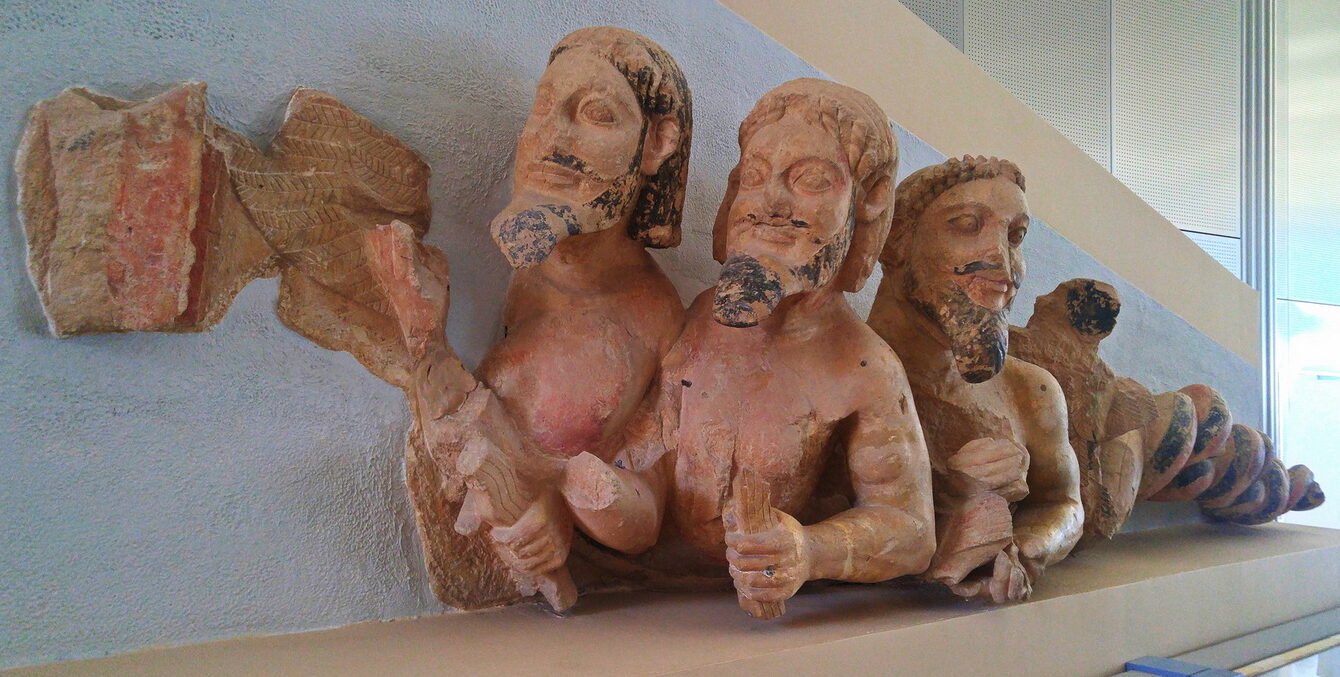
The sculptural grouping (actually a single giant relief figure commonly nicknamed the “Three-Headed Daemon”) had formed part of the West Pediment of the Hekatompedon temple, built on the site of the Parthenon in about 550-570 BC and sacked by Persians in 480 BC. Thus, it too dated to the archaic period, but it shared nothing of the formalism of the Korai. The three daemonic heads and torsos seemed to erupt both from their writhing tail and the reconstructed pedimental backdrop with such boisterous force that I instinctively took a step back when I looked up at them. They still retain significant traces of their original paintwork. And unlike Korai, Caryatids, and even much of classical Greek sculpture, they are all movement and almost cartoonish exaggeration. They also contrast dramatically to what Stallings describes as a stasis imposed on Greek sculpture in its British interpretation.
When we left the museum for our hotel, we experienced something that we encountered at least twice when returning from the foot of the Acropolis rock. The streets of the Plaka district below it are old, with many turns and some dead-ends. We got lost in them as often with maps as we did following our noses. But here’s the thing: every time we sought to go straight back to our hotel, or to angle off toward the market district, the streets seemed to fight us. When we gave in to them, they deposited us, regardless of our various turnings and doubling-backs, at about the same spot, directly across Vasilissis Amalias Avenue from Hadrian’s Gate. This was the symbolic entrance to the grounds on which stand the gargantuan ruins of the Temple of Olympian Zeus. From there, we could easily enough follow the avenue to a point opposite Syntagma Square, and turning away from it, find our hotel.
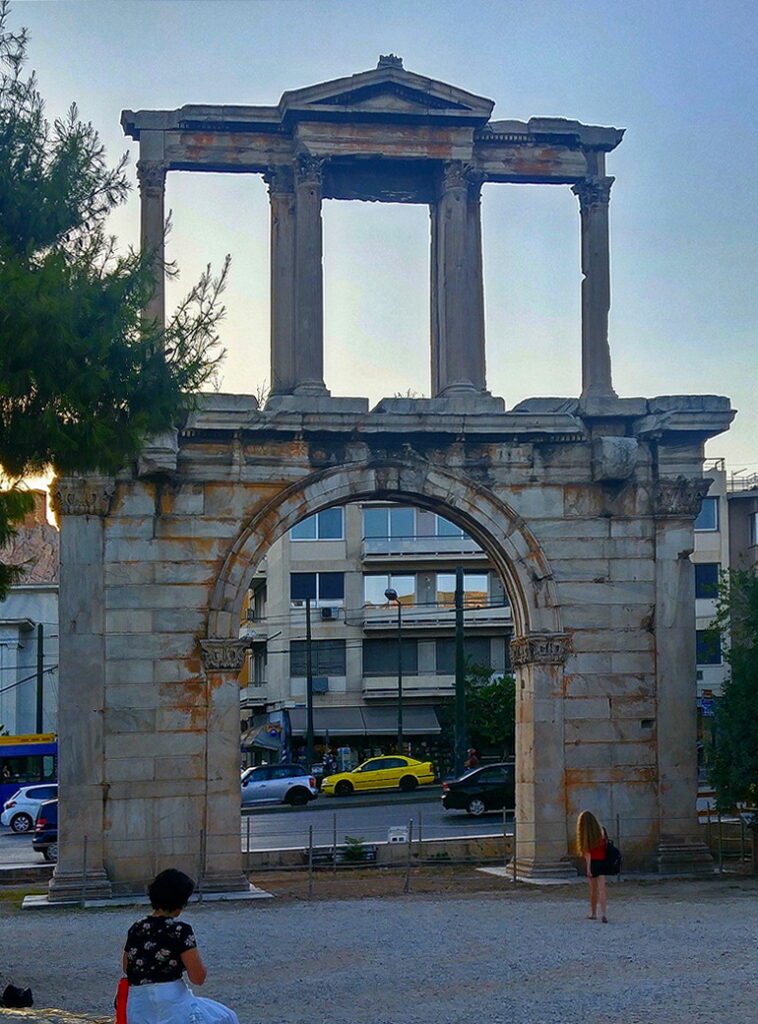
But what was it that gave these old streets this stubborn agency? In what embodied narrative had they come to serve as actants? I never did find out. The streets below the Acropolis are old, to be sure, but most potted histories of them I’ve read begin with the medieval period. On the flight home, I began to wonder if these streets might have been formed by the topography encountered by pilgrims to the Acropolis, or by ancient processions between the Parthenon and the Temple of Zeus. North Americans (like me) are accustomed to see roads and streets in terms of efficiency and ease of navigation for transit, commercial or military movement, or the direct delivery of employees to commercial or industrial work. We tend to forget that the long history of streets and avenues goes back millennia before factories and commercial districts, and for much of that history, ceremonial processions embodying power and authority, community and collectivity were common along them. Could these streets have been reminding us of some once-essential connection between two sites related by ceremony, or by access to stone-working, metal-working, or building trades?
I’ve not found any online discussions that argue this case; they may have been un-reachable to my cursory searches. But there are two arguments against the hypothesis. First, there seems to be no evidence of a grand “way” between the two sites; just a maze of streets that appeared to two dazed heat-stricken tourists to share a singular will. Second, the history of the Temple of Olympian Zeus is discontinuous. Its construction began about 520 BC, commissioned by two sons of the tyrant Peisistratus to replace a previous temple built by their father and torn down after his death. But work ceased after about ten years when the tyranny of one of the brothers was overthrown. It remained unfinished for over 300 years; some sources say because it was seen as an embarrassing act of hubris in democratic Athens. Andrew Lawrence Crown notes in Aristotle’s ironic advice to tyrants (from The Politics) the following points:
“By impoverishing the subjects, the maintenance of a guard by the citizens will be prevented. Hard at work due to their poverty, they will be prevented from conspiring against the tyrant. The building of great works keeps the people occupied and poor, so the tyrant must direct the inhabitants of his city to build great temples and pyramids and other magnificent works. In order to pay for these monuments he must increase and multiply taxes to ensure the mass of citizens remain poor and working. Tyrants should also be fond of making war in order that his subjects may have something to do and be always in want of a leader.”
(This uncannily resembles at least one currently-popular conspiracy theory about the New World Order, and in a different sense, the musings of a certain US president. Stallings, too, notes a link between monumentalism and tyranny.)
There were periodic attempts to finish the Temple, including one by a Seleucid king who saw himself as the embodiment of Zeus (!), and another by the Roman emperor Augustus. Eventually, nearly 640 years after it was begun, it was completed (in 132 CE) by an absolute ruler with an engineer’s “can do” attitude to his world: the emperor Hadrian, who furnished it with an enormous statue of Zeus, and added another of himself of similar magnitude. But it was looted and damaged during a Germanic invasion a little more than a century later (267 CE) and never rebuilt. Instead, it became a source of stone for other building projects.
So, the Temple of Olympian Zeus, unlike the Parthenon and despite the majesty of its ruins, had only a brief heyday; a mere blip in longue durée time, and so is unlikely to have been the cause of the tendential web of streets connecting it to the Acropolis. However, it is worth noting that the grounds on which it stood had been dedicated to Zeus before the first such temple on the site, commissioned by Peisistratus, was built.
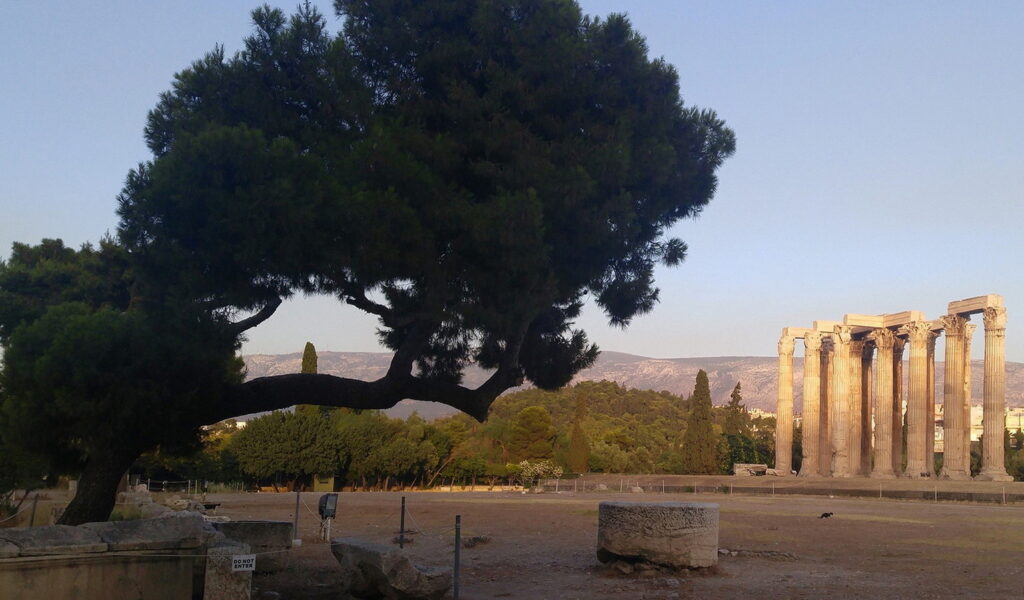
Even if my processional hypothesis is wrong, I think I’m justified in advancing another, more general one: that the locations, orientations and material realizations of the Parthenon and the Temple of Zeus were not random, and that whatever their specific rationale, sites and buildings such as these must be understood as situated and constructed in relation to meaningful topographies, to other sites and buildings, and practically speaking, to types of human activity beyond that of the sculptor, architect, philosopher, priest, or orator: to sacred and ceremonial activity, yes, but also to the work of artisans, the sources of their materials and the locations of their workshops.
This is not just a matter of ancient history. Tourists today who head straight for the Parthenon to cross it off their bucket lists are missing the point of that building if they see only the building and not its relations to the Acropolis as a whole, and if they treat the Acropolis as a singular destination in isolation from the material, religious and civic history of the rest of the city.
The Victorian art critic Walter Pater intuited this connective tissue, and in his “The Heroic Age of Greek Art,” lays out some of the ways in which it debilitates an understanding of the material arts:
“What we possess, then, of that highest Greek sculpture is presented to us in a sort of threefold isolation; isolation, first of all, from the concomitant arts—the frieze of the Parthenon without the metal bridles on the horses, for which the holes in the marble remain; isolation, secondly, from the architectural group of which, with most careful estimate of distance and point of observation, that frieze, for instance, was designed to be a part; isolation, thirdly, from the clear Greek skies, the poetical Greek life, in our modern galleries. And if one here or there, in looking at these things, bethinks himself of the required substitution; if he endeavours mentally to throw them back into that proper atmosphere, through which alone they can exercise over us all the magic by which they charmed their original spectators, the effort is not always a successful one, within the grey walls of the Louvre or the British Museum.
“And the circumstance that Greek sculpture is presented to us in such falsifying isolation from the work of the weaver, the carpenter, and the goldsmith, has encouraged a manner of regarding it too little sensuous. Approaching it with full information concerning what may be called the inner life of the Greeks, their modes of thought and sentiment amply recorded in the writings of the Greek poets and philosophers, but with no lively impressions of that mere craftsman’s world of which so little has remained, students of antiquity have for the most part interpreted the creations of Greek sculpture, rather as elements in a sequence of abstract ideas, as embodiments, in a sort of petrified language, of pure thoughts, and as interesting mainly in connexion with the development of Greek intellect, than as elements of a sequence in the material order, as results of a designed and skilful dealing of accomplished fingers with precious forms of matter for the delight of the eyes. Greek sculpture has come to be regarded as the product of a peculiarly limited art, dealing with a specially abstracted range of subjects; and the Greek sculptor as a workman almost exclusively intellectual, having only a sort of accidental connexion with the material in which his thought was expressed.”
Note the references to “petrified language,” and “pure thoughts,” which he pairs with “a manner of regarding it too little sensuous,” and elsewhere with a “coldness” of sculpture viewed in such terms. He opposes this coldness in a language of tectonics, motion and timing; a language of the body, of action and process; of connection and melding. It’s all a kind of material erotics and in emphasis it fits like a glove with the contrasts Stallings draws between such liveliness and the exile of the Parthenon Marbles to the cold and grey of London, their exposure there to British middle-class sensibilities, and, I would add, to the isolative effects of a culture of objects and objectives: of commodities.
Now to a consideration of Stallings’ way of situating the meaning of the sculptural elements removed by Elgin from the Parthenon frieze and now in the British Museum (still commonly referred to as the “Elgin Marbles”), and of those still in Athens (which the Greeks denote, inclusive of those in London, as the “Parthenon Marbles”). She treats their meaning, and the meaning of the Parthenon itself, as embedded in a web of relations and oppositions manifest in the poetry and prose written about them: a web that is geographical, cultural, and political; that has mutated yet maintained certain continuities over two hundred years, and that is set in a context of 25 hundred more.
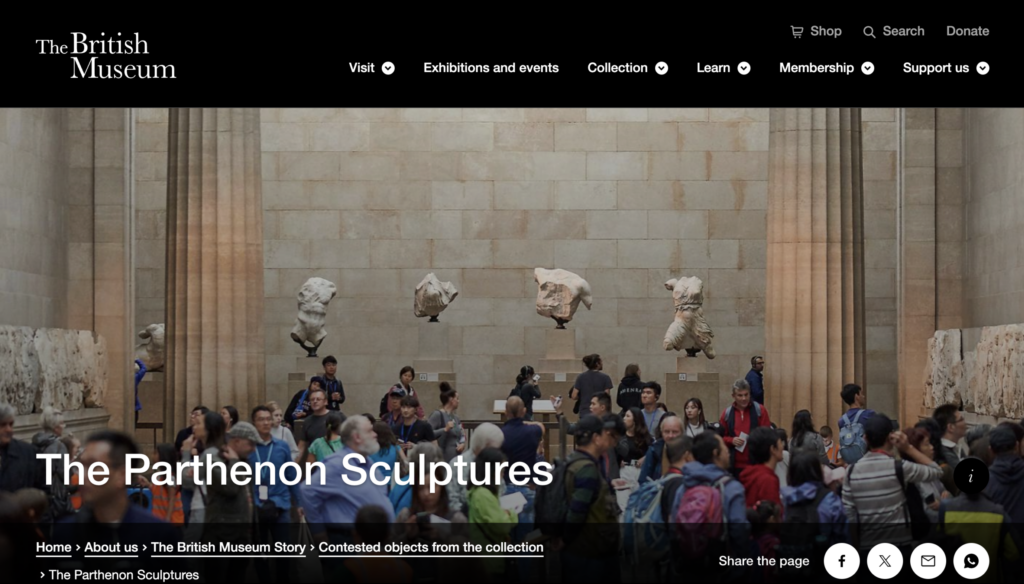

As good a place as any to start such a consideration is with nomenclature. The British Museum still refers to the material it received from Lord Elgin via the British government as the “Elgin Marbles,” as this is, in British law, their legal title. This collection also includes some material acquired by Elgin that did not come from the Parthenon proper.
The Greek government and the Acropolis Museum prefer “Parthenon Marbles” for any sculpture removed from the Parthenon, (most of the frieze has been removed to stay damage from air pollution and past repairs; their places are taken by replicas). To these, they add sculptural/architectural features still in place on the building. According to the British Museum page for them, the “Parthenon Marbles” consist of a frieze showing the procession of the Panathenaic festival (commemorating the birthday of the goddess Athena); a series of metopes (sculpted relief panels) set into the frieze depicting the battle between Centaurs and Lapiths at the marriage-feast of Peirithoos; and figures of gods and legendary heroes from the temple’s pediments.
These formed part of the architectural fabric of the last of two (or possibly three or four) successive temples. The second to last of these, built of limestone between 570 and 550 BC, is generally referred to as the Hekatompedon. It was destroyed by Persian invaders a century after its construction began and was replaced between 447 and 438 BC by the present building, now commonly called the Parthenon or the Temple of Athena Parthénos, though it appears to have been at first called the Hekatómpedos after its predecessor. It was built in thanksgiving for the defeat of the Persians during the Greco-Persian Wars, at the instigation of Pericles, who had to battle morose and judgmental budget-cutters in the Athenian assembly who claimed he was “decking out our city like a wanton woman, decorating her with costly stones and thousand-talent temples.” (With almost no effort, I can hear these words spoken in the rasping, bitter voice of the present leader of Canada’s federal parliamentary Opposition.) The Parthenon, it should be noted, was just one of the major edifices constructed at this time as part of a wider building project that transformed the Acropolis.
Though later associated with the cult of Athena Parthénos this new temple may never have been officially called the Parthenon, and some of the functions attributed to it may have been the remit of a temple which once held the statue of Athena Polias (as with the Parthenon and its predecessors there was more than one edifice built on this site). It is now commonly (but not consensually) identified with a temple called the Erechtheion, a little to the north of the Parthenon. Either the Parthenon or the Erechtheion may also have served for a time as the Athens city treasury (which held its collection of offerings to the gods). The Parthenon also served for a time as the treasury of the Delian League, the forerunner of the Athenian Empire. In a 2014 book, The Parthenon Enigma: a New Understanding of the West’s Most Iconic Building and the People Who Made It (New York: Vintage), archaeologist Joan Breton Connelly argued that the Parthenon’s “sculptural programme” presents successive genealogical narratives of Athenian collective identity from the birth of Athena through various epic and cosmic battles to the war of Erechtheus and Eumolpos. This, she claims, served a pedagogical function, perpetuating the founding myth of Athens and its shared values in collective memory. The “redoubtable” Mary Beard (as Stallings styles her) disputes this claim, but her supporters appear to be dwindling.
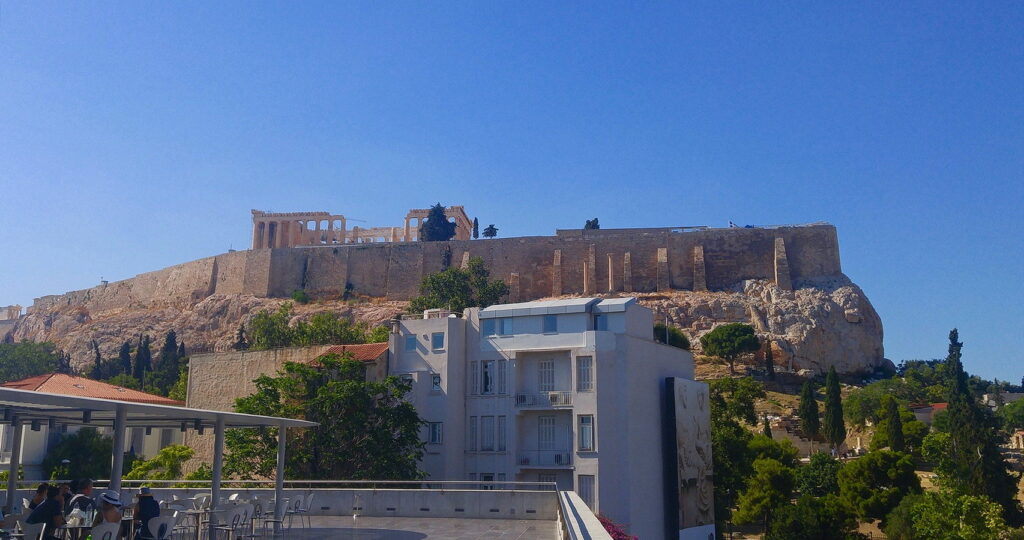
The Parthenon or Temple of Athena Parthenos, is still the most prominent ruin on the Acropolis, and has taken on an international significance in the modern era. According to its Wikipedia entry, it is “an enduring symbol of ancient Greece, Western civilisation [sic], and democracy”—a somewhat ironic statement given its rather convoluted history. It survived largely intact from its construction until 1687, though it was damaged by a catastrophic earthquake shortly after being finished, and again by Christians opposed to its “pagan” imagery around the time it was converted into a Christian church, about 500 CE. There was also interior reconstruction associated with that conversion, and latterly its reconversion into a mosque in the 15th century.
But in September 1687, during the Morean War, disaster struck. A Venetian army under Francesco Morosini laid siege to Ottoman-controlled Athens and began shelling the buildings of the Acropolis. A lucky shot either ignited a powder magazine in the Propylaea (the formal gateway to the Acropolis) or scored a direct hit on a Turkish munitions dump inside the Parthenon. The resulting blast reduced the Parthenon from a functioning building to, as Stallings terms it, a “picturesque ruin.”
In subsequent years, casual vandalism, souvenir hunting, and quarrying of marble from the ruins for other construction projects further debilitated the built fabric of the Acropolis. The city of Athens had declined in population and influence to a point at which it could no longer effectively protect its own built heritage. This was the case in about 1800 when the British Ambassador to the Ottoman empire became interested in a project which would amount to the most significant and systematic act of peacetime defacing ever perpetuated on the architectural remains of Classical Athens. Only the air pollution of 20th-century Athens came close to it in cost; neither the Greek War of Independence nor two world wars inflicted such damage on the Parthenon.

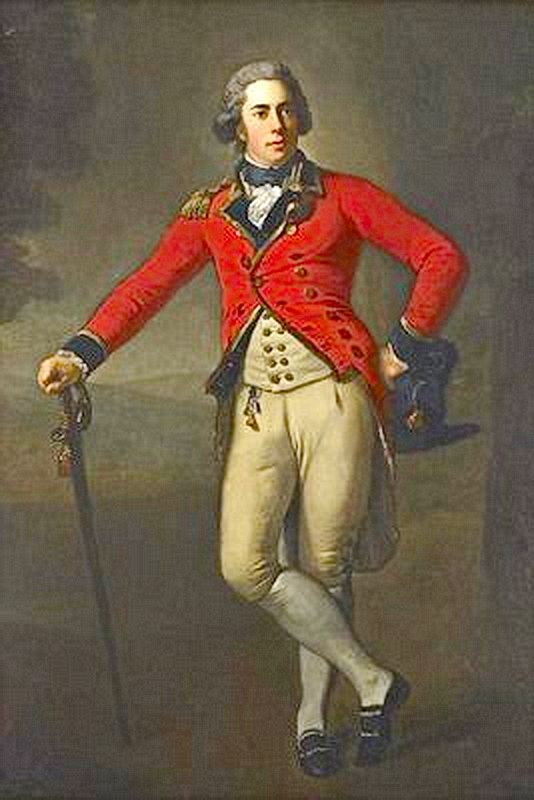
The British diplomat responsible for this damage was Thomas Bruce, 7th Earl of Elgin and 11th Earl of Kincardine (1766—1841). During the first decade and a bit of the 19th century, his agents removed several, though not all of the metopes from the Parthenon frieze, along with other sculptural and architectural items, destroying part of the cornice in the process, and shipped them to Britain.
Lord Elgin was a fairly typical nobleman of his time. Schooled at Harrow, Westminster, and St. Andrew’s, he completed his education in Paris and entered the British army, purchasing a commission as captain in 1789 and being rewarded with a colonelcy for raising a regiment of Fencibles in 1795. He became a Scottish elected peer in 1790, and over his lifetime took several official appointments.
Like his noble contemporaries, his life rested on the twin pillars of inheritance and striving. An inherited title and even a landed estate did not guarantee one’s security or prospects, and Elgin’s military commission and promotions (he died a full general), plus his office-seeking, provided additional sources of income. It was normal at the time for diplomats and officials , especially colonial ones, to enrich themselves through their offices by various means, including insider trading and banking, skimming income from public works, instituting fees or taking bribes (there often being a grey area of indeterminacy between these two), and collecting (aka quasi-legal looting) of antiquities and other cultural items. They also used their fortunes to speculate in land, stocks, and bonds, and to gamble at the races, at cards, and in Monte Carlo. And to pay off debts incurred in such activities.
However, the obverse of advantages offered by a system of officialdom that allowed private enrichment was the fact that senior officeholders were very often required to help from their own pockets with expenses incurred in the running of their offices (e.g. the entertainment bill of certain ambassadorships). Private collecting facilitated by public office could also prove expensive, as it did in Elgin’s case. So did the upkeep of a town residence as well as a country estate, plus another residence in foreign parts, plus the day-to-day costs of keeping up appearances. Plus, gambling debts and interest payable on them.

In 1798, Elgin was appointed ambassador to the Sublime Porte (the seat of government of the Ottoman Empire, so named for the entrance to the palace in which it was housed). He demonstrated significant diplomatic skill in extending British influence (contra Napoleon) there, before his ambassadorship ended about 1802. During his time in Constantinople, he developed an interest in Greek antiquities and at his own expense began to hire artists, draughtsmen, and architects to make drawings and plaster casts of classical Greek sculptures, architectural features, and other artifacts, under the remit he gave his Neapolitan agent, a talented painter named Giovanni Battista Lusieri (1755—1821). This work commenced in 1800/1801, ostensibly to benefit “the progress of the Fine Arts in Great Britain.”
But then, Elgin’s ambitions widened. In 1801, he sought and claimed to have received a firman (a letter of permission) from the Ottoman central government for his agents not only to measure, sketch, and take plaster casts of antiquities, but also to “take away [a few] pieces of stone with old inscriptions of figures thereon.” An Italian translation of this letter, made by the British Embassy in Constantinople is now part of the British Museum collection, and is rendered in full into English as an appendix to Frieze Frame. But the original (if there was one) has not been found. And in any event, Elgin was soon, at the behest of his chaplain, Philip Hunt, going well beyond his permission to “remove [a few] pieces of stone.” His agents were instructed to saw out and trundle off entire sculptures and, in one notorious instance, a load-bearing caryatid from the Erechtheion, which required an unsightly brick support to keep a whole section of that temple from collapse. The story was that both Hunt and Lusieri persuaded Elgin to remove these items; Lusieri urging upon him a need to prevent them from falling into the hands of Turkish souvenir-hunters and vandals. The truth of these allegations, against Lusieri in particular, like much about Elgin’s acquisition, removal, and eventual sale of his collection of Greek antiquities, remains to be demonstrated conclusively.
In total, Elgin’s people removed about half of the Parthenon’s frieze, plus a caryatid and a column from the Erechtheion, plus numerous other items from elsewhere in Athens and across Greece. It helped in this endeavour that Athens was, at the time, a small provincial town of about 10,000 people, overseen by poorly paid and (if we are to believe British accounts) barely literate Ottoman officials. It would shrink by half again a little later in the century.
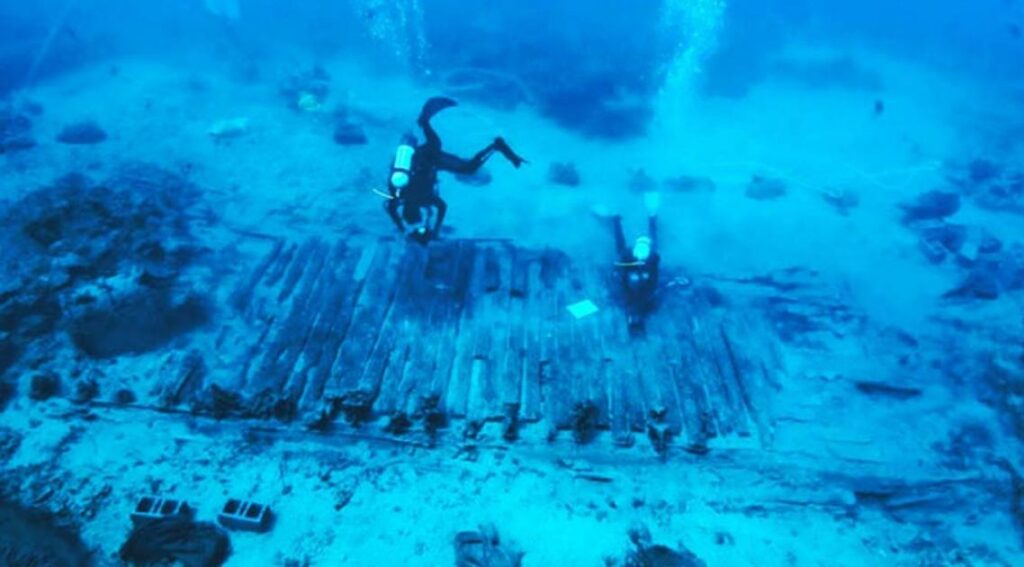
A large shipment of these removed antiquities was put aboard a ship, the Mentor, bound for England, in 1803. The Mentor did not live up to her name: she was wrecked off Kythira, and it took Elgin three years and much of his remaining wealth to recover the cargo. Despite this blow, Stallings notes that Elgin continued to employ Lusieri as his agent to carry on archaeological excavations, measurements, and removal of artifacts destined for Britain for several more years.
By the time the Parthenon Marbles arrived in England, Elgin had given up on his dream of decorating his country house in Fife with them and instead was offering to sell the lot to the British government to pay off his debts. In the meantime, as Stallings describes from contemporary documents, the Marbles were first housed in a glorified shed, in which Elgin also hosted prize-fights to boost attendance. Eventually, in 1816, the government did buy his collection, on behalf of the British Museum, for approximately a third of Elgin’s original asking price, and about half of his last offer. Elgin suffered other reversals, personal, medical and financial after 1803, and eventually moved to the Continent to avoid his British creditors and died in Paris.
More recently, he has suffered a posthumous reputational reversal. In a magisterial study, Lord Elgin and the Marbles, published by Oxford in 1967 (a revised edition came out in 1983), William St. Clair depicted Elgin with a very British restraint as genuinely interested in the public benefit the Marbles would bestow on British arts, and as somewhat reluctantly (at first) persuaded by Hunt and Lusieri to consider removal of parts of the building’s fabric. St. Clair further represented both Hunt and Lusieri as genuinely driven by worries that the temple and its sculptures would suffer significant further damage from Turks, travellers, and the locals. He averred that in the end it was probably a good thing that the Elgin collection came to the British Museum.
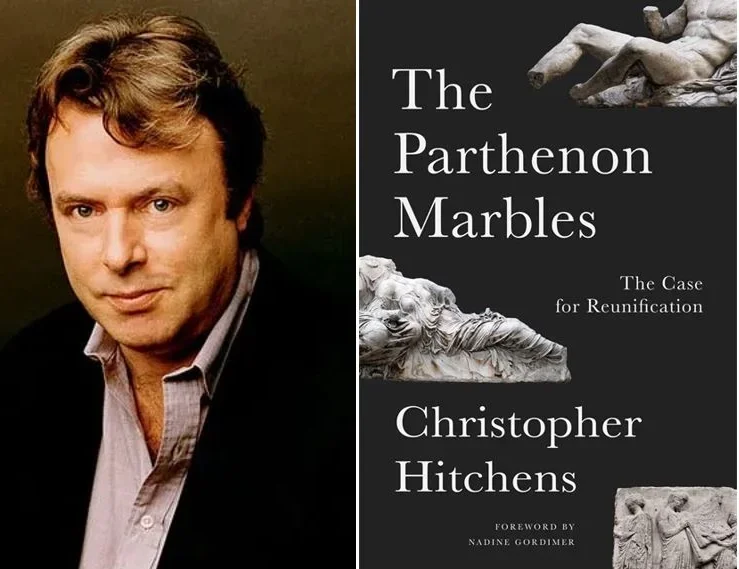
However, in 1987, Christopher Hitchens, in The Elgin Marbles (Chatto & Windus, 1987; republished 2025 by Verso in a revised and expanded edition as The Parthenon Marbles: The Case for Reunification) dismisses this picture of Elgin, presenting evidence that from the beginning he had clear intentions of decorating his country seat with sculptural examples from the collection he had made in Greece. Hitchens also depicts the firman that Elgin took as his permission to remove parts of the frieze and other architectural elements from the Parthenon as a suspiciously incoherent document of little validity. (St. Clair had judged it merely as “ambiguous” and thought Elgin and Hunt’s interpretation of it as credible.) Hitchens also treated Elgin’s collecting activities as effectively a form of looting joined to a sense of entitlement and makes short work of arguments advanced in support of the British Museum’s custody of them. And he notes, sardonically, his parting gift to the Athenians: a clock, with an accompanying proviso that they had to build the tower for it.
What, then, are we to make of Elgin’s great caper, and the subsequent history of his collection in London? Stallings takes pains to avoid a tendentious picture of Elgin, but she clearly sees him, as does Hitchens, as more self-interested than public-spirited in his acquisition and subsequent efforts to sell the Marbles. This reflects the long-overdue spirit in which issues raised by appropriation of antiquities are now being judged. Further, evidence that has come to light in the past half-century concerning Elgin’s motives (and his varying claims about his intent) has also not been kind to him. Perhaps the best that can be said of him is that he was a man of his class and his times. I suspect that Stallings would say that the present issues concerning custody of the collection named for him need no longer rest on his personal responsibility or culpability for the fate of the Parthenon’s fabric and the removal of a large part of it to England. I would agree with this assessment.
But before we move on from Elgin, there is one way in which I would suggest that his attitude and actions still matter, because they were formed in terms of a wider complex of dispositions. Some of them are far from dead, are still shared widely, and indeed are resurgent in dangerous and toxic form today.
In the 18th century, Great Britain (united into one political entity in 1707), eclipsed Spain as the world’s preeminent colonial power. By the end of the century, not even the loss of the Thirteen Colonies could shake that status. With that ascendancy there also developed a set of intertwined attitudes, mores and values that came to define the British noble, landed, mercantile, and industrial elites, and also pervaded the broader middle classes. These dispositions defined and justified the predominance of British (and more specifically, English) social mores, culture, politics, and economic organization. These included a number of specific identity elements such as these:
- That British colonial ventures and acquisitions were justified by the superiority of the British “race” and of its moral and intellectual culture. Two corollaries to this were that the indigenous peoples of the Empire lost their sovereignty as a natural outcome of their own weaknesses and inability to develop the productive potential of their own lands.
- That the strength of the British “race” rested on its enterprise, in turn derived from its intellectual and technological capabilities, its moral capacity and resistance to corruption, its lawfulness, its democratic forms of governance, and its physical culture.
- That the British sense of moral responsibility was part of a wider sense of responsibility with economic, social, and political dimensions, and that it was primarily individual in its exercise, whatever the influence of “breeding” and other factors. This individualism was also taken to have freed the British to accumulate power, wealth, and authority in international affairs and to engage in such affairs as moderns.
These capacities and capabilities were commonly said to be reflected in directness but also courtesy of civil speech and action and also in restraint (through “manners”) of the body and emotions in the interests of advancing productive activity. This dispositional complex also included chaste and purity-oriented forms of sexual expression (a contribution of the growing middle class, resisted for many decades by the nobility); respect for education; ability to make practical use of abstract concepts and logic; employment of both empirical examination and rational explanation, and development of an aesthetics oriented to a “purity of (ideal) form” tied to realistic depiction in disciplined and universally understood ways. Further, these dispositions were seen to be informed by a respect for tradition tempered by a developing sense of progress as British-led, driven by education, moral disposition, and racial heredity. Thereby did the British become modern.
Missionaries and educators carried these notions into British colonial possessions, and they formed elements of the “white man’s burden;” a claim to responsibility for the “improvement” of colonized peoples, which, as has since become apparent, was contradicted in action by many colonial agents and agencies.
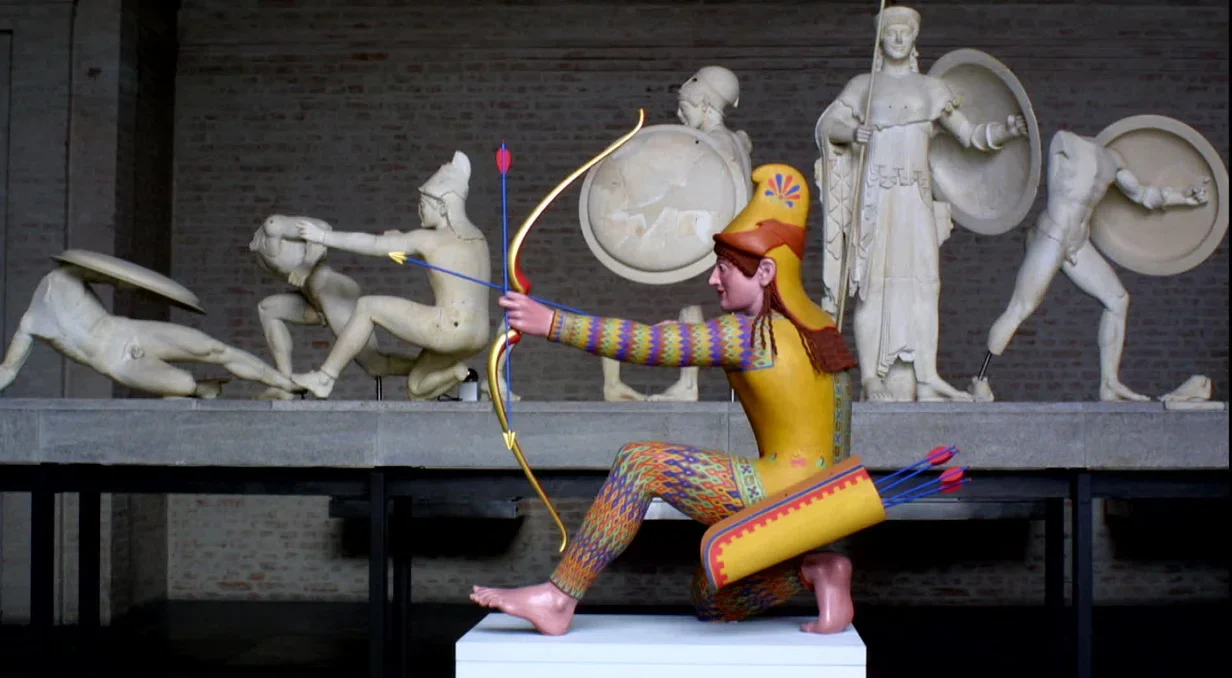
These characteristics of Britishness were never universally accepted and were often selectively adopted or applied. They were, for the most part, matters of opinion rather than decree. There were British voices which protested contradictions between ideals and actions undertaken in their name. In particular, their racialist aspects (and the slave trade) were contested. But such ascriptions were common enough to be hegemonic in a Gramscian sense: they defined a spectrum of accepted discourse in terms of which rule and superiority were implemented.
They also appeared in prejudicial judgements of nationalities over whom the British did not exercise direct dominion: for example, southern Europeans (Greeks, Turks, and Italians, especially), and even colonial rivals of the British such as the French and the Dutch. Even British philhellenism was infected: its veneration of Classical Greece could be laced with observations that contemporary Greeks were not legitimate or deserving heirs of classical civilization and were unable properly to care for its material legacy.
Stallings makes note of numerous examples of this prejudice, plus a popular 19th century idea that the whiteness of classical sculpture in marble represented a universal conceptual aesthetic centered on purity of form, realism in depiction, and restraint and chastity of spirit. It was actually known to many conversant with classical Greek sculpture in Elgin’s own time that such work was commonly painted, and in bright and varied colors at that. But this didn’t become common knowledge. A century and a half later, I was not taught about it and learned of it only around the turn of the present century, from an online article that described the coloring of classical statuary as a recent “discovery” by “experts.”
Stallings’ awareness of such attitudes takes her account further even than that of Hitchens in exploring an important corollary: that the discourses and attitudes of colonialism infected British perceptions of other peoples outside their own imperial orbit. Elgin was not in Greece as a colonial overseer but as an ex-ambassador, and he knew full well that Greece was part of the Ottoman empire and that, at least pro forma, he needed permission from that imperial government to do what he was about to do: thus, the importance of the firman and its interpretation. All the same, on his departure he bestowed (or imposed) upon the Athenians a clock: a fittingly insulting symbol of British time-discipline and technological superiority.
But the key consideration here, I think, is not whether Elgin saw himself as a benefactor (to the British or to humankind), or whether he was mainly interested in furnishing his country house and paying off his debts. Stallings steps to the verge of a discussion that goes well beyond an individual’s moral culpability. That “beyond” is the question does it still matter as it once did, whether Elgin as an individual acted out of public spirit or cupidity? I would venture that what does still matter is that Elgin, regardless of motive, thought to acquire and remove the Marbles because he could and perhaps also because he should, and that he thought this because he was British. I would suggest that he imagined he had a kind of natural right or duty to intervene in their fate, regardless of whether he intended to save them for posterity, decorate his house, save his finances—or all three. And in this Elgin’s project differs profoundly from Byron’s. Mary Beard’s digs against his charisma and “ghastly doggerel” notwithstanding, his wild dash to join the Greek forces in the War of Independence was less a wish to save the Greeks than to serve them or serve with them.
Elgin’s sense of his own appropriateness as an agent in the future of Greece’s past grew out of his social formation; how he had learned to be not only noble, but British, and how he had learned to see his Greek and Turkish contemporaries as lesser peoples: less able to care for their cultural heritage, less deserving of a claim to it, and manipulable. Remember also that Elgin’s sense of entitlement to the Marbles was aided and abetted by a circle of friends, colleagues, and acquaintances even as his actions were decried by enemies and dissenters. Elgin was not only an individual moral agent, nor even a typical product of a specific noble order: he was both of these and also an embodiment of an entire class, status, racial, and colonial system, of its geopolitical culture, and of its political and economic supports.
Stallings does not develop an explicit and extended discussion of this dispositional complex. That’s understandable, given that her primary interest is in the role of poets, artists, and art critics in capturing the details and character of debates over the Marbles. In that she has succeeded. She may also have foregone an extended treatment of their broader implications because she was not writing a social-theoretical treatise and perhaps because of a sense that a broader discussion might appear speculative, or conversely as repetitive (she notes this about connections made between an aesthetic of whiteness attached to classical sculpture in marble sans paint), and a racialized discourse of whiteness.
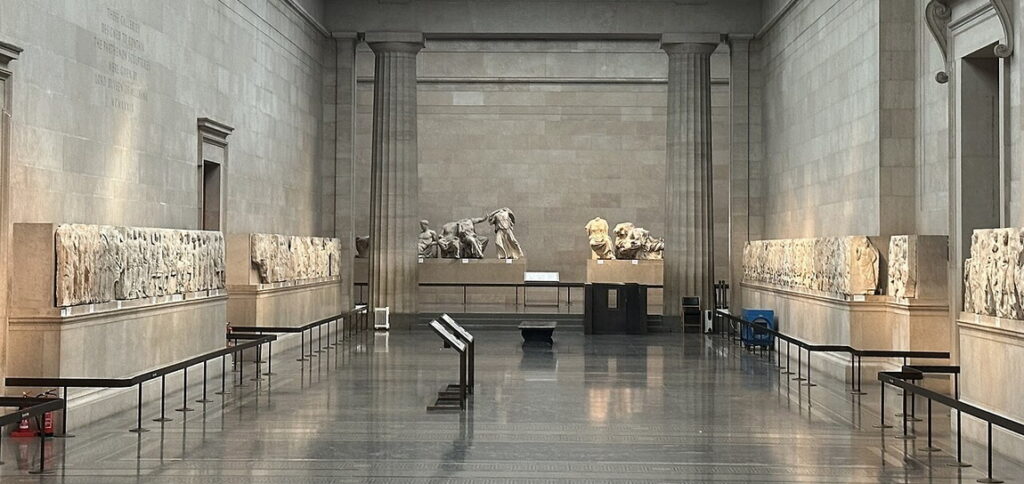
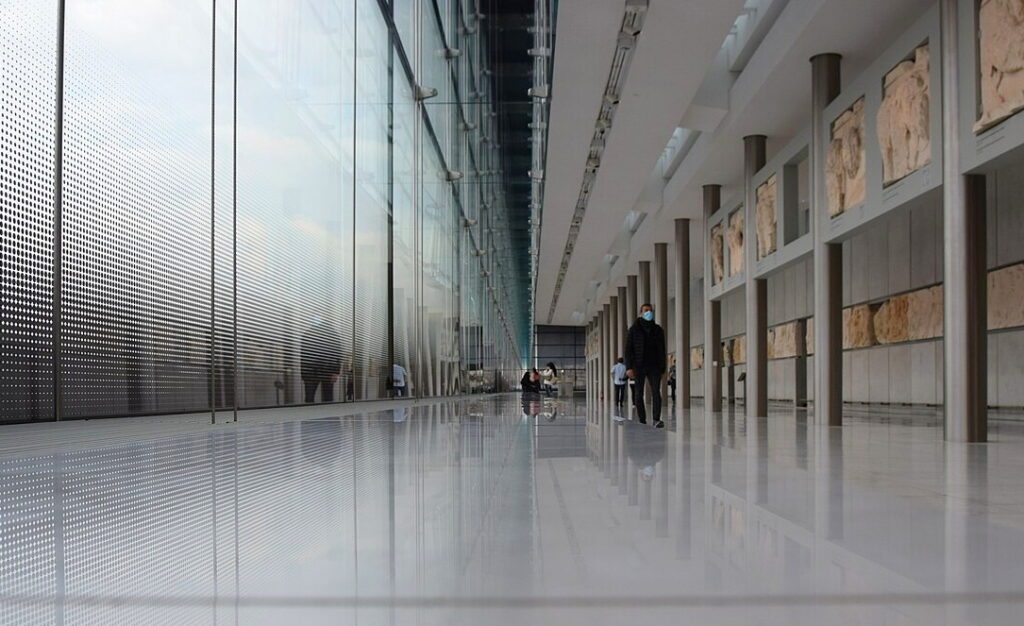

It remains briefly to note Stallings’ discussion of the latter-day lives of the Marbles, now in Rooms 18 and 19 of the British Museum. Most of the Parthenon sculptures removed by Elgin are in the former, and the lone caryatid from the Erechtheion is in the latter.
Most of that history is uneventful, save for the occasional small act of vandalism or instance of accidental damage. But a notable exception to this normalcy was a proposal by Joseph Duveen to construct a purpose-built gallery to house the Elgin collection. Duveen was an art dealer to the transatlantic rich and famous who collected a vast fortune and became an English Lord in 1933. He offered to pay for the whole project but with a significant condition: namely that he be allowed to hire those he judged expert in the cleaning of sculpture to remove “dirt” from all the marble pieces. To Duveen, such sculpture was normatively white. This requirement was quietly given de-facto leave, and Duveen’s workers set about their task in 1937—1938 with copper scrapers and corundum abrasives. The result was indeed blindingly white, but many contended that the exercise had ruined the sculptures, removing both the patina of the marble and much of the fine detail of the sculptures themselves. Stallings leans to the ruination side of this controversy, but as late as the 1990s a British Museum report claimed that the damage was not as catastrophic as had been alleged.
The Marbles in London also barely missed a true and total catastrophe a year after the Duveen Gallery’s official opening. In the midst of the Blitz in 1940, Museum authorities decided it was time to move the collection into safer storage, deep underground in the Aldwych subway tunnel as well as in the Museum’s own vaults. This task was completed merely a day before a German bomb scored a hit on the Duveen Gallery. It would have wiped out the entire collection. Together, the cleaning scandal and the near-miss of the bombing fatally undermined still-current arguments that the Greeks would not be able to house, protect, or care for the Elgin Marbles properly.
Those Parthenon sculptures which have found refuge in the Acropolis Museum now rest in a state-of-the-art facility in which they inhabit a third-floor gallery which is, as the Museum’s own description has it,
“. . . specially designed to accommodate the sculptures of the Parthenon. The space is arranged in the form of a glass-walled chamber that wraps around a rectangular core whose orientation and dimensions match those of the Parthenon’s original cella.
“The outer walls of the core incorporate the relief-carved blocks of the temple’s Ionic frieze, mounted in the same position as they held on the monument, but at a lower height for better viewing. The metopes are presented in pairs between the steel columns of the hall, which have the same number as the Parthenon’s columns, while the colossal figures once displayed in the building’s two pediments have been mounted on low, pedestals at the east and west side of the gallery, where they are visible from all directions.
“The exhibition combines the original marble sculptures with plaster copies of those retained in the British Museum or other foreign museums. The glass walls enclosing the gallery provide natural lighting and allow a direct line of sight between the sculptures and the monument from which they come.”
Unlike the Duveen Gallery in London, this layout encourages museum visitors to engage in processional movement past the sculptures, taking in the stories they tell sequentially, rather than observing them, as Stallings put it, from a “fixed vantage point.” She also makes a pointed remark about the plaster casts of elements in London or Paris: “Here, the color white indicates not purity or chastity but absence, and in a surprising inversion, inauthenticity.”
Stallings makes a few recommendations for future displays at the British Museum and also, very pointedly, for those at its glorious Acropolitan rival:
“The history of Greece doesn’t stop in the year 500 when ‘pagan’ rituals were banned from the Parthenon and suddenly begin again with independence in 1823. The Acropolis Museum likewise, might enrich its exhibits with the history of the Parthenon post-Pericles, as church and mosque and fortress, and of the Acropolis, once crowned with a Frankish tower, Ottoman houses, and a minaret.”
Anyone familiar with the internal flame wars of Greek national historiography over the three fortresses of the Classical, the Byzantine, and the Ottoman eras will recognize this as a gently-lobbed Molotov cocktail.
At the end of her narrative, Stallings makes a claim that has grown on me though it is necessarily figurative rather than physical. She depicts, with much documentation from the poetry of Cavafy forward, that the Elgin Marbles and their counterparts in the Acropolis Museum are already united despite the failure (to date) of negotiations to deliver the former from London to Athens. They are united in a flowering of poetry and prose about them (I especially recommend Anna Griva’s poem), often speaking in their voices. The lone caryatid from the Erechtheion has been represented, even in British Museum labelling, as united by familial connection, affection, and ethereal communication, to her “sisters” in Athens. And together, they are also united in exile from their places on the Acropolis; one in London, and others indoors at the Acropolis Museum, necessary to protect them from present-day climatic conditions. All of them, like international refugees today, have little choice but to take such asylum as is offered by their respective hosts. Stallings is one of the international army of the righteous which holds these exiles in its embrace.
Also at the end of the book are some surprising conclusions which read more like beginnings, as if she were already considering a sequel. Here are a couple. First, she imagines the return of the Elgin Marbles to Greece as a form of “joyous sacrifice” analogous to the ancient Panathenaic and other festivals, and adds:
“The seagoing nations of Greece and Britain are on more of an equal footing now than ever and retain close and friendly ties. But what better way for a post-Brexit Britain to display large-mindedness, its good faith, generosity, its participation in the brotherhood of nations, to recall its position as foremost among the liberty-loving Philhellenes than this magnificent gesture?”
I think I detect just a hint of irony in this statement. I hope I do, anyway.
Another concluding zinger is this:
“. . . I think the debate about the fate of the Marbles is not ultimately between Greece and Britain; from the start, it was between Britain and itself, something to take up with its own conscience . . . Far from breathing fire [over the return of the Elgin Marbles to Athens], one of Greece’s slogans about the marbles has been simply “Why not?” And I think that is the question.”
Amen!
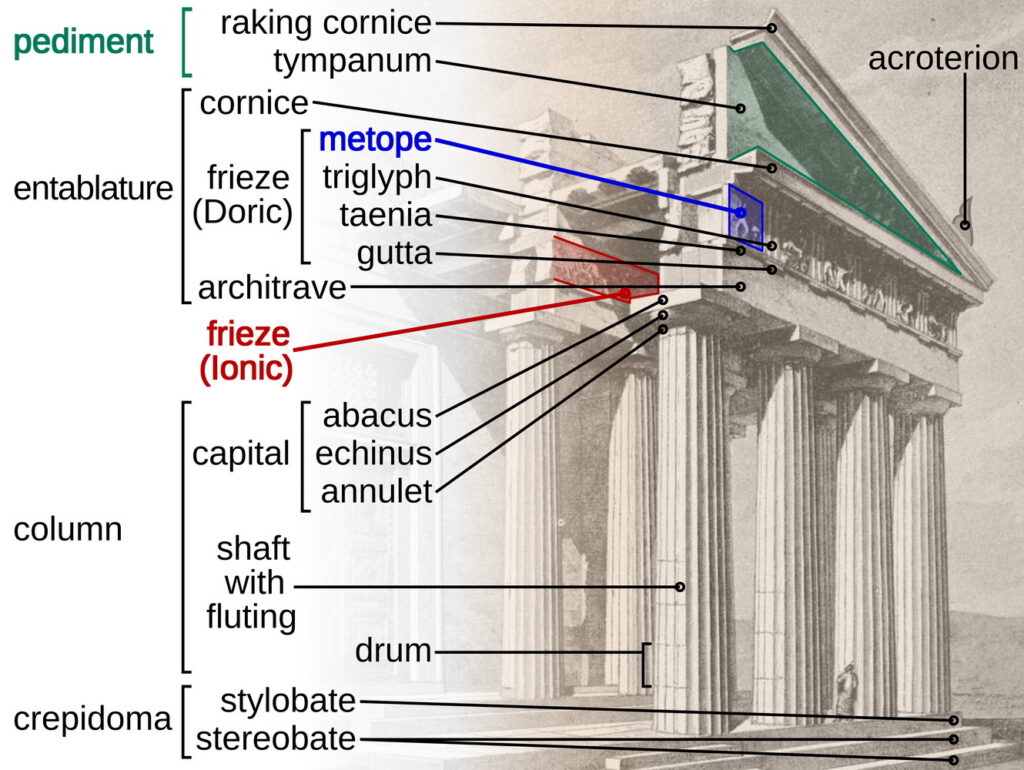
A final note: if I have not yet convinced you to buy the book, take note that it contains no less than five very useful appendices. Appendix A addresses money in relation to the Marbles and to Elgin’s various claims or transactions, and much else including relative values and equivalences in different historical periods, and the perceived value of money as a possession, security, or vessel of legitimation. Appendix B gives a modern timeline of the Parthenon and the Acropolis marbles, especially the 19th and 20th centuries. C provides a diagram of architectural elements of the Parthenon (slightly at variance to the one illustrated in this review). D gives an English version of the Italian translation (the sole extant copy) of the firman granting permission to Elgin’s agents to commence their work. And E gives the full text of Byron’s long poem, “The Curse of Minerva,” in which he roundly condemns Elgin’s removals from the Parthenon and Erechtheion.
Notes and references
“Hubris overcame dread, and after much agony, the paper came together.”
Sahar Siavashi and William Ramp (2022), Pedagogies and Possibilities of Crisis: Greek and Iranian Film. Chapter 4 in Legacies of Ancient Greece in Contemporary Perspectives, ed. Thomas M. F. Gerry (Wilmington, DE: Vernon Press)
“Andrew Lawrence Crown notes in Aristotle’s ironic advice to tyrants (from The Politics) the following points:”
Andrew Lawrence Crown (2021). Advice for Tyrants and the Possibility of the Good Life in Aristotle’s Politics. Voegelin View, January 27.
“The Victorian art critic Walter Pater also intuited this connective tissue, and in his “The Heroic Age of Greek Art …”
Walter Pater (1880). The Beginnings of Greek Sculpture, I: The Heroic Age of Greek Art.” Fortnightly Review, February, 1880.
“Elgin’s military commission and promotions … plus his office-seeking, provided additional sources of income.”
This pattern was repeated by Elgin’s son, James Bruce, 8th Earl of Elgin (1811—1863), who served successively as governor of Jamaica, Governor-General of the Canadas, High Commissioner and Plenipotentiary in China and to the Far East, and Viceroy of India. In China, he also took a military role, leading the bombardment of Canton during the Second Opium War. He was generally seen as an enlightened administrator, backing labor reforms in Jamaica, and representative government in Canada. He is reported to have decried the manner in which Britain forced commercial relations on China. However, a liberal colonial official is still a colonial official. In Canada, the 8th Earl endorsed the 1847 Bagot Report written by his predecessor and seen as a founding document of the Indian Residential School system, now seen by many as institutionalizing cultural genocide under the guise of Indigenous education. And in China, in October 1860, near the end of the Second Opium War, he ordered the complete destruction of the Old Summer Palace to avenge the torture and murder of 19 European and Indian prisoners of the Chinese. The burning of the palace complex saw the destruction of a significant proportion of China’s cultural heritage dating back some 3,600 years, and of formal gardens that were arguably the most impressive in the world. Many of the artworks and artifacts that were not destroyed were looted and are now to be found in museum collections around the world. And like the Greeks and their successive governments, the Chinese and the current president of the People’s Republic have not forgotten.
The 9th and 10th Earls followed career patterns similar to the 7th and 8th; both holding offices relating to colonial affairs. The 9th Earl was a somewhat undistinguished and conservative Viceroy of India between 1894 and 1899, but in 1902—3 led a revolutionary commission of enquiry into the British conduct of the Boer War. According to his Wikipedia entry, “[t]he Elgin Commission . . . travelled to South Africa and took oral evidence from men who had actually fought in the battles. It was the first to value the lives of the dead and to consider the feelings of mourning relatives left behind, and it was the first occasion in the history of the British Army that recognised [sic] the testimony of ordinary soldiery as well as that of the officers. However, his Encyclopedia Britannica entry indicates that the direction of the commission was largely set by Prime Minister, Campbell-Bannerman, not by Elgin. Elgin also served as Secretary of State for the Colonies from 1905 to 1908. His son, the 10th Earl, combined a military career with a directorship of the Royal Bank of Scotland, and also served as Assistant Private Secretary to the Secretary of State for the Colonies from 1908 to 1911. The 11th Earl, alive at the time of writing, aged 102, also pursued a military career which he combined with various business and ceremonial appointments.
“In a magisterial study, Lord Elgin and the Marbles, published by Oxford in 1967 (a revised edition came out in 1983), William St. Clair depicts Elgin with a very British restraint …”
St. Clair published a related volume in 2022: Who Saved the Parthenon?: A New History of the Acropolis Before, During and After the Greek Revolution (Open Book Publishers), available at time of writing on Internet Archive. Sadly, I am a slow reader and did not get to it in time for this review.

William Ramp
William Ramp is (semi-)retired from the University of Lethbridge, Alberta, Canada where he taught social and cultural theory. He’s disconcerted to find himself in his eighth decade, nursing a long, idiosyncratic memory and driven ever faster forward in time by winds that also chase ahead of him massive drifts of never-to-be-finished writing and neglected documentation. He is definitely NOT at peace with old age nor ill health but is kept in line and enlivened by adult children, friends, extended family, and fortuitous encounters, online and off. He rages at the persistence of various of his garden-variety demons, but suspects he should calm down and have them in for coffee and a chat while there’s time. Though a dyed-in-the-tweed academic, he has resumed a love for incidental writing left off in high school. It’s how he keeps his footing now in perilous times and in free-range conversations (too few now, alas!). He harbours more faults than Cascadia and concomitant regrets but tries to turn them to such redeeming uses as remain possible. His interests are largely intellectual and cultural but he also delights in old books, obsolete tools and machinery, and the spring chorus of frogs. And in grafting strange sprigs to unsuspecting trees, and making dangerous use of hammers, knives, stepladders, a machete, and (in the near future) a scythe. He persists in watching thunderstorms outside in bare feet, and in talking to corvids. He gravitates to things kicked to the curb of modern life, bumbling waywardly around the dimming porch-lights of past cultures with Walter Pater and his 19th-century ilk. He tries not to let frustration with the passionate intensity of the misled or the whirling gyre of bad politics and worse news eclipse an affection for strayed and refugee things and people of this world. Banner photo used by permission of Bradley Rawlings; headshot image augment by René Laanen, Sr.