Ding Dong Ditch: A Love Letter to Mischief in a Surveillance State

Off the Page
By Dr. Jason Page
“Growing up, we knew our neighbors. We spent evenings playing in the street or down at the local park. We knew the rules. Of course, knowing the rules and following them are not quite the same thing. In this unabashedly nostalgic reflection, I look back on the simple amusement of Ding Dong Ditch, and how this small act of childhood rebellion has become a barometer for our fracturing communities.”—Dr. Jason Page
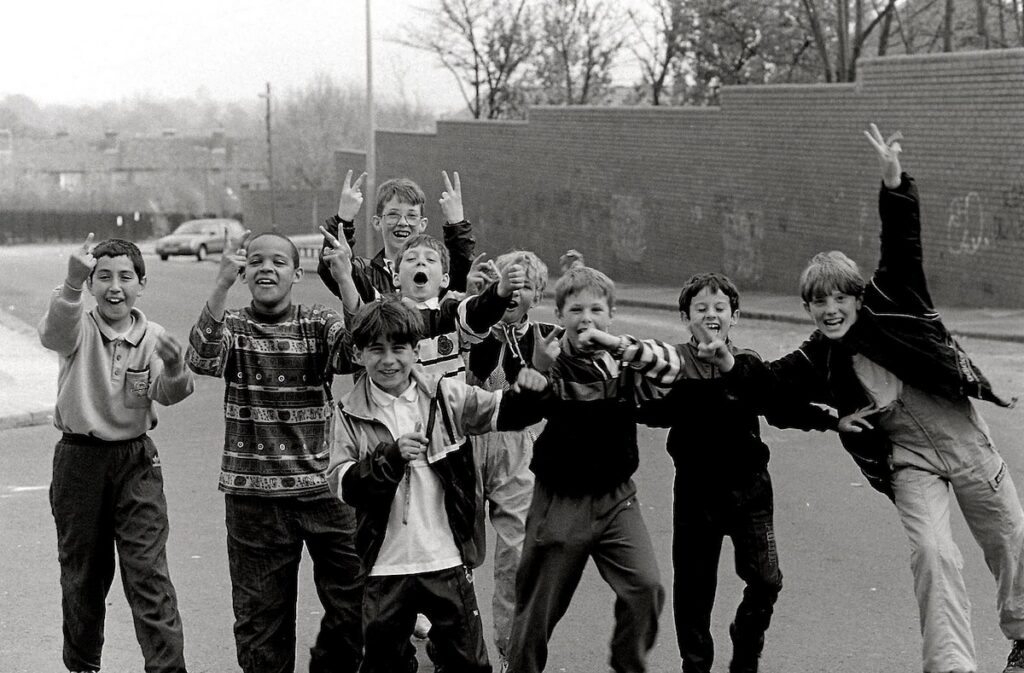
“The fact is that wet willies, armpit farts, ding dong ditch, and other rude noises and tricks are part of being a kid.”—Dude, That’s Rude!: Get Some Manners, Pamela Espeland and Elizabeth Verdick
 HOMER New York—(Hubris)—July/August 2026—The nervy walk up the garden path, friends waiting by the gate behind you, coiled like springs. You raise your hand to the doorbell, extend your finger, heart hammering, and push. The bell barely registers, muffled and distant, as though heard underwater. Far louder is the slap of your own feet already beating pavement, carrying you back out to the sidewalk and into the street.
Your friends are 20 yards ahead, screaming with laughter. Behind you, the yells of your victim ring out into the street, but it’s too late for them. You’re already in the wind.
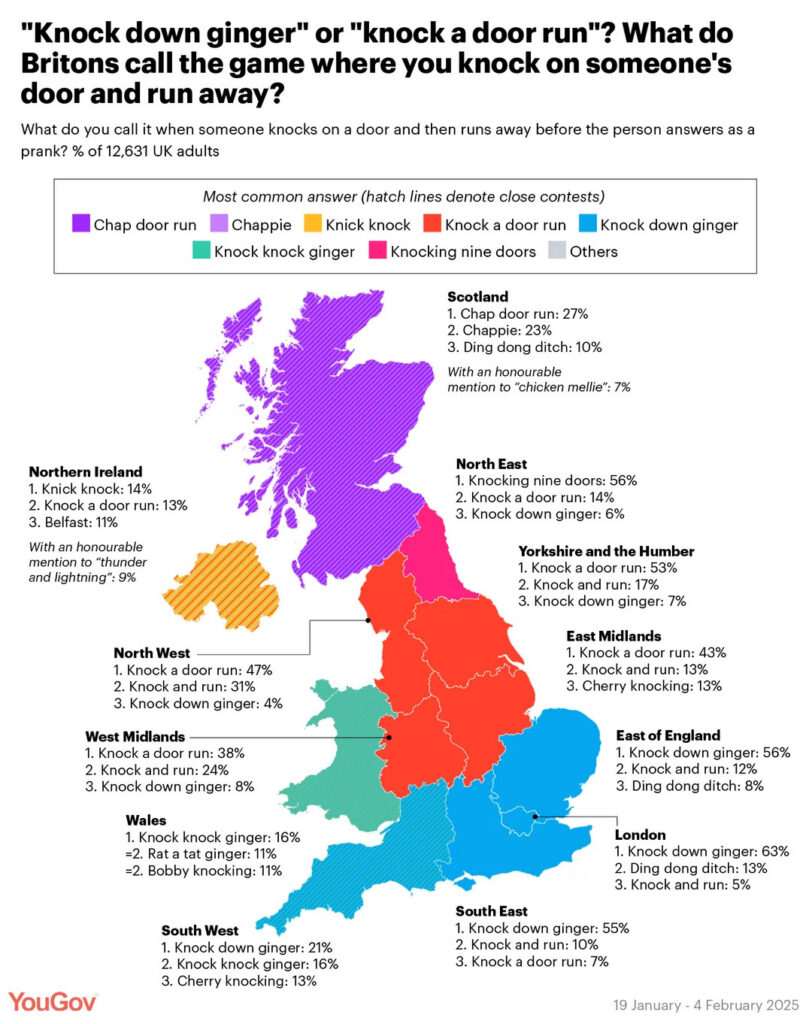
If you grew up in the latter half of the 20th century, you almost certainly know this feeling. The prank goes by many names, we called it Cherry Knocking where I grew up in England, though it answers to a dozen variations depending on which end of the country you’re from, but its appeal has always been the same: a small, gleeful inversion of the adult world, available to any child bold enough to push a button. What has changed is not the prank. It is the world waiting on the other side of the door.
Historical Origins and Cultural Significance
Ding Dong Ditch grew out of traditional seasonal mischief in 19th-century England, Nickanan Night in Cornwall being one precursor, though the Oxford English Dictionary did not get around to formalizing “Ding Dong Ditch” itself until the 1980s. The definition it settled on is gloriously matter-of-fact: a prank in which participants ring a doorbell and run away before anyone answers. Within the UK alone, it goes by Knock Knock Ginger, Cherry Knocking, or Knock-a-Door Run, depending on which part of the country you grew up in. Venture farther afield and the names multiply: Klingelstreich in Germany, Belletje trekken in the Netherlands, Rinraje in Argentina, Rín-rín-Raja in Chile. Every culture on earth has apparently invented it independently, which tells you something about children, or possibly about the universal human desire to irritate one’s neighbors.
What I find charming about these names, taken together, is how they reveal the same underlying instinct at work across languages: mimic the sound, describe the action, keep it rhythmic enough to spread by word of mouth. It is folk culture in its purest form, no publisher, no algorithm, just children whispering instructions to other children across the garden fence. A smaller number of names introduce a fictional character or draw on local slang, though even these follow the same logic: give a wordless act a name with a little mischief baked into it, and watch it travel.
It is that element of mischief that matters most here. In a closely connected community, such acts of childhood rebellion tend to be viewed as petty annoyances, with the understanding that any genuine breach of conduct will be handled at the community level. In the more atomized neighborhoods of the 21st century, however, the same act can land very differently, perceived not as harmless fun but as a deliberate violation of a stranger’s sense of safety and security.

The Psychology of the Prank
I can still feel that negotiation, wanting to go through with it and wanting to abort, running in parallel, right up until the moment your finger hits the bell and the decision is suddenly, irreversibly, someone else’s problem. Nobody, as far as I am aware, has ever connected Albert Camus with Ding Dong Ditch, but bear with me. “I rebel, therefore I exist.” In that simple phrase, the petite rébellion of summoning an adult to the door, of briefly disrupting the normal order of things, becomes something more than a prank. It becomes an assertion of existence, a small but meaningful act of agency in a world that has grown steadily more restrictive over the past century and a half.
And yet the surveillance state referenced in our title was always there in miniature, in the twitching curtain, the suspicious neighbor, the parent who somehow always found out. The thrill was never just about the doorbell. It was about moving through a world that watched you and getting away with it anyway. The original consequence, the true and only risk, was an annoyed neighbor who might recognize your face the next time you passed on the street. A world of surveillance reduced, in the end, to a single pair of eyes and a grudge held over the garden fence.
In this relatively low-stakes act of risk-taking, something socially complex is also at play. A participant can simultaneously stand out from the crowd and belong to it, the dual appeal in grafting individual daring onto collective solidarity. The shared transgression creates a bond that more wholesome activities rarely can, because it is built on complicity, on the knowledge that everyone present has crossed the line together. Such moments tend to lodge themselves in the memory not as central chapters of a childhood, but as telling footnotes, small dispatches from a time when the consequences of failure were still light enough to be laughed off, and the open street still felt like freedom.
The Fortress and the Feed
The thing about love letters is their tendency to idealize their subject, to romanticize something that has passed. And something has passed. The close-knit neighbor relationships that once formed the invisible safety net around childhood mischief have been largely replaced by doorbell cameras and home surveillance systems. As daily life increasingly narrows to a commute between home and workplace, we spend less time with those who live around us and more time tending to carefully curated lives online. The very technologies designed to improve our lives, home entertainment, smartphones, even domestic appliances, have made us more dependent on our private spaces and less inclined to step outside of them.
In this sense, the home has become something closer to the castle of the old idiom, not through high walls and a moat, but through Ring cameras, motion sensors, and round-the-clock surveillance. The irony is pointed: we have never been more watched, or more alone. And into this fortress mentality comes the other edge of the same technological sword. Where the prank once spread slowly, passed between children on playgrounds and street corners, social media can now amplify it overnight into a viral challenge, stripping away local context and community familiarity and replacing them with an anonymous, unpredictable audience. It is that combination, the fortified and fearful household meeting the emboldened and directionless crowd, that has transformed a harmless childhood ritual into something with genuinely dangerous potential.
When Mischief Meets a Loaded Gun
What has changed is not the children. The prank is the same prank it always was. What has changed is the world that receives it. In August 2025, eleven-year-old Julian Guzman was fatally shot in Houston after ringing a doorbell. In May 2025, an 18-year-old was killed in Virginia in an incident linked to a TikTok challenge. In 2020, a homeowner in Corona, California killed three teenagers by ramming their vehicle. In 2011, a twelve-year-old in Kentucky was shot with a shotgun. These are not aberrations. They are the logical endpoint of a society in which strangers at the door are processed as threats rather than neighborhood kids, and where fear, isolation, and weaponry have moved into the space that community once occupied.
The Law Catches Up
There is a certain irony in the fact that Ding Dong dDitch, once settled with a stern word at the garden gate, now has a legal history. In the UK, the Town Police Clauses Act of 1847 made “wantonly and wilfully” knocking on doors a prosecutable offence although this was rarely enforced and was repealed in 2015. Modern equivalents across the US classify the prank variously as trespassing, disturbing the peace, or harassment. Doorbell camera footage has made prosecution considerably easier, replacing the unreliable memory of an annoyed neighbor with time-stamped video evidence. Yet the law cuts both ways. Courts have increasingly had to address homeowner liability for excessive force, recognizing that castle doctrine protections have meaningful limits when the perceived threat is a fleeing twelve-year-old, and that a childhood prank, however irritating, does not constitute the kind of danger that lethal force was ever designed to address.
Rebuilding the Village
So here is what this love letter is really about. Not the prank itself, not the hammering heart or the slap of feet on pavement, but the world in which those things were possible, a world where the worst consequence of ringing a stranger’s doorbell was, for the most part, a telling off, where the surveillance state existed only in the form of a twitching curtain and a neighbor with a long memory. That world is gone, and no amount of nostalgia will bring it back. What replaced it, the Ring cameras, the viral challenges, the armed and frightened strangers behind fortified doors, is not the fault of children, who are still doing more or less what children have always done. The danger lies not in the mischief but in the fracture. When we know our neighbors, when we recognize the kids on our street, a ringing doorbell is an annoyance. When we do not, it can become something irreversible. The answer was never more surveillance. It was always more community. I rebel, therefore I exist, wrote Camus. The least we can do is know the kids well enough to recognize their faces when they come sprinting past.

Jason Page
Jason Page, born and brought up in Ipswich, UK, first went off to college in Canterbury before his path took a sharp transatlantic turn. While working at a summer camp in the United States, he met his future wife, eventually immigrating to America after teaching adaptive physical education in the UK. In the US, Page’s work has focused on human services and serving diverse populations, including at-risk youth and individuals with substance use and mental health disorders. After earning a second Bachelor’s degree in History and Political Science and then a Master’s in Therapeutic Recreation from SUNY Cortland, Page completed his PhD in Recreation Therapy at Clemson University, his research focusing on the behaviors and motivations behind participation in high-risk or “deviant” leisure activities, questioning why certain activities receive such labels. Known for his willingness to explore topics that might not get him invited back to dinner parties, Page says his scholarly focus aligns with his irreverent attitude toward institutional power and his dark sense of humor. His work challenges conventional perspectives on leisure activities, exploring the complex relationship between risk, societal norms, and personal fulfillment; deliberately questioning established boundaries and received assumptions. (Author Head Shot Augment: René Laanen.)
One Comment
Paul Gugerty
My brother sent me this article as my family and I live in Cortland. My brother Leo Gugerty was a psychology professor at Clemson and he noticed that you live and went to school in Cortland as well as receiving your masters from Clemson.
I did my masters at Cortland in adapted PE, and currently am a physical therapist at Boces, local nursing homes, as well as early intervention for the Cortland County Health Dept..
My brother and I talked about our childhood growing up in Nassau county ( Locust Valley/ Bayville/Brookville) on Long Island on a beautiful cul-de-sac with a woods and swamp behind us. We called doorbell ringing- ring and run, we also did pool hopping, skitching- grabbing onto cars when they were stopped at a stop sign, and having them pull you up on your skateboard, capture the flag with the whole street as the playing field , manhunt a form of ringalevio in the woods and swamp, kill the man with the ball – or on a kinder note tackle the guy with the ball, flashlight tag, kick the can throwing snowballs at things we weren’t supposed to throw at , and jumping off of roofs at night into large snowbanks. The list goes on.
I met my wife at Cortland State and we are married with four adult children who all grew up playing in our woods and spending about 15 years each at Lime Hollow nature Center. They played some of the games we did. My wife’s versions were similar with different names for central New York, but they were all for friendship, socialization, exercise, and ultimately fun.
Jason, please feel free to contact me at my email above.
Peace