Dinocrates & Mount Rushmore

“Though he got most of the facts wrong, it appears that in seeking to create the Mount Rushmore Memorial, Borglum was inspired by a story about Alexander the Great which appears in the work by Roman architect Marcus Vitruvius Pollio, De architectura. According to Vitruvius, it was not, as Borglum maintained, Alexander’s desire to carve into the ‘Olympian mountains.’ Instead, another mountain, which would be deemed ‘holy’ centuries later for a completely different set of reasons, was marked for development and by someone just as ambitious as Borglum. Enter Dinocrates, the architect of Rhodes, who upon learning of Alexander’s victories, thought it expedient to seek his patronage.”—Dean Kalimniou
Diatribe/North
By Dean Kalimniou
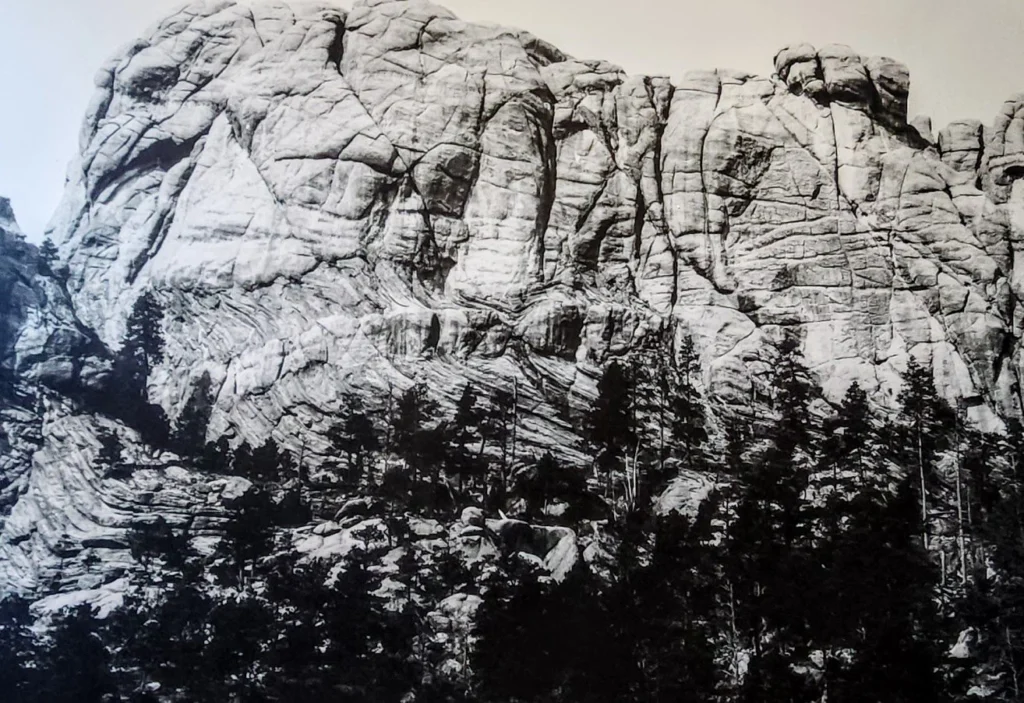
“What does this Mount Rushmore mean to us Indians? It means that these big white faces are telling us, ‘First we gave you Indians a treaty that you could keep these Black Hills forever, as long as the sun would shine, in exchange for all of the Dakotas, Wyoming, and Montana. Then we found the gold and took this last piece of land, because we were stronger. . . . And because we like the tourist dollars, too, we have made your sacred Black Hills into one vast Disneyland. And after we did all this we carved up this mountain, the dwelling place of your spirits, and put our four gleaming white faces here. We are the conquerors.”—John Fire Lame Deer, from Lame Deer, Seeker of Visions
“A tomb now suffices him for whom the whole world was not sufficient.”—Alexander the Great
“During his first term, Mr. Trump told Kristi Noem — then a U.S. representative from South Dakota, now Mr. Trump’s Secretary of Homeland Security—that his ‘dream’ was to be on Mount Rushmore. She later gave Mr. Trump a model of Mount Rushmore with his face on it.”—“Room for One More on Mount Rushmore? (The President Wants to Know.),” by John Branch and Jeremy White, The New York Times, June 27, 2025
 MELBOURNE Australia—(Hubris)—May 2026—“Somewhere in America . . . backbone of the continent, removed from succeeding, selfish, coveting civilisations and out of the path of greed, an acre or two of stone should bear witness, carrying likeness, a few precious words pressed together, an appraisal of our civilisation, telling of the things we tried to do, cut so high, near the stars, it wouldn’t pay to pull them down for lesser purposes.”
Thus mused Gutzon Borglum, the American sculptor who went on to deface the sacred Lakota Sioux site of Tȟuŋkášila Šákpe, or “The Six Grandfathers,” with the iconic likenesses of four American presidents. For him, the gargantuan profiles represented the quintessence of American civilization. Etched indelibly upon the lofty heights, far removed from the corruptive and corrosive influences of daily life, they were to remain, for evermore, an imperative, set in stone, for subsequent Americans to follow.
Borglum was interested in the fine line trod by people of the modern age between the sublime and the barbaric. One of his early sculptural works in bronze, “The Mares of Diomedes,” portrays the man-eating and uncontrollable horses belonging to the king of the Thracian Bistones, Diomedes.
The demi-god Heracles left his favored companion, Abderus, in charge of them while he fought Diomedes, only to learn that the boy had himself been devoured by the ravenous steeds. In revenge, Heracles fed Diomedes to his own horses, then founded the city of Abdera next to the boy’s tomb, perhaps highlighting just how prone to devour itself humanity is, without the intervention of the divine.
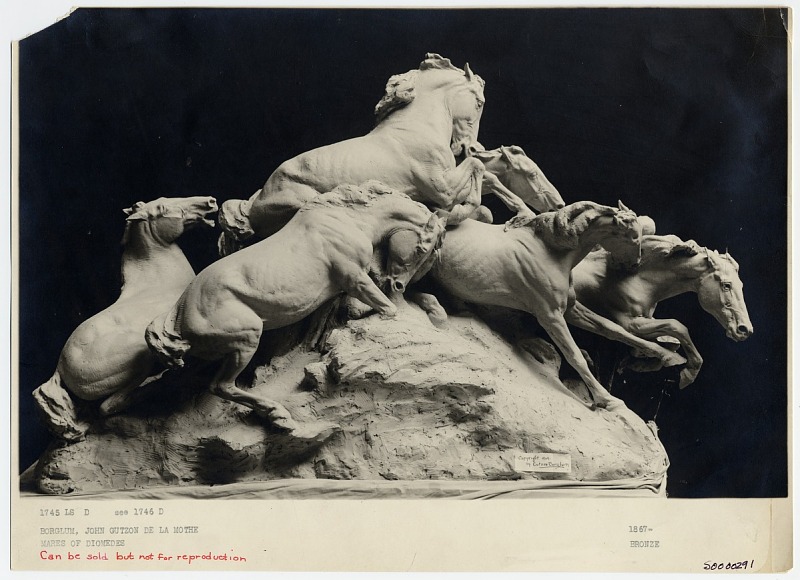
It is probably for this reason that in 1918, the sculptor was one of the drafters of the Czechoslovak Declaration of Independence. Yet Borglum, in pursuing his “Mosaic” interests atop the holy mountain of the Sioux, was inspired by other characters of antiquity.
In 1934, a Washington cartoonist for The Washington Herald portrayed Borglum as a man-mountain—massive, elemental, monumental—and quoted him as saying of the Mount Rushmore memorial: “Alexander the Great wanted to convert the Olympian mountains into sculpture. Michael Angelo wished to carve colossal figures on Carrara Mountains—America alone is achieving in a National Memorial, the dreams of these great men.”
Though he got most of the facts wrong, it appears that in seeking to create the Mount Rushmore Memorial, Borglum was inspired by a story about Alexander the Great which appears in the work by Roman architect Marcus Vitruvius Pollio, De architectura. According to Vitruvius, it was not, as Borglum maintained, Alexander’s desire to carve into the “Olympian mountains.” Instead, another mountain, which would be deemed “holy” centuries later for a completely different set of reasons, was marked for development and by someone just as ambitious as Borglum.
Enter Dinocrates, the architect of Rhodes, who upon learning of Alexander’s victories, thought it expedient to seek his patronage. As Vitruvius relates: “[R]elying on the powers of his skill and ingenuity, whilst Alexander was in the midst of his conquests, [he] set out from Macedonia to the army, desirous of gaining the commendation of his sovereign. That his introduction to the royal presence might be facilitated, he obtained letters from his countrymen and relations to men of the first rank and nobility about the king’s person; by whom being kindly received, he besought them to take the earliest opportunity of accomplishing his wish.”
For reasons unknown, the age-old Greek system of μέσον—or relying on one’s familiarity with higher-ups to gain some advantage—failed Dinocrates. Try as he might, he could not obtain an audience with the mighty potentate through the usual channels. As a result, he decided to take matters into his own creative hands.
Vitruvius takes up the story: “[A] man of tall stature, pleasing countenance, and altogether of dignified appearance [Dinocrates,] [t]rusting to the gifts with which nature had thus endowed him, he put off his ordinary clothing, and having anointed himself with oil, crowned his head with a wreath of poplar, slung a lion’s skin across his left shoulder, and carrying a large club in his right hand, he sallied forth to the royal tribunal, at a period when the king was dispensing justice. The novelty of his appearance excited the attention of the people; and Alexander soon discovering, with astonishment, the object of their curiosity, ordered the crowd to make way for him, and demanded to know who he was.” In short, Dinocrates, oiled up or otherwise, was a hottie and a man of action, two things that were bound to capture the attention of Alexander.
Borglum, on the other hand, though no cosplayer, was just as intrepid, stating that “a man should do everything. . . . Boxing fencing, horse-back riding . . . handsprings.”
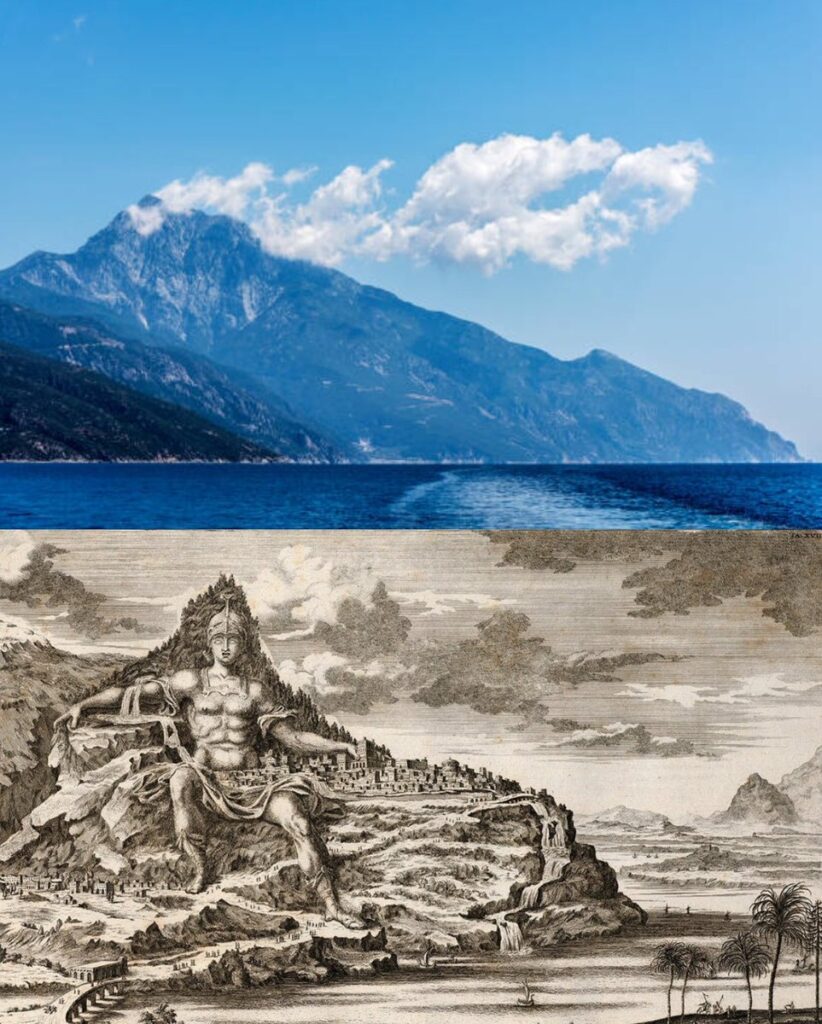
Dinocrates, like Borglum, was there to convince Alexander that he could do everything. After observing dispassionately the way the oil glistened on his muscular torso, the Macedonian king asked Dinocrates who he was. “A Macedonian architect,” replied Dinocrates, “who suggests schemes and designs worthy your royal renown. I propose to form Mount Athos into the statue of a man [i.e. of Alexander, himself] holding a spacious city in his left hand, and in his right a huge cup, into which shall be collected all the streams of the mountain, which shall then be poured into the sea.”
Not only would this be a Hellenic Rushmore, but an actual polis. Had the scheme come to fruition, we would now quite possibly be concerning ourselves with Russian penetration of the statues’ orifices, rather than Russian penetration of the monasteries that exist upon Mount Athos, the mountain holy to Orthodoxy. But I digress.
Alexander quite liked the idea of being immortalized in such gargantuan fashion, but his megalomania was tempered by pragmatism and he began to pepper the plucky Dinocrates with logistical questions, such as: “Was soil of the neighborhood . . . of a quality capable of yielding sufficient produce for such a state?”
Not one to be put off by such mundane concerns, Dinocrates, in the manner of a property developer extolling the health-giving benefits of a local swamp, admitted that no, given that the city would be carved into a mountain, there was no soil, but fear not, supplies could be brought in by sea.
Impressed by his ingenuity and his desire to mirror the domination of men in the domination of nature, Alexander gently declined to enter into the real estate deal of a lifetime, not wanting posterity to think him a fierce warrior but a property dupe.
Thus, he responded: “I admire the grand outline of your scheme and am well pleased with it: but I am of opinion he would be much to blame who planted a colony on such a spot. For as an infant is nourished by the milk of its mother, depending thereon for its progress to maturity, so a city depends on the fertility of the country surrounding it for its riches, its strength in population, and not less for its defense against an enemy. Though your plan might be carried into execution, yet I think it impolitic.”
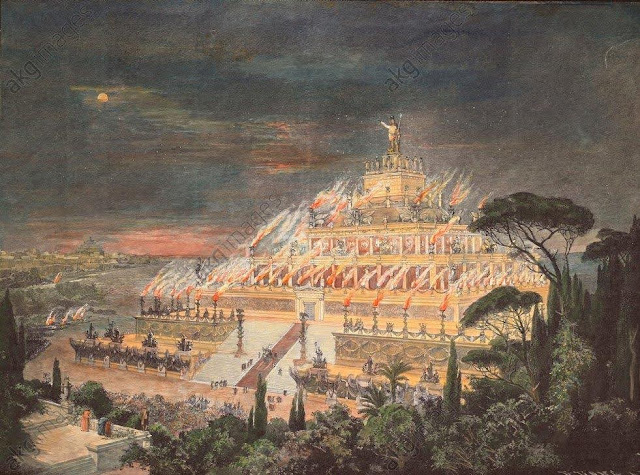
Nonetheless, it appears that to be deprived of the shimmering undulations of Dinocrates’ physique was more than Alexander could bear. “I . . . request your attendance on me, that I may otherwise avail myself of your ingenuity,” he commanded his supplicant, and Dinocrates went on to design the funerary monument to Alexander’s general Hephaestion in Babylon (built in imitation of a Babylonian temple, six stories tall and entirely gilded), as well as being involved in the reconstruction of the Temple of Artemis, at Ephesus. Most famously however, failing to convince Alexander to build a city in the clouds, Dinocrates is said to have gone on to act as director of the surveying and urban-planning work for the city of Alexandria, in Egypt, possibly Alexander’s greatest tangible legacy.
It may not be true, as Badger Clark eulogized Borglum at the sculptor’s funeral in 1941, that “he did not die, this artist, engineer and dreamer. He will live longer than the monument he created. Coming generations, five thousand years hence, will not ask who the characters on the mountain are, but who carved them?”
However, following in the footsteps of Dinocrates, he was to set in stone the political manifesto of an entire people while, simultaneously, disfiguring the natural shrine of the nation America displaced and conquered.
In his declining years, Dinocrates, the sweat of sultry Alexandria streaming off his spare tire, would have nodded in appreciation as the redoubtable Borglum pounded at the holy rock with his jackhammer, compelling it to yield, and take the form of Abraham Lincoln’s beard and Teddy Roosevelt’s spectacles.

Dean Kalimniou
Born in Melbourne, Australia, lawyer-poet Dean Kalimniou (also known as Konstantinos Kalymnios) is, among all else, a screenwriter, short story writer, children’s author, and translator well known to Australia’s Greek community. One of the few Australian-born poets writing in Modern Greek, he has published eight poetry collections. As spokesperson for the Panepirotic Federation of Australia, Kalimniou has consistently raised awareness about the plight of the Northern Epirot Greek minority in Southern Albania. As a journalist, Kalimniou has written a column, Diatribe, for Melbourne’s Greek newspaper, Neos Kosmos (New World), since 2001. He also writes regularly for OPA! magazine and New York’s NEO magazine. In November 2007, Kalimniou was awarded a Government of Victoria Award for Excellence in Multicultural Affairs by the Governor of Victoria, Professor David de Kretser. (Author Head Shot Augment: René Laanen.)