Drifting Toward Home
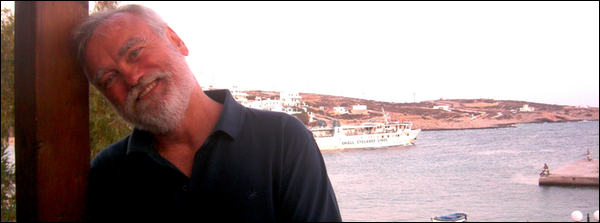
I want to build a house just like the man/across the bay who whistles as he pulls/bricks from the back of his donkey, a house/of words or shards of words from Homer’s time./In the modern language I struggle with,/his words are lost, or broken, a few still whole./Thimós is anger now, back then the soul,/the animating principle. And fos/was not the light enveloping our days,/but as Cunliffe writes, . . . a person, a man, a weight./Stathmós, where you and I would catch the Metro,/back then a keep for sheep and goats. Drómos/was a stretch of grass for horses, long and flat,/no holes. Then someone raced chariots there,/so now it’s any road. Kólpos wasn’t bay,/ but folds along the upper part of a peplos.”—Don Schofield
Imagination’s Favors
By Don Schofield
 THESSALONIKI & ATHENS Greece—(Hubris)—September/October 2026—As a writer, and as a human being struggling for decades to find greater self-awareness, I have carried on a lifelong dialogue with myth narratives. As a child, I believed, sometimes fiercely, in Christianity (until my mid-teens). In my early twenties, as an undergraduate lit major I focused on Myth Criticism, an approach to literature that uses ancient, mostly Greek, myths to talk about modern and contemporary works. One reason I moved to Greece once I finished graduate school—but by no means the only reason—was to immerse myself into the landscape, culture and language in which those ancient narratives still reverberate.
I’m not naïve. I know Greece is a modern European country. And that the ancient myths have been the basis of so many works of literature, art, and music over the centuries—in multiple languages and cultures—that by now any new rendition, including, most recently, Christopher Nolan’s The Odyssey, is but a palimpsest of those original tales. Nevertheless, the archetypes continue to show through.
And it’s those archetypal motifs, especially as found in Homer’s Odyssey, that have inspired my writing for decades.
The Immortals
By Don Schofield
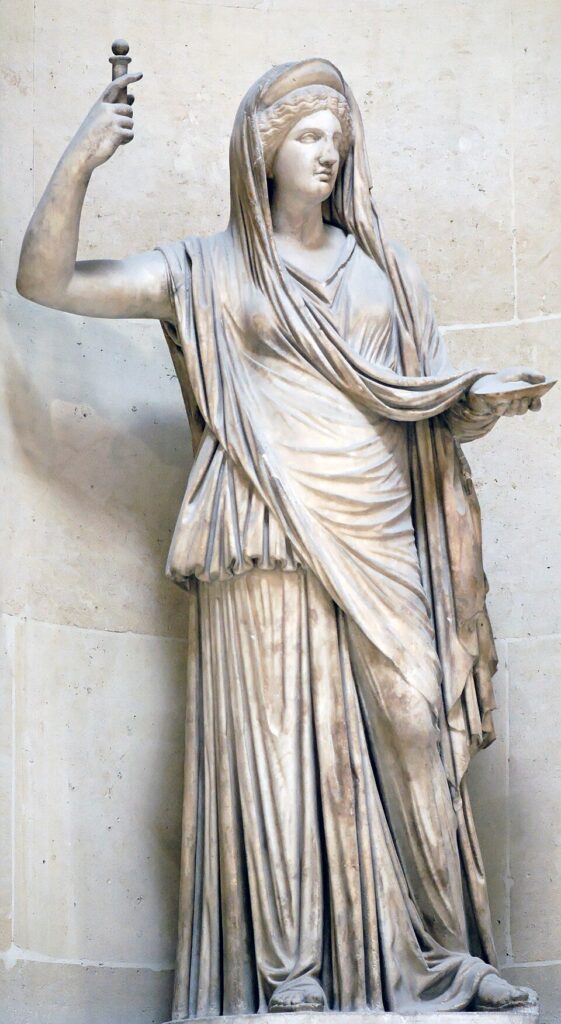
“Hera is not . . . mother as mother but mother as wife.”
—The Gods of Greece
Mother writes that she can’t control her bowels.
Pain runs up her spine, down her arms.
Her husband, who left her, comes round every Sunday
for a meal. Of Reno, the nights alive
with neon, bells, whoops of truckers
at blackjack and keno, she won’t write.
She married my father, stayed till he beat her,
then longer for the courage to be lonely again.
I call them immortal, him standing over her
fire in his eyes, her running off
with the next man who took her to his bed,
because, as we know, even gods
are human—vain, contentious, disorderly
in their wants. Only death is eliminated.
And the need to believe in an ideal world.
Published in Before Kodachrome, 2012.
Eidothea Grieving
By Don Schofield
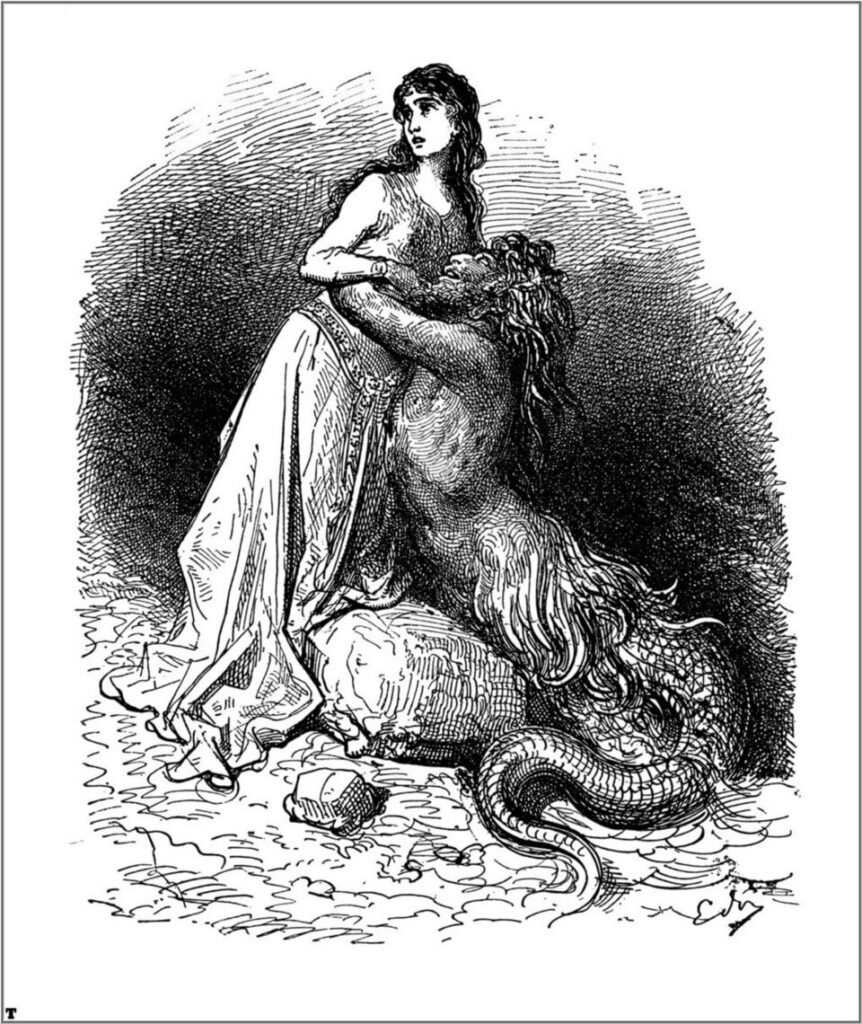
“The Ancient of the Salt Sea . . . Proteus of Egypt . . . is, they say, my father.”
—The Odyssey, Book IV
Waves keep rolling
and I keep asking
this vague mound under blankets—
why a lion, why a falcon, why a towering flame?
Why all those years walking the beach,
following your tracks with the urge for you,
Father, your touch, your solidity,
your hand firmly holding mine?
You were grass once. From then on
I treaded fields so carefully,
wondering what shapes I took
in Mother’s womb—or was it your womb,
Father? Did I step from your ear,
a girl already asking questions?
I thought I could have you
with words, Father. While you slept
I’d spread feathers, fur or sand—
whatever was where your ear
should be—and whisper,
Who are you? Who am I?
I’d touch my hair, my chest,
and shiver at the thought
that I’m not me, I’m you. Seals clapped
each time you became a towering flame
for the crowds of locals and travelers
who’d wrestle you to learn the future. You won.
You always won. But still you kept changing—
bull laboring up a hill, boulder
rolling through scrub, flicker of trout, gull
barely touching the waves—
each shape flashing before our eyes
then lost in a sea of shapes,
like these questions I can’t help but ask—surely
if you’re nothing fixed then you’re all things,
Father, a trompe l’oeil
of everything,
right?—except, for me, a father.
When I step outside,
the mountains are waves
against a hard blue sky. Wind
rattles the unsteady boards of our hut,
while inside, your shifting comes slower.
No fire, no tree, you’re almost
solid, curled up at the edge of your bed,
barely breathing. Or is your dying
just another disguise,
that urgent expression
a dolphin caught in nets? I stroke your hair—
your hair—smell the sea
on your fading breath. Let me
be the one who finally pins you,
Father—here, now—
the one who makes you give me
in your dying the answers you never gave me
living. Let me hold your body
to its one, final shape: the un-
recognizable figure of a man.
Published in Approximately Paradise, 2002.
#MeToo
By Don Schofield
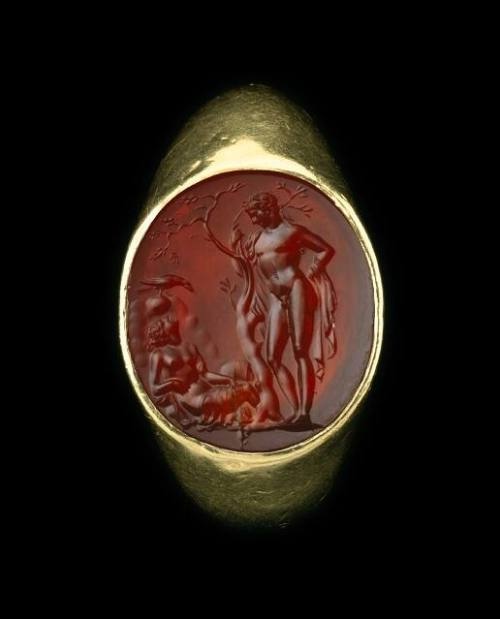
Spit in my mouth or serpent’s tongues in my ears,
whatever it was, it was his curse on me
for saying no. Yeah, he’d get confused
sometimes, call me Alexandra one day,
Cassandra the next. Whatever he said, it was only
to ravish me, show me his musical,
oracular, athletic prowess (i.e.,
his penis). Should’ve known me better—daughter
of Priam, proud and vain and much too young
to care about the future, except, as princess,
to know that mine was made. So I said no—
how could I not? For that he spit on my tongue.
Now none of you will ever believe,
however true, a single word I say.
Published in The Flow of Wonder, 2018.
My Neighbor’s Brush
By Don Schofield
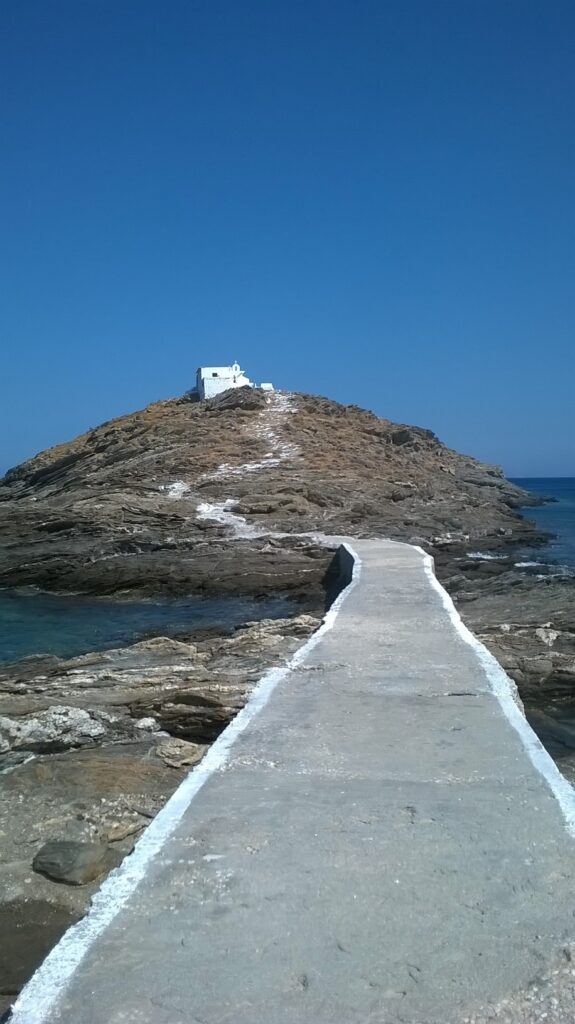
Climbing this rock, I carry my neighbor’s brush
with long, stiff bristles, emblem of my presence
on this island, desire to help,
to be with the locals
whitewashing their chapel,
its loose head rattling on a handle
tall as a man,
pocked and gouged,
with so many layers of white
nothing could get them off,
or tall as a lanky boy
eager for a pat on the back,
job well done . . . .
Son of driver carries it,
son of waitress, gambler, lumberjack,
abandoned son of priest and nun . . . .
Whose child am I
here on this island of strangers? Stavros
brings goatmilk every morning, Kyria Maria
eggs, and another I don’t know,
when the moon is low and the wind has stopped,
leaves squid on my steps. The man who rows his boat
and helps his maimed wife step out
has a life more solid than mine. A hundred years ago, he says,
fewer houses and not so many boats,
but the stone walls and gardens were here, that row
of lemon trees, more threshing floors and more
rimathes, songs from Homer
and before: their words have changed
but not the music and not our stories
of a lost home . . . .
~
Seven brushes. Seven buckets. Six locals
mixing well water with quicklime,
laughing as they estimate
the monthly pay they’d get for this
if paid at all. A glass of wine
for the seventh, the bearded foreigner
they set to work on the outside wall of the porch.
I dip my brush, swirl it around, swing it
up to the top of the wall, wind driving
beads of whitewash into my mouth and hair,
cries of a lamb from the fields below
into my ear. I stroke each spot
several times and several times
stir the grains of earth, loose stems, winged
creatures drowned in white . . . .
Where the stucco ends,
bricks in rows, globs of mortar.
I paint these too, till my bucket is empty,
then climb to the porch, face and beard
splotched white, a prophet come in from the wilderness,
ready to fling this brush, this almost
perfect image of the soul, down at my neighbors’ feet,
speak my message from the divine.
Yet I have no vision of the world to come
or its end. I could say my body fails while the spirit remains
elusive as air, that the gap between
one life and another never fills
except with loss, but I’m not sure. And even if I rattled off
each precise step to salvation,
they couldn’t understand my language,
maybe a word or two.
~
Wade and I hitching to Sacramento, sharing
a beer and cigarette, no one stopping so we’re sitting
in the weeds and he’s going on:
You think ‘cuz you white the world be white
or you gonna make it that way
with them scrawny fists, but shit,
ain’t no one doin’ good
‘cept somethin’s in it for him. I slap
whitewash on stones wedged
under bricks, spread it deep into crevices,
thinking how my neighbors paint their world
white, even weeds and dirt
at the base of this wall—
so, white my adolescent anger
rifling cubby holes, car to car, any suburb
south of town. I thought I was getting even,
grabbing coins, wallets, shotgun shells, bottled
holy water, pliars, flashcubes, snapshots—now I know
I was hoarding tokens of the love
I thought everyone else had, and credit cards
to charge the bitterness to them.
Now I’d empty my bucket
into the cracked core
of that anger, fill and empty it again,
till a river of white
flowed from there to here,
and every parent, lover or friend
I’ve ever wronged
would float by—
I’d stroke each one.
Stroke and stroke.
Wade was right.
~
No candles, no votives, no psalters’ stand, no curtained
door to the altar, all the icons carried out, Stavros,
on a chair, painting the line that separates
Heaven and earth. Mea culpa, mea culpa, mea maxima
culpa, I chanted as an altar boy on cold
weekday mornings, sure I was damned. But here,
stepping out of the empty chapel,
I’m blinded by white,
till I lean into the well and see my own dark face
shining back. If I were Odysseus,
this bucket would be my shield, this brush
paint circles to let the gibbering shades
come forth: first my father
with hugs more substantial than when he was
alive, still saying, I can’t, I can’t, Mother
at a distance with her contrapuntal, I won’t.
Then my companions in the children’s home:
Wade, Luna, Santucci, Bill and Roy
Steele—all of us at attention as Sister Leonardo
slams our gritty palms with a belt,
no woman or man under that white habit, just rage
to make us bad boys pure. Nothing
stopped my desire when a hair slipped down
Sister Hermione’s forehead; even now I’d stammer
if she called my name, as if I spoke
some alien tongue—and I do:
America, I anoint my face and arms in your names
that will never leave me:
Fresno, Reno,
Yosemite, Nipinnawasee . . . .
Here, washing up, my flesh shines
in the incessant meltemi. I gaze down at the crumbling
cliffs and feel the despair
always there, watch the waves and feel love
come and go. Heaven, earth or underworld—
not much difference here. I drop the bucket
into the pigí—spring or source,
the word’s the same—lift this brush
and drift toward home.
Published in Approximately Paradise, 2002.
Polyphemos on His Veranda
By Don Schofield
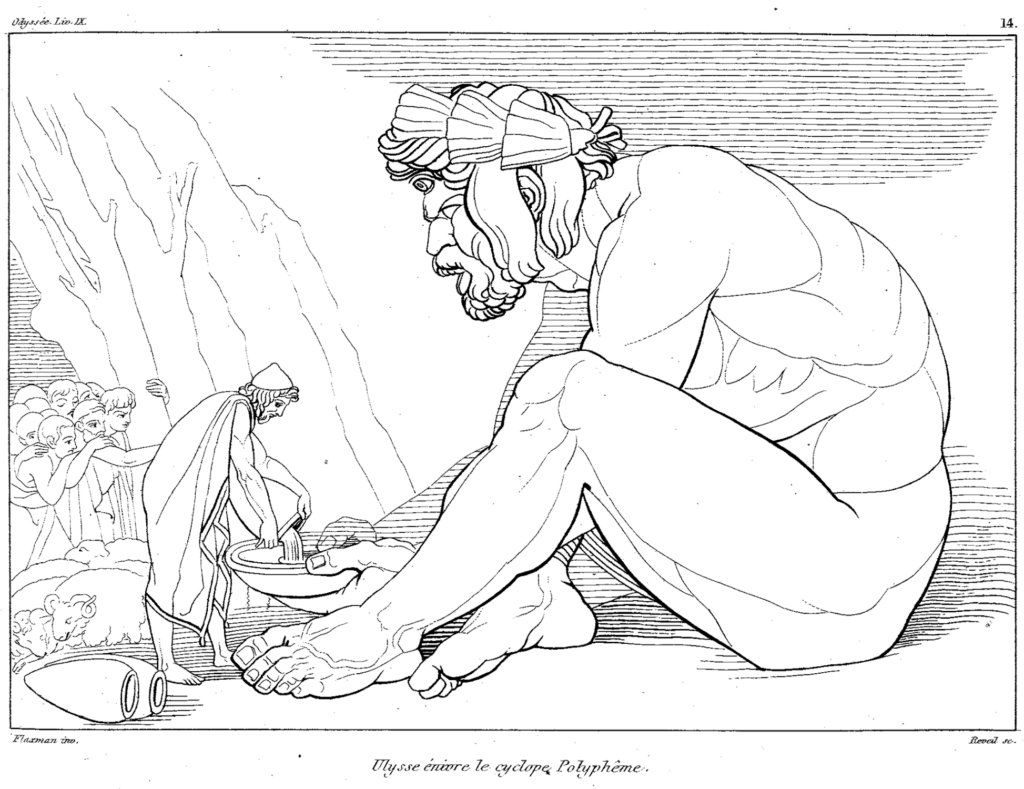
My cave is whitewashed of course, blue logs
for rafters,
fish drying on the sill. All of it
leans toward the sea
that glitters a million gold eyes tonight. My eye
grazes like a goat on Orion, the Bear, the jewelled belt
of the Huntress, the flight
from Cairo to Paris. Twin hearts—one loves, one yearns
to devour—I’m the beast
best forgotten. I remember that braggart Nobody,
his comrades’ voices like chirring cicadas. I should’ve
wiped away some goat turds
for them to sit, should’ve shared my best wine. But, oh,
his mates were tasty
as lamb on a stick. Thought he’d blinded me, but this eye’s
resilient, can spot the Huntress at the far end
of the cove
collecting what shines. Crones say her temple sank
to the bottom of the bay
and it’s true: sometimes the sea holds like a swirling
pane of glass. From my porch I can see
clumps of algae
on toppled columns, a sandal poking from silt, terra-cotta
votives still legible,
the broken pedastel of the oracle
now a nest of octopi staring back at me. Currents
wash over those columns
like the meltemi scrapes this cove,
pulls another brick
from my wall. I watch it sink to the bottom of the bay,
as if my heart—the one that loves—
wants some current to lift it
smooth and gleaming, set it gently on the sand
among nets, broken oars,
scattered ash and bone, for her to find.
Published in Approximately Paradise, 2002.
Athens Snow
By Don Schofield
I’m startled as I wake
by the stark silence
of morning. No dogs barking,
no cars starting,
only the whisper of snow
swirling in a March wind,
From Mt. Penteli
all the way out to the islands,
the radio says, and here,
drifts inching up doorways and sills,
weighing down the mimosas,
the garden’s urns
losing their form, the marble grapes
of a fountain
iced over. It’s easy
to lie here and remember
in another country, another time,
nuns telling us in school
how each flake is unique,
as we watched them fall, so delicate,
into anonymous mounds.
Drifts could pile so high
they once kept our family cabin
snowed-in for days. We listened to the radio
till the batteries died,
then clawed out
to an all-white landscape—
no road, no car, the apple trees
in the orchard below
crowned and glittering,
the whole mountainside
still as our breath
hovering in front of us
—till that buck
stepped out from behind the shed,
clumps of ice
hanging from his antlers, ears twitching,
eyes glaring, hungry and cold;
then he bounded up the slope
through chest-high drifts.
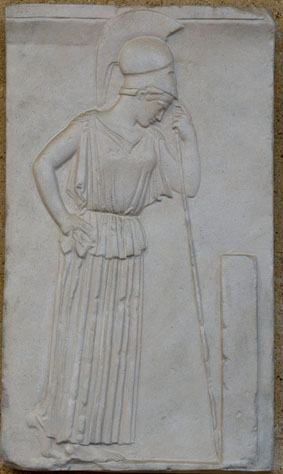
Now I gaze at the marble Athena
on my neighbor’s balcony—
a bas-relief
of the goddess grieving,
pressing her forehead
to her spear, snow on her cheek and breasts,
little ridges on her raised arm,
the tip of her helmet. Soon
all of her will be covered
in a formless mound
as my own body
grows heavy with years. Snow builds
in the quiet wind
just as each
singular moment
falls to endless
drifts of time, at their core
a darkness, a pulsing sentience
with the eyes of that buck
determined to go into
the glittering present.
Published in A Different Heaven: New & Selected Poems, 2023.
Traveling Greece
By Don Schofield
“Where are thy men of might? thy grand in soul?”
—Lord Byron
At Ephesus, a guide once told our group:
The ancients read from left to right and back
and saw it as analogous to plowing.
I knelt and took my journal from my pack,
let my pen be pulled by oxen-mind.
~
Who would do what I just read about?—
stuff a pine tree’s hollow full of needles,
then slip a mirror deep inside the clump
for sun to heat the needles, flames to
sputter up and quickly spread—soon
all of Attica is burning fiercely.
~
I can’t remember—did it really happen?
Did I go to Patras, board a ship
just like Odysseus, that master warrior,
man of many ways? He’s gone for good
since now we’ve traded glory in for fame.
~
On Santorini a cab just hit a donkey
head-on and kept on going, headlights shattered.
The donkey’s knees are broken, neck and spine.
That fact—I feel it. I am lost in it.
I hear the gasping locals gathered round,
the donkey bellowing in dirt and blood.
Eyes flared, we cannot comprehend this fate.
~
On Ithaka, inside the police station,
a family, the son and mother shouting,
the father, in his fifties, shouting back.
He’s clearly angry at his teenage son.
The mother can’t defend the boy enough.
The one policeman hasn’t said a word.
He lets their voices rise with accusations,
counter-accusations. The father leans,
grabs his son, shakes him hard, boy pushing back,
mother flailing with her tiny fists.
~
The chapels of Kastoriá have frescoes
with eyes gouged out, the chalky white a glare
of sorts. The locals blame it on the Turks,
their hatred of the Greek religious way,
and none believe this one old man who says
it brings good luck to seed the upturned soil
with the Virgin’s eyes.
~
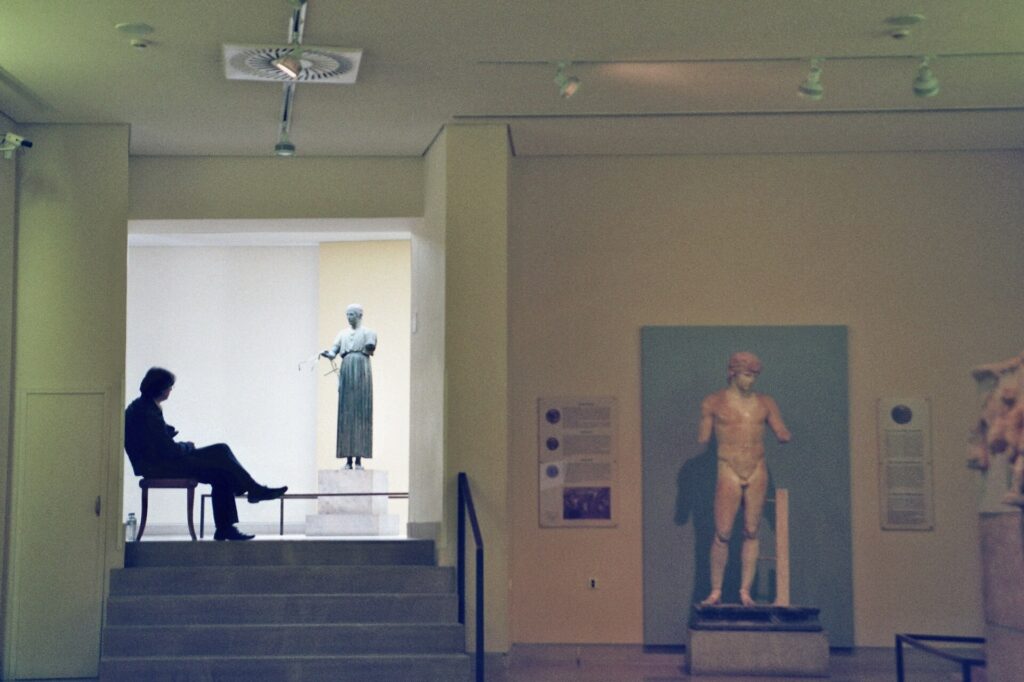
Delphi morning.
Olive groves aglow in spreading sunlight.
Chill up close to columns. My friend
points to a sign in German, translates:
Please don’t wake the statues.
Published in In Lands Imagination Favors, 2014.
With Homer’s Words
By Don Schofield
“There are, of course, conjectures in abundance . . . .”
—Richard John Cunliffe, A Lexicon of the Homeric Dialect
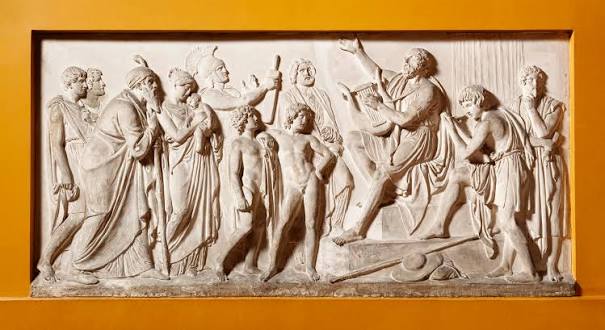
I want to build a house just like the man
across the bay who whistles as he pulls
bricks from the back of his donkey, a house
of words or shards of words from Homer’s time.
In the modern language I struggle with,
his words are lost, or broken, a few still whole.
~
Thimós is anger now, back then the soul,
the animating principle. And fos
was not the light enveloping our days,
but as Cunliffe writes, . . . a person, a man, a weight.
Stathmós, where you and I would catch the Metro,
back then a keep for sheep and goats. Drómos
was a stretch of grass for horses, long and flat,
no holes. Then someone raced chariots there,
so now it’s any road. Kólpos wasn’t bay,
but folds along the upper part of a peplos.
Yimnós, naked, for him the hero with no armor,
an arrow with no quiver. Nóstimos,
what’s tasty, had to do with going home,
as if our sense of taste transports us there.
Thomátio was palace for him; for me,
just this room I rent, though I would build
a palace, word by word, each ancient cognate
a brick against the loss, its endlessness.
~
How could the verb for loss, dévome,
be lost? Maybe Homer whispered
this imperative I hear around me—
ákou na deis, listen to see—and so,
like him, I wake to hear ίlios,
sun. I smell the day and say,
Sίmera. I take a morning walk
to taste the gossip filling the air
with heroes, since kléos, glory, lip to lip,
tongue to tongue, is still with us.
~
Neró, neró, my neighbor’s children call
and run into the sea, then back to their mother
laying out their towels; neró, neró,
as if that whole expanse of swaying froth
were just this word, one Homer never mouthed.
~
A boy, I’d wait for each night’s story.
And when it came, the weight of her its weight
upon my bed, its sound her voice, till sleep
would come and she would leave a lamp still lit,
a tiny corner lamp that filled the room
with glow. Lámpsi, I’d say today,
though Homer’d say, Lámbo. Which is brighter?
~
Some nights the moon’s her slender wrist
against the dark. The fishing boats arc out
across the bay. Soon there’s no difference
between their drifting lamps and drifting stars.
The fish all see each lamp as moon
and rise to it to feed a hunger we
too share. At dawn the skiffs unload their catch
along the beach, the glinting hordes all going grey,
their vacant eyes still open, still wanting moon.
~
Where do the lost words go? To another realm,
perhaps, a decaying hall all smoke and laughter,
where lesser kings and queens keep nodding off.
Telemakhos is gone. No Priam, Mentor
or Agamemnon, only children racing between
plastic tables, grabbing bottle caps,
playing tag. Homer’s nodding too
as Helen’s beauty fades against his heart
because he knows he’ll never hear again
lefkóleno, white-armed, glaukóno, glowing-eyed.
~
Perhaps in their ethereal domain
the gods are howling all the broken words,
the shades in theirs closing in on a ring
of crusted blood, to taste the words and smell
their memories awaken. Only Homer’s words
will come to them, the ones no longer used,
like poiitós, well-made, while in our world
the poiitίs, poet, hammers away.
~
Fenggári isn’t Homer’s word, although
he loves the moon, as he loves the fish that rise to it
till morning comes. He sees the goddess passing.
Nóstimi, he sings, or is it my neighbor
singing from across the bay? And I
sing with him, as brick by brick I butter
and tap: Lefkóleno. Lámbo. Dévome.
Published in In Lands Imagination Favors, 2014.

To order copies of Don Schofield’s books, visit his Author Page here; or order individual works: From the Cyclops Cave: A Braided Memoir (2025); A Different Heaven: New & Selected Poems (2023); The Flow of Wonder (2018); In Lands Imagination Favors (2014); Before Kodachrome (2012); Approximately Paradise (2002).

Don Schofield
Born in Nevada and raised in California, Don Schofield is a graduate of CSU, Sacramento (MA, 1978) and the University of Montana (MFA, 1980). A resident of Greece for many years, he has taught literature and creative writing at American, British, and Greek universities, and traveled extensively throughout Europe, the Middle East and farther afield. Fluent in Greek, a citizen of both his homeland and his adopted country, he is the editor of the anthology Kindled Terraces: American Poets in Greece (Truman State University Press), and has published six books of poetry in the US, the first of which, Approximately Paradise (University Press of Florida), was a finalist for the Walt Whitman Award, and a more recent collection, In Lands Imagination Favors (Dos Madres Press), reached the final round for the Rubery Book Award (UK). His translations of contemporary Greek poets have been honored by the London Hellenic Society, shortlisted for the Greek National Translation Award and nominated for a Pushcart Prize. Six poems from his most recent poetry collection, A Different Heaven: New & Selected Poems (Dos Madres Press) were also nominated for a Pushcart. From the Cyclops Cave, his first book-length memoir, came out from Open Books last fall. Currently, he lives with his companion Aleka in both Athens and Thessaloniki. (Author Head Shot Augment: René Laanen.)