Emily Hipchen’s Animal Husbandry: Stories of Relinquishment
The Hubris Review/Interview
By Claire Bateman, Poetry Editor
“I posted recently that I think sometimes being born—just being born! Not even writing about it!—is opening a window and crawling through it into some strange place better viewed behind glass, too loud, too many voices, too many big things elbowing out what matters, which is usually almost the smallest thing you can imagine. How anyone has patience for the importunance of catastrophe, I don’t know. I am seriously irritated by having to swallow huge events as if they’re the only drivers of changes. It interests me much more how little it takes to shift any story into a different one, not surprisingly maybe, but somehow surprisingly. I am fascinated with the story of a famous person—I forget now who—who died of a mosquito bite. Or the stories of anyone’s rescued pet, full of near misses and almosts, and such small tweaks could have meant entirely other narratives. I love how this kind of thing affects not just what happens but who one becomes. Had my birth family kept me, who might I have been?”—Emily Hipchen
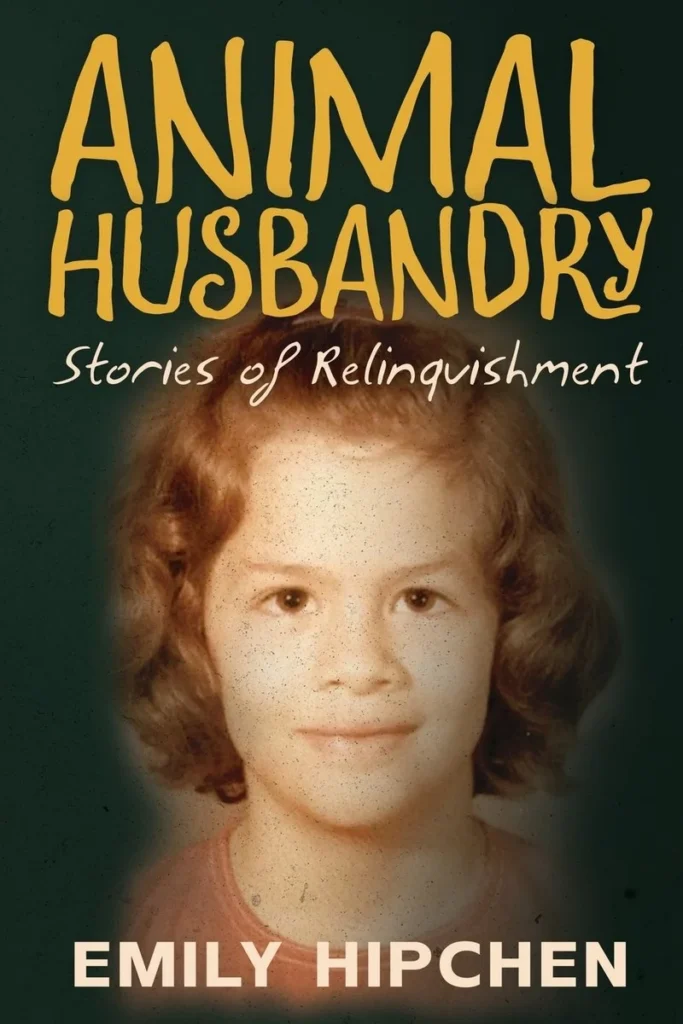
Emily Hipchen. Animal Husbandry: Stories of Relinquishment. Serving House Books, 2026. 160 pp. The Routledge Critical Adoption Studies Reader. Routledge, 2024. 270 pp. Coming Apart Together: Fragments from an Adoption. The Literate Chigger Press, 2005. 208 pp.
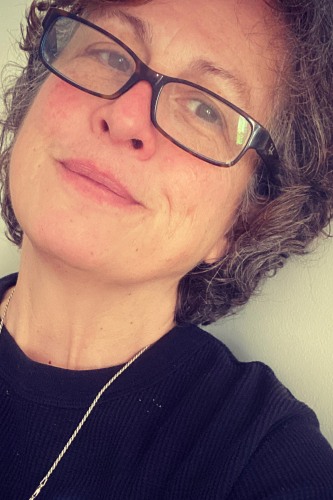
 GREENVILLE South Carolina—(Hubris)—July/August 2026—Emily Hipchen’s books are deeply immersive reading encounters. Each takes a different and distinct approach to complex questions inherent in the experience of loss, grief, adoption, and family bonding; Animal Husbandry, the most recent book, both deepens these questions and expands the exploration of various kinds of relinquishment in vivid and surprising ways as she portrays her interactions with and observations of the animal world (with a porous boundary between humans, animals, and place) and tells the story of her marriage, her husband’s death, and experiences such as the recovery of her singing voice and reuniting with her biological parents.
The Routledge Critical Adoption Studies Reader, which Hipchen compiled as editor of Adoption & Culture, the journal of the Alliance for the Study of Adoption and Culture, is a pedagogical Humanities-based interdisciplinary compilation of scholarly excerpts that investigate how adoption and other forms of alternative family making intersect with race, history, culture, and identity. She presents the volume as “the beginnings of a textual home, a kind of jumping-off point for Critical Adoption Studies (CAS) scholars”; this ambitious project brings together conversations from a range of disciplines such as media and literary studies, law, and philosophy.
The first section focuses on primary questions and positions such as the origins of adoption, definitions of “roots,” secrecy, removal policies, racialization, eugenics, immigration, citizenship, and how adoption appears in American literature and ideology. Along with other offerings by a wide range of scholars, Judith Schachter [Modell] analyzes adoption rhetoric in the context of contract theory and Kimberly Leighton interrogates the notion of “genealogical bewilderment.” The second part is centered on the body: “the natural and unnatural, gendered, sexed, raced, technologized, reproductive or infertile, endangered, needy, commodified body not just of the adopted person, but all of those involved in representations of adoption practices, policies, and connections”—for instance, Judith Butler addresses the question of whether kinship is always heterosexual and Marianne Novy explores issues of family and difference in fiction and drama, particularly the works of Shakespeare. The third section is a collection of narratives that contrast “idealized stories of adoption in which the family is home and a hopeful nurturing space” with stories that portray the process’s difficulties. There are several excerpts on transnational adoption, for instance, Arissa Oh’s discussion of its Cold War origins, and Heather Jacobson critiques common assumptions about the nature of surrogacy work as she expands the definition of reproductive labor.
The compilation is especially rich because as Hipchen points out, the field is “messy,” characterized by “internal tensions and irresolutions,” as is the topic itself—which leads us directly to the other two books, both memoirs: Coming Apart Together and Animal Husbandry. In each, there is both love and generational trauma, coercion, and beauty, and in both, Hipchen heroically refuses the ease of settling on a monolithic narrative as she writes about the parents who let her go and the parents who adopted her. Instead, she turns and turns again each aspect of her experience and (through imaginative projection informed by personal research) the experiences of both sets of parents and even some of their forebears, such as her grandparents’ escape from Fascist Italy. In Coming Apart Together, she states, “What I know is that there is the truth. And then there are these other truths, simultaneous with it and each other. The struggle is in telling a true story when there are so many different kinds of truth, so many different angles, voices, possibilities, nothing linear, nothing really straight and tellable. And yet, what in life isn’t a story? How do we understand anything we don’t have a story for? How impossible it is. How impossible to tell anything, in the end. But you know that’s the thing about telling a true story, I think. Usually, to tell it at all sensibly, actually say what’s true, you have to line up the bits and pieces you can just about to see distinctly and imagine the rest.”
I was excited to have the opportunity to interview Hipchen—we’ll speak primarily about Animal Husbandry, though this conversation will relate to the context of all three works.
Bateman: These narratives are portrayed with such vulnerability and precision that I felt I was actually inside those experiences. Both memoirs are very much about place—locations such as Tampa/St. Petersburg and the Gulf of Mexico as well as time as place, with the details of those times. For instance, in Coming Apart Together, you write vividly about the 1960s in New York—the baby doll pajamas your mother wore, the demeanor of the priest who mandated that your parents relinquish you, the slate-colored roof and the drain on the delivery room floor of the Immaculate Conception Infant Home in Buffalo where you were born. And each of your topics is inextricable from the others: passion, family love, loss, betrayal, and reconnection; the growth of the mind with identity and self-understanding in a particular culture; the beauty, violence, and complexity inherent in biological life itself, from birth, childhood, adolescence, aging, and death to the physical process of releasing musical notes from the throat to the imminent threat of alligator attack, the dissection of an unidentified marsupial, and your dogs’ innate, exquisite proficiency in resolving a rat incursion in your yard. As you make use of a nonlinear presentation, your writing can be both dreamlike, even occasionally dissociative, yet it is also unsparing as you unpack how we experience, construct, and interpret narratives, especially when they are fractured or disrupted. So, although at first I was tempted to ask analytical questions about your writing practice, what I really want, and what readers might most appreciate, is the story of how you learned to tell these stories. For instance, I love how you give us a glimpse of that process in “Transportation,” in which you are first beginning to learn to read (Animal Husbandry), and then complicate it in “Among Men,” where you describe how you can’t feel the arm you write with as a part of yourself and explore the dynamics behind that sense of disconnection.
Can you tell us more?
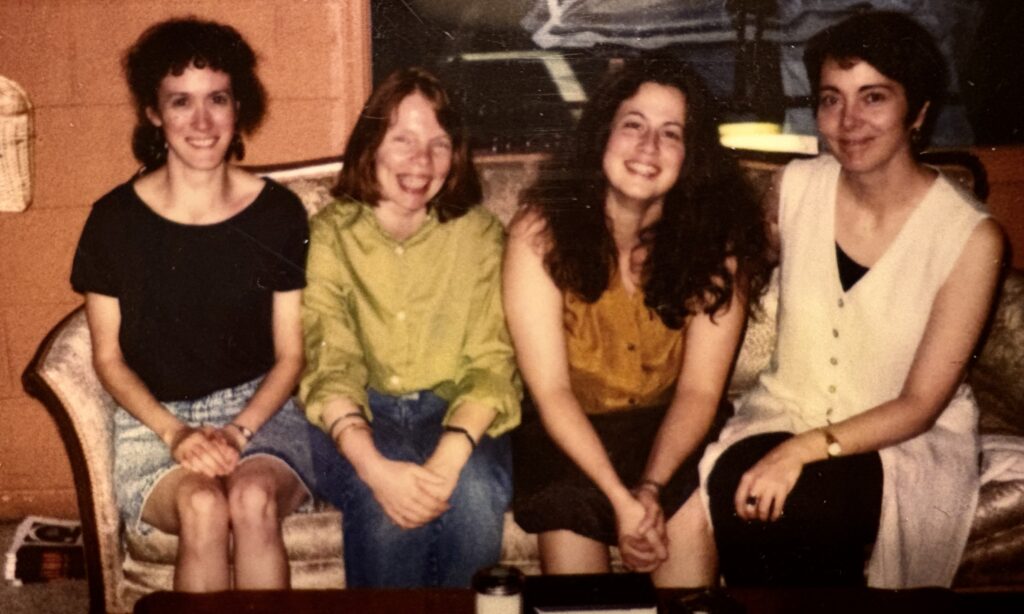
Hipchen: If you don’t mind, I want to start by talking about Claire Bateman, whom I met at Clemson when I taught there in the 90s, and whose poetry I’ve read avidly for years and years. She and Elizabeth Boleman-Herring and I were fast friends quickly. I think there must still be around here somewhere the picture of the three of us on a couch in a café in Clemson looking just like the unformed babies we were, but didn’t think so then.
So, chatting with a friend means one just says more in a much more relaxed fashion; hence the prolixity and informality that follows. It’s me, talking with a good friend, as if still on that sofa 30 years ago.
Hi, Claire, and thank you for asking all these questions.

OK, so to address the first of these: “Transportation” suggests that the whole shebang starts with books, with reading; likely how it always starts, certainly how it started with me. Insatiable reading.
I discovered an article recently that suggests that reading is dissociative and that young readers who read obsessively—how I read from a very early age—are struggling to be present in their own lives. What they do then is cadge other lives in reading stories of and by other people. I don’t know whether that’s what I was doing, but I do very much remember that feeling of being inside a book watching and just—being—in my favorite stories, being with people and animals who didn’t know I was there but who, in a way, depended on my presence to exist, or so I thought. I remember the first time I opened a book, and it occurred to me to wonder what the people were doing when it was closed, what they did when I wasn’t watching them. It was a real shock to find a duplicate copy of a book, in fact. Who were these people, what were these stories, that they could proliferate like that? I felt them so singularly.
So always, stories for me have been a way to be elsewhere. In my own writing, that means elsewhere in my own perception of the past, things gone and never maybe as I knew them, but only (now) as I know them and in language. A consciousness that I was constantly narrating, recalling, imagining, creating, arranging, making sense of, making language of my life—that came surely after a childhood of both reading and practice constructing stories.
I remember standing in my shower as an adult just after having been contacted by my birth parents. The water was as hot as possible. I was trying to recall myself, because I felt I was falling, like out of an airplane, into grief, and I couldn’t figure out what I was grieving. Until it came to me that for decades, I’d been storying my mother into being—all wrong, of course, the reality nothing like anything I’d imagined. In that shower, in that moment, I realized that all those stories I’d been telling to myself about her were just poof—gone—unavailable. I could never purely imagine her or her life again. I can’t now remember well what I’d been telling myself all those years. Knowing the reality of her burned out all the other stories. I was desperate in that moment; I think it makes me a little desperate now to remember it. It felt like I was losing my mind.
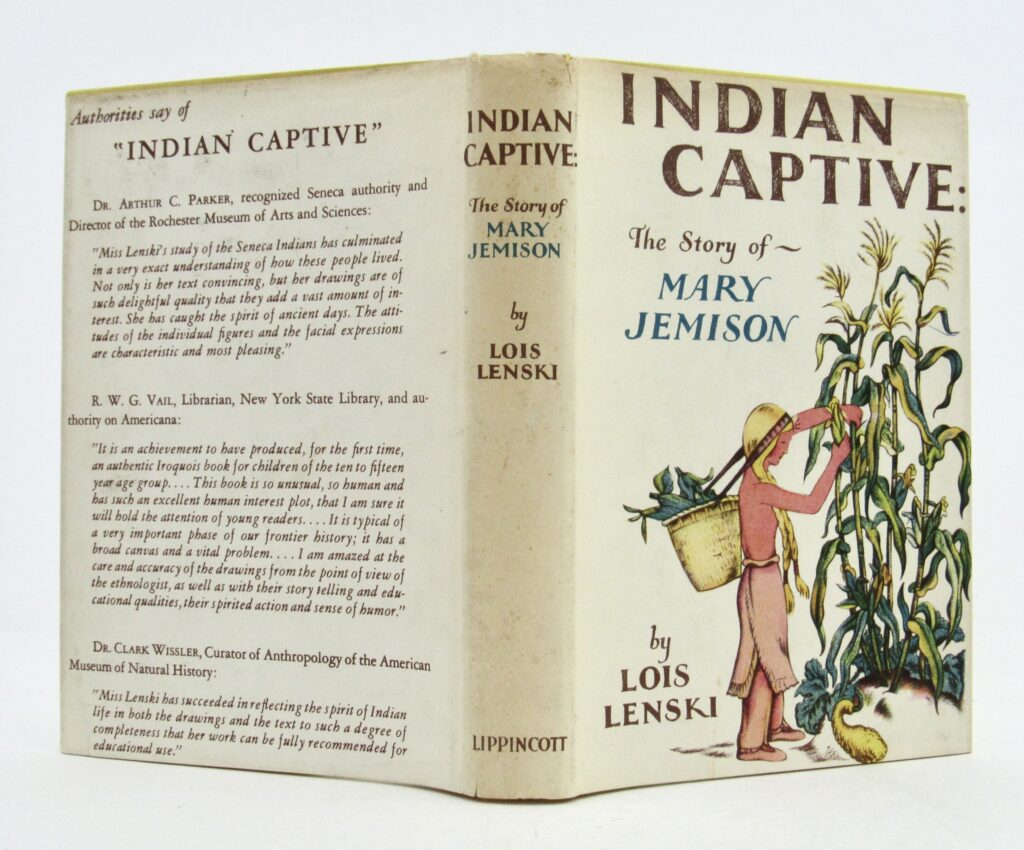
When I was a very little girl and could read better than most kids could, my teachers sent me to the library during reading lessons. At the library, I wanted only one book: Corn Tassel, a book I have never found again in that form—a children’s book, with lots of illustrations on thick, slick pages. I would read that book, turn it over, read it again, happily, over and over again for hours. The book was a children’s adaptation of Mary Jemison’s capture and adoption by Indigenous people—she was a replacement child for Indigenous children slaughtered by whites. The story described how she was loved and valued in her adoptive home. We love the stories we love as kids, I think, that tell us about other people who have a tentacular grasp on our own lives somehow.
But my other favorite stories were any that my brother was reading, the deal particularly sweetened if I could steal the books without his knowing and I could color and write in them, so that they were never how he left them. Many were about little boys; most were about the sea and pirates. I loved the thievery and cleverness of pirates. I loved thieves, full stop, but pirates got the ocean, too. They seemed to claim everything and nothing. I liked thinking about that power. I think reading stories and imagining stories became, eventually, writing stories and then externalizing them so that other people could read them. Like the people who made the books I read.
Bateman: Can you write about how you grew in your relationship with stories as you got older, how you experienced that tentacular grasp as you grew and changed and got your degrees and lived life and experienced a deep and authentic love in your marriage with Chuck?
Hipchen: I don’t know why I don’t write about horses. For a long time, that’s all I read: Black Stallion, Flicka, Black Beauty, National Velvet, all of them. What I loved about the horse stories, I think, was the horse itself. Human boy, human girl, I didn’t care about them. I felt so anxious when the horse was threatened; I felt hurt when the horse was hurt; I felt indignant that people mistreated them; I felt I was a horse. In short, horses helped me feel and learn hard lessons about hope, failure, transactionalism, unfairness, beauty, death, power. It’s interesting that I can’t remember a thing about the people in those books, just how it felt to be the horse.
There was a period where I consumed Harlequin romances and historical soft-core erotica. I don’t know what I liked about these stories (I eventually saw them as funny). Of course I liked the detail, the clothes, the moments of intersection with history, and I wondered often what it must be like to be so charming and beautiful that some charming and beautiful person would fight for you. But ultimately, I think I was watching how these stories worked. The structure was so overt and consistent. You could see how everything was being used, history, people, everything—all tools. I was interested in how the machinery of the story worked.
And then I encountered Jane Eyre and Pride and Prejudice. The latter I tried when I was 13 because someone told me it was funny. It was not funny. I forgot about it and picked it up again when I was 16 and thought it was hilarious, savage-hilarious. I read later that those three years are the ones in which most people develop a sense of irony, so there I was without it—and then with it, and that changed everything about how I could receive the story. I began to see the differences between what was said and what was meant, which is really key to understanding that kind of story, those kinds of conversations. (I can still be a literalist like I was at 13.)
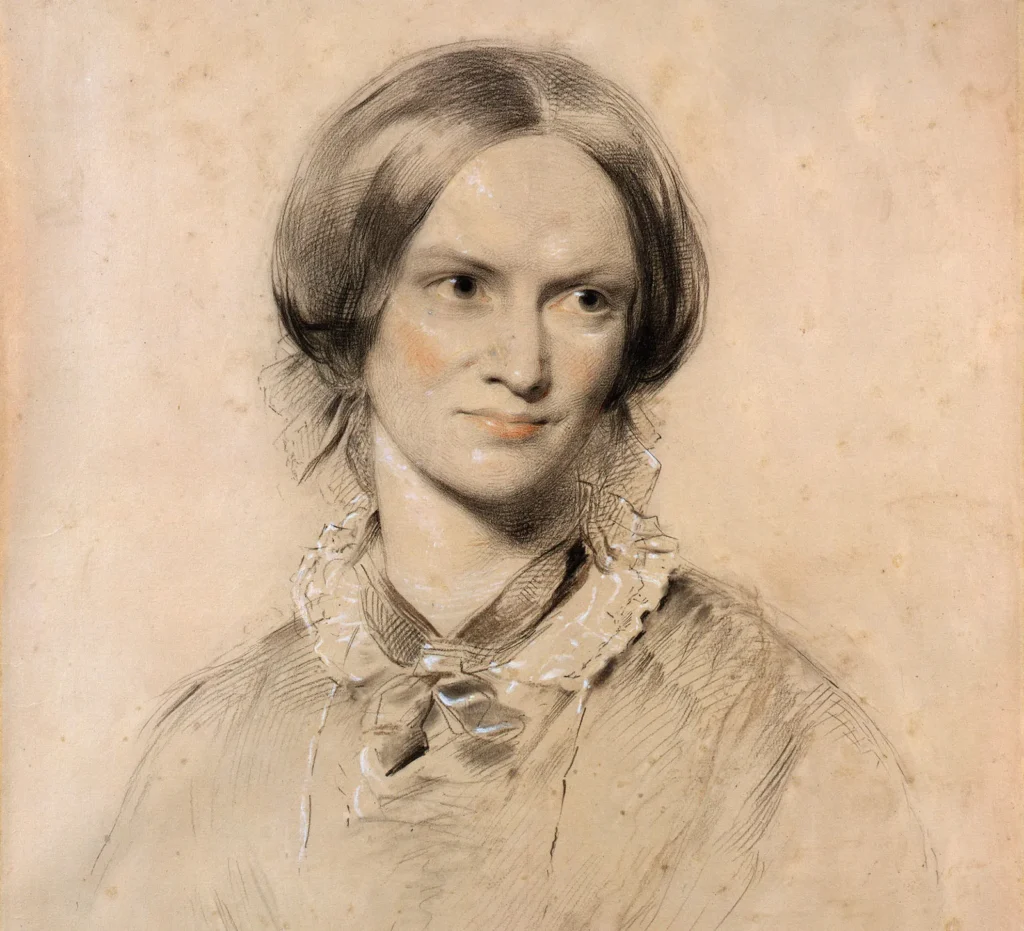
It’s hard to love Austen; the novels are difficult and angry (my dissertation’s on Austen); it was Jane Eyre, though, that I fell in love with, how Charlotte Brontë wrote that overt conventional bullshit story, but then undid it at every step, it’s wonderful. Austen is like this too, but so much more biting. So, by the time I knew anyone to talk to about Eyre, the conversation started with something like: “It’s good he was half-blind and disabled by the time she married him.” I chortled with recognition. What I mean is that everything in that book is trampling the literalness of what I was used to reading, making it clear that the whole enterprise of suborning young people into love as a prelude to marriage, as a harnessing of their reproductive labor—well, that was another way of making them horses, or little boys, or anything that’s used for anything else. Eyre for me is almost the perfect novel, aside from Frankenstein, which has its own resistances to all the things that people are lured into, especially by stories.
Which is not to say love is somehow inherently bad—my relationship with Chuck, my husband, was utterly transformative, different from but equally as life-changing as my relationship to my families or career. But it is to say that romance can be a machine like a story, or a system like a story, that has a purpose in a larger system that rests solidly on making people into things in order to use them. And I do think that if you read Eyre and Frankenstein, really any of those novels, you can see that there’s no either/or in this, either—that one attends to the constraints and artifice but feels most alive watching Heathcliff suffer for Cathy. That scene where he digs her up and holds her and makes sure his dust and hers will mingle after death! Or that scene in which Jane, wandering on the moors about to throw her life away as St. John’s sacrifice in India and hears Rochester calling her name!—or a thousand other of these moments. This feels and feels deeply even as the stories show crushed people in the machinery of social life and heterocoital patriarchy. I’m not sure what to call it exactly since it’s this admixture of patriarchy, Christianity, racism, classism, imperialism, God knows what else. Categoricalism, maybe, into which individuals are sorted. Human social life, probably.
I think in a sense one needs stuffing with any trope to then see that trope undone and to write it that way. And so, adoptions, Mary Jemison, pirates, horse books, and romances led to the rest of it.
Bateman: Please give us a little taxonomy: what kinds of books tend to “work for you” and what kind don’t, and what does this say about you, the shape of your passions, fascinations, and aversions? How has this informed your own writing?
Hipchen: I like books that speak privately or intimately to me. I like books that remind me how small things matter and how life is full of the possible, the mostly unrealized possibilities that become a kind of ghostly crowd of might-have-beens that haunt what is. I think, often enough while I’m reading, about what the story might have been had just this thing changed, or that detail been omitted or half-expressed. I think this often, about just living.
I posted recently that I think sometimes being born—just being born! Not even writing about it!—is opening a window and crawling through it into some strange place better viewed behind glass, too loud, too many voices, too many big things elbowing out what matters, which is usually almost the smallest thing you can imagine. How anyone has patience for the importunance of catastrophe, I don’t know. I am seriously irritated by having to swallow huge events as if they’re the only drivers of changes. It interests me much more how little it takes to shift any story into a different one, not surprisingly maybe, but somehow surprisingly. I am fascinated with the story of a famous person—I forget now who—who died of a mosquito bite.* Or the stories of anyone’s rescued pet, full of near misses and almosts, and such small tweaks could have meant entirely other narratives. I love how this kind of thing affects not just what happens but who one becomes. Had my birth family kept me, who might I have been? Had I been left at the orphanage? Had another family adopted me? The accident of geography that meant I could be adopted at all—and that’s just the one event, early in my life.
I like the instability, the other possibilities, of stories and how stories get tied to individual becoming. We are dependent utterly on the particulars, susceptible to acts that feel like agency (whether they are chosen or not is undiscoverable). In stories as in life there is this sense of capitulation to the past tense, that stories even in the present tense settle out somewhere in the past.
It’s that contingency made up of small, almost negligible details, that make a story appealing to me. Big things, blowing up things, impossible people who are too good or too bad, unmotivated collapse or growth that seems too quick or unclearly caused—that seems pointless to read, to me, maybe because I go to books for the machinery of the real: for how a few random plot points or character traits produce what seems inevitable. Attached to this is serious attention to the smallest things in any sphere of perception and failures of that attention, too. I’m always thinking about how the smallest least attended-to gestures can, observed carefully, show you all the things that weren’t and why—all the effects small, barely perceived motions might have (this is the overt question I ask in “Impediments,” but it’s everywhere in what I write). In a sense, this is how I think I see the world as most alive in itself, and most hopeful—boom goes another giant star and a thousand planets are vaporized, sure, but the scale of that is inconceivable or more to the point, unattainable and unaffected by anything one can say, do, think, or be.
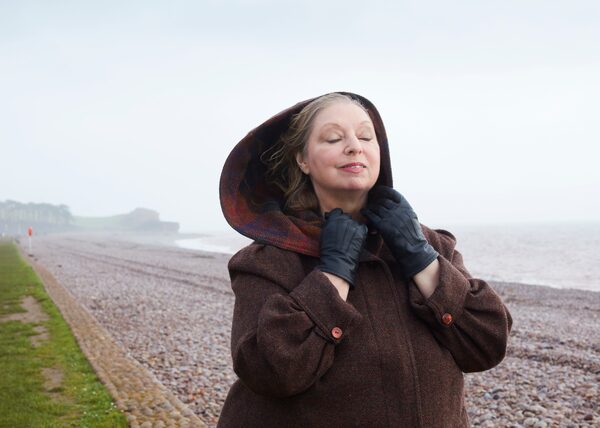
I also like books in a way that’s so much less personal it can seem entirely abstracted. I really like historical fiction, for instance: there is something in a story—say, written by a fabulous stylist like Hilary Mantel—that both says, “I am then” and “I am now.” Books that undo time, but not overtly (the science fiction version of this is too clunky for me, usually) are fascinating, but then what story doesn’t confuse time? I am writing this over a couple of days, into nights, into early mornings, but the time in this set of speculations is always “then” and for you, reading: “now.” [An observation: no one writing their own lives doesn’t screw up verb tenses—the whole genre needs editors simply to render time consistently. I think, in a sense, first-person writing can feel, as you write it, temporally displaced: the now of remembering, but still: remembering.]
One of the tests of a good book for me, and this is a cliché I know, is that it bears re-reading over a lifetime, and that each re-reading is a new version of the story. I am writing now about Frankenstein as an adoption novel, not at all how I read it when I was a teenager, nor how I was taught it, nor how on most days I think about it, nor how I taught it myself to sophomores. It creates big questions, shifting questions, asks me to look again and see differently, and frankly I think does and has done that for lots of people for the 200-plus years we’ve been reading it. Maybe all I mean is that the book is open enough for a long enough period that it can become a common conversation about what is generally important and temporally unbound—what matters to people regardless of the moment or who they are. Maybe I mean stories with whom one can have a relationship. Not a hook-up, not a dalliance, but a relationship.
Bateman: I’m fascinated by your remark about “a story, or a system like a story, that has a purpose in a larger system that rests…solidly on making things out of people in order to use them.” In telling your own stories and the stories of the people you know, and also in your academic exploration of adoption, in what ways do you seek to reverse that process, to restore personhood? (And it strikes me that you do this with animals as well.)
Hipchen: One of the things I do in writing classes is ask students who want to write about their lives to stop participating in them and to find a corner from which to watch. I tell them: when you write about other people, real people, you have to find a way to use them. All writing is using, life writing is using real people, and it’s one of the most challenging things about it, for me. That is, I recognize that what I do is find stories in my lived life and make them into material. Most people just live, I mean; I am wandering around noticing what I can use.
I am unhappy with this; I would rather be the kind of person who lets people (and myself) alone and just, I don’t know, doesn’t tell about them or render them on the page, or lose them in my own thinking of them. I don’t know that I do, or can, honor their livingness except by never writing about them. Writers always take someone and trim them to the box they’ve made, reducing the cloud of possibilities that are the context of every life to the story they want to find. And that’s never humanizing. Even this kind of writing is that kind of writing: this isn’t me, it’s me talking about a me that writes, and I couldn’t and wouldn’t produce myself fully here. Why should I? It’s a lot of words, I know! But I am not in this here like you may imagine (and you are imagining me, I know that too). I’m not being shifty or cagey, or maybe I am—all I mean is that you and I, everyone and I think everything, is bigger and different than what can be said about it or what it can say about itself. I know this is also a kind of cliché.
Sometimes I think that’s lonely, that this business is lonely, but then I think about the capacity for loneliness in most of the writers I know, and it’s huge, like a tolerance for gluten or clutter.
Awareness doesn’t undo the urge. I think, for me, to write stories is to succumb to a fever. I never understand fevers in other people, for sex or drink or procreation or cleanliness, but that’s a failure of analogy. One day I will stop writing, but it will only be because I have stopped being able to write. I could make the choice to write fiction, and have. Or poetry, and have. They interest me less and less as I age, though, for reasons I can’t quite fathom. The best I can do is say that nonfiction compels me because of my fascination with what-if, with alternate realities, with trying to find my way into some other place or time that I can imagine down to the studs and out again. The longing for otherwise is huge and displacing and dissociative, thus to pin myself to what is, is a kind of anodyne. But a false one, right? Because the what-is I produce is artful, arranged, manipulated. I feel saner, doing nonfiction; it’s as false as anything, though.
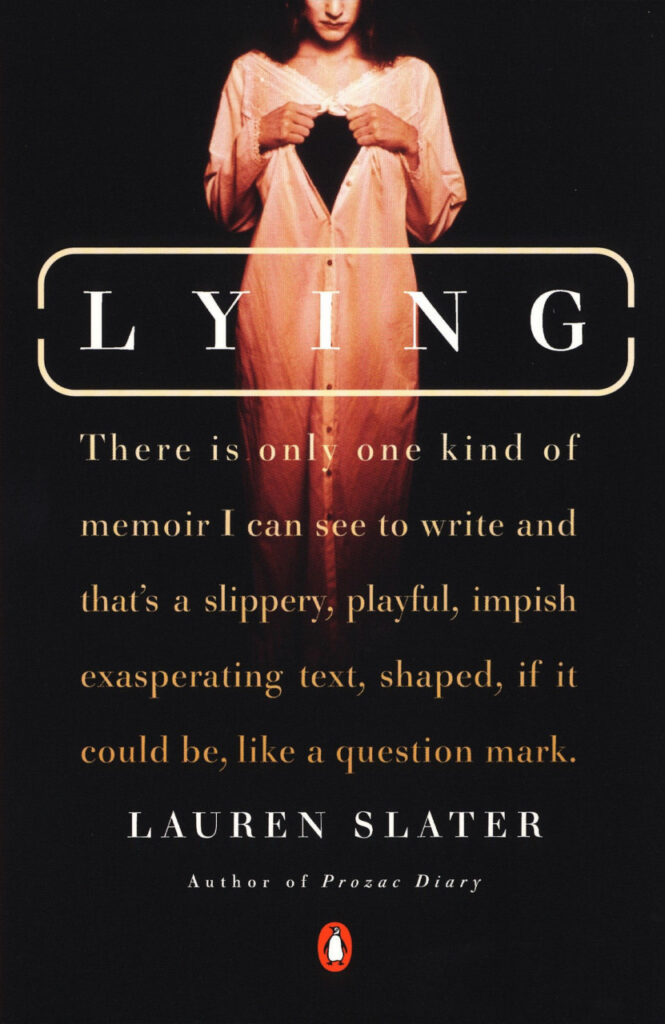
Another favorite book: Lauren Slater’s Lying: A Metaphorical Memoir. Many of my colleagues dislike it or find it dubious or so undoing of their work that it’s distressing, or that it so deconstructs genre and identity that it upends fundamental beliefs. I like that about the book; I like that it blows through diagnostic identities, the absolute metaphorically of language, the exigencies of copyright—every authorial shibboleth you can imagine. Gone. It’s hilarious, it’s profound, and I want everyone who wants to write about themselves to read it. Fundamentally it says: you are not a singularity, no story is intimacy, there are no unique personal truths you can tell, diagnosis is simply a way to pin you down in someone else’s definition, your parents did and didn’t make you, every story is everyone’s story, and on and on and on. Its premise, a playful one, is “how can people who lie, which is all of us, say anything truthful about ourselves except by lying in all the ways possible?”—well, one of its premises. It’s fabulous.
So, for me, the only ameliorating thing I ever try to do (and I am no Slater) is that cliché of modern character creation: not to settle people absolutely into the things they remind me of. I try to leave a bit of space for them to be contradictory and to escape what I can say about them. I think I do that least well with my father, better with animals and possibly with Chuck. Chuck objected to his portrayal in “Gator Bites”—he said it made him look like he wasn’t careful with me. We had that conversation, I listened, I changed nothing, because we agreed in the end that we had neither of us been careful, which is what my mother pointed out at the end of that story, in her way. He liked best his character in “Broody,” though I never asked why. I suspect it’s because he’s accepting, kind, amused, busy, and nerdy there, and no one, not even the baby chickens, was likely to die. My mother, who read everything and said nothing, can be quoted as saying (which she did, having caught me writing love letters when I was 17), “never write down anything that you don’t want people reading in the papers the next morning.” I suspect this is her ventriloquizing her own mother or some other woman who wanted to guard her reputation from scandal in the 1940s and 50s. She was forced to wear girdles and gloves until the 1970s; I think of this as a metaphor.
There are people I simply don’t write about at all, though I’ve known them and there are stories. I don’t write about them because I feel that would be wrong. People have asked for a direct sequel to my adoption memoir, Coming Apart Together—a relation of my experience in reunion, literally that, though of course Animal Husbandry is a kind of gestural sequel, or sequel by stretchy analogy. But I don’t know how to write the book they’ve asked for, yet or ever, simply because I am not sure how to write again about my birth family. The distance makes it hard; that and the pressure to make it an argument, somehow, about—something, adoption, abortion, fate, I’m not sure. I’d much rather not make that argument, or do it outside having to make people into characters I move around in plots.
And then there’s this: to me, animals are as interesting as people, and they have busy, complicated personalities and character, just like people; the distinction to me is superficial. People are also animals, just animals some people privilege and ascribe with qualities like humanity, a misnomer if there ever was one.
Bateman: You remarked, “I loved the thievery and cleverness of pirates then. I loved thieves, full stop, but pirates got the ocean, too. They seemed to claim everything and nothing. I liked thinking about that power.” Is this the power of narration?
Hipchen: I like people who are free in the world, for whom boundaries are there to cross, who disdain ownership as an obligation that goes both ways. Nothing we have here stays ours, is ours. It’s an obligation to give everything up (I am not Christian, but I think Jesus had that part right). I mean, this applies to narrative in all kinds of ways. I’m thinking of Kurt Vonnegut’s diagrams, just as a start. But I am thinking of Beowulf and any oral tradition, I am thinking of the multiple iterations of Frankenstein—there’re over 500 of these now—but also how stories enter how we think, as with Freud in the West or any holy book or fairy tales. I think of Billy Joel’s taking Beethoven into a pop song, or sampling in some pop and hip-hop music especially, but that taking in/on is everywhere (even Beethoven, even the hymn book in Protestant churches).
This carries over into conversations I have often enough about ownership in families: the idea that you own your children, you can do with them what you want, that they “belong” to you in some way that implies they belong to you. In adoption, in families, of course, ownership of children is a central stumble. My mother signed the paperwork that freed me to be adopted; the judge signed the paperwork that created my adoption. My new parents had a right to me even beyond this legal one, but why? I have colleagues who describe this transfer as a kind of enslavement; can you own a human being if that person is a child? Do you own them after their majority in some way (does “my family” include that idea)? What do we really mean by family “belonging” if it doesn’t intersect claims that resemble other kinds of owning? Is the act of relinquishment generosity or surrender? Or coercion? Can any of those apply if the child is never anyone’s in particular? Why does a mother or father of the child’s body have any right to relinquish? Why does any other person have a right to adopt? There’s a whole body of literature about the abolishment of the family-system that centers on some of these questions.
And of course, the stakes get really messy when you start imagining these questions with their particularities intact. If a surrogate has a baby, to whom does it belong, if anyone? If the state is a party in all of this, which it emphatically is, what is its stake and why is it involved? If your egg donor is, say, Lithuanian, and your sperm donor is, say, Ghanaian, and the surrogate is, say, Brazilian, what is the child’s nationality or ethnicity? If it’s born in, say, China, what is its nationality? We sort these things legally, of course, but the difficulties of all this got vivid for me because during COVID, surrogates gave birth and had to parent babies that weren’t “theirs” and to which they had no biological claims aside from having gestated them. Is moving such babies away from their gestators, often across national and sometimes continental lines, a form of trafficking? Is trafficking a kind of stealing, and if so, what is being stolen and from whom? Do you see what I mean about how this idea of thievery and disclaiming ownership are at the bottom of these questions I have and have had for decades?—and these are only the beginning.
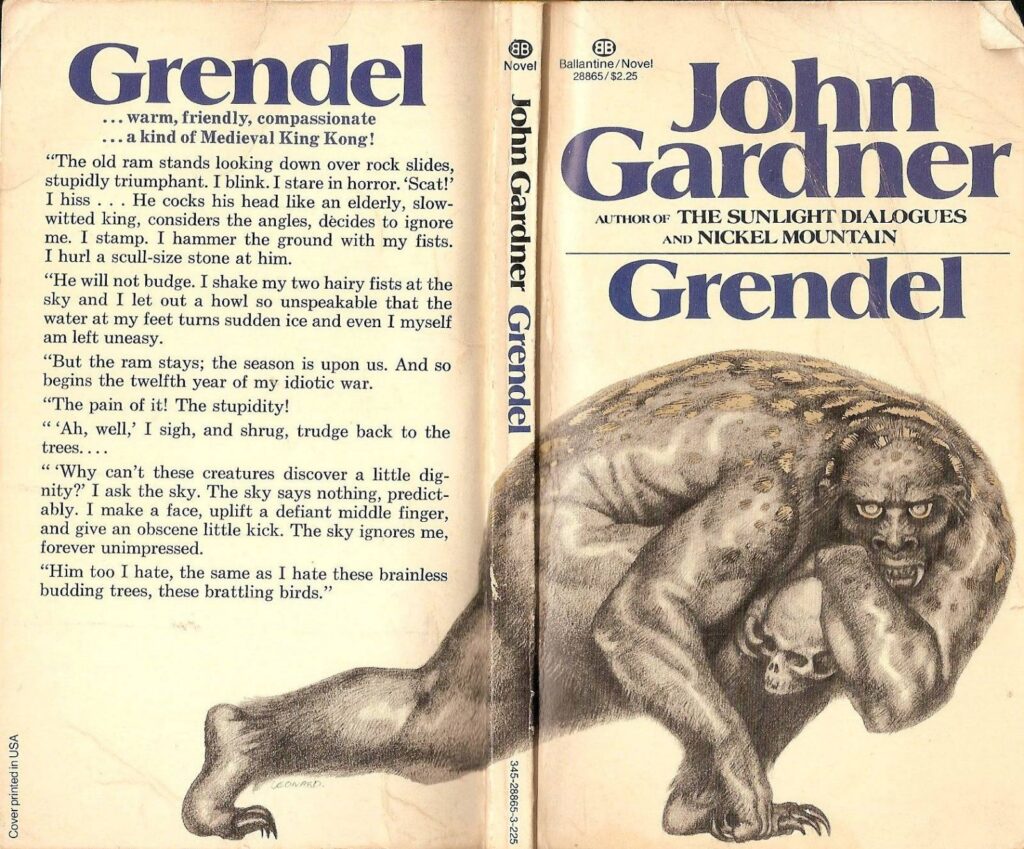
But if we start with the idea that every narrative is essentially stolen (or rather free to use)—there is nothing new under the sun, which is at least Vonnegut’s and Ecclesiastes’ claim—then what’s left to do when you want to tell unique stories? Me, I think what’s left is attention and voice. We have seen novelty approached by shifting attention. This is in part what fanfic is, but you can see it in a lot of places, as in novels like Jean Rhys’s Wide Sargasso Sea, or John Gardner’s Grendel, or in whole movements, as with the ones engaged in texts like Claudia Rankin’s Citizen, or Maia Kobabe’s Gender Queer, or Louise Erdrich’s The Night Watchman, among a lot of others. Shifted attention can also show up simply in the kind of new metaphor you see in a lot of poetry: that little frisson of surprise that you’d not seen that before in that way.
Voice is less attended to, but now with AI, I bet we’ll be coming back to that in spades as a way of thinking about what’s of value in what we read. If a bot can tell you a story, one you’ve heard a million times, then inventiveness and livingness has to sit elsewhere. I’ll bet it’s voice, I’ll bet it’s in that Genesitic moment of literal inspiration, that’s where we’ll begin to take on the bot-dom blando-voice we encounter all the time now.
So: I think narrative is a kind of piracy full stop, if the pirate manifesto is the correction to the hoarders’ one. I remember reading in Beowulf about the righteous murder of the king who keeps his wealth; the disaster of the dragon who burns it all with fire for the theft of a cup and then is itself destroyed. It’s a trope, everywhere a trope, that you must not keep anything, since nothing is yours, not anything at all. I wish it were easier to love and relinquish (and my god, Elizabeth Bishop, what adult hasn’t had enough practice losing?). I’m just writing and rewriting that story over and over again, I think, how to give, how to give up, how to accept that as not commerce but life.
Bateman: This makes me think about how you remark, “Everyone is searching for his last parents . . .” and “Every parent is lost, even the ones who are less than a phone call, maybe even only touching distance away. The problem is universal, its politics never very far from the nerves of everyone who by virtue of being born, being suffered, is looking to reunite.” In this way, too, rather than portraying adoption/relinquishment as singular/separating, you connect human experiences, just as with your emphasis on contingency, which also unites us since no one is ever ultimately safe.
Hipchen: A long time ago, when critical adoption studies was really just getting rolling in its present forms, Adam Pertman insisted that adoption was a narrative all of us encounter in one way or another (Wayne Carp has said similar things). But honestly, I think we alienate a process by disallowing, as familiar, its components. Who hasn’t lost something or someone? Who hasn’t taken someone or something in? My birth mother had five more children, each of them loved and wanted, all of whom individually I respect and love and would not wish out of existence. My birth father on two occasions framed them as replacement children for the one she lost. That’s how he understood it (some of my siblings do, too). We are all born as part of someone else’s story (that’s Carolyn Steedman), but as I’ve been saying, those stories have limited variance.
I am insinuating that adoption difference isn’t difference—if we all lose and take in, then why have a whole discipline or set of questions around adoption? I think because I see the flattening of details in that erasure, and the details are material. In adoption studies, we have been roiling this question for as long as I’ve spoken to anyone about it—why does it feel different if it isn’t?—and looking for the right way to speak about those differences when they can be erased by saying “we have all lost and all taken in. Pish. Same, same.” I want here to say two things, neither original: the first is that adoption creates hierarchies, power structures, moralities, that are necessary to maintain social structures that derive their power from reproduction in families, so that we need to discriminate, as a US senator lately did, between families biologically kinned and those created by other means in order to maintain other power relationships. For this argument written far better than here, I recommend reading Sayres Rudy’s essay in Adoption & Culture on adoptee erasure. He musters the field writ large to talk about these questions (among others). The other thing is that we say things and then believe them and then repeat them and then codify them into law as if they were entirely natural, without question. One of these things is the necessity for identity of knowing where or whom you come from; the best people I know who have discussed this issue in adoption studies are Kim Leighton, Sally Haslanger, and Charlotte Witt. Does it matter to really anything to know your personal past beyond your birth? Whom does that knowledge then serve? What systems does it uphold that ought at least to be in question? Adoptee concern with origins irritates (I think productively) because it destabilizes pat ideas about conventional modes of reproduction and their superiority as not so much natural as useful to certain systems, especially systems of oppression.
This is the long way to saying: yes. Adoption exists, is abjected, and is erased as “not really different” all simultaneously, and that seems to me the kind of thing that I get to talk about in all these forms and books. And so, though I’m only sometimes talking about being relinquished, institutionalized, and then adopted (as with Coming Apart Together, the Companion, and “Feeding the Animals” and “Wonderland” in Animal Husbandry at least), I’m always talking about it/never talking about just that.
[Language is hard. Language is so hard to say truths in.]
.jpg)
Bateman: Finally, does Animal Husbandry feel like a completion of the personal storytelling you began in Coming Together Apart and the community storytelling you facilitated in The Routledge Critical Adoption Studies Reader? And what might some of your next projects be?
Hipchen: I never thought of it that way, no, but it’s possible!
The absolute next thing is the Frankenstein project, which I’ve been on and off developing for six years now—the work comes very slowly for someone like me in a form (scholarship) that makes me intensely anxious. That project looks at what the novel, but mostly its adaptations, have to do with kinship and identity, especially when complicated by the kind of origins The Creature has. In a sense, he’s the perfect study for this problem, who we are as what we came from, as how we were made and by whom, in what process, and of what. That book should be ready late next year (fingers crossed, I’m hopeful and trying to work).
I’ll deliver a paper on Whale’s Bride of Frankenstein in a couple of weeks at a conference on adoption in Leeds (UK). It always bothered me that in the novel, as virtually everywhere, the female creature needs to be both the sexual partner of The Creature and fertile. Why is that? If you look at the last 30 seconds of Bride of Frankenstein, you can see Whale grappling with the problem and then just burning the whole business down, literally. Shelley herself sees the difficulty, but it’s framed in a single sentence in which Walton quotes Frankenstein, so how do you even catch that or take it in? In any case, I began thinking about Frankenstein because a colleague, Ellen Peel, wrote an essay we published in Adoption & Culture a few years ago. It got me to revisit a novel I’d read ages ago and not thought of as about adoption at all. And then I did. Given that The Creature is not an adoptee (though Caroline, Elizabeth, and Justine are), it’s such a strange text to use for this purpose, but I’m finding it both very productive and challenging to work with.
I’m also working on another anthology for Routledge, with a co-editor, Marina Fedosik. We’re collecting expertise on the past 15 years in life writing studies from scholars all over the world, logging the shifts in attention, approach, and discussion on the subject. I also have proposed a textbook for creative nonfiction classrooms, though that’s not contracted yet.
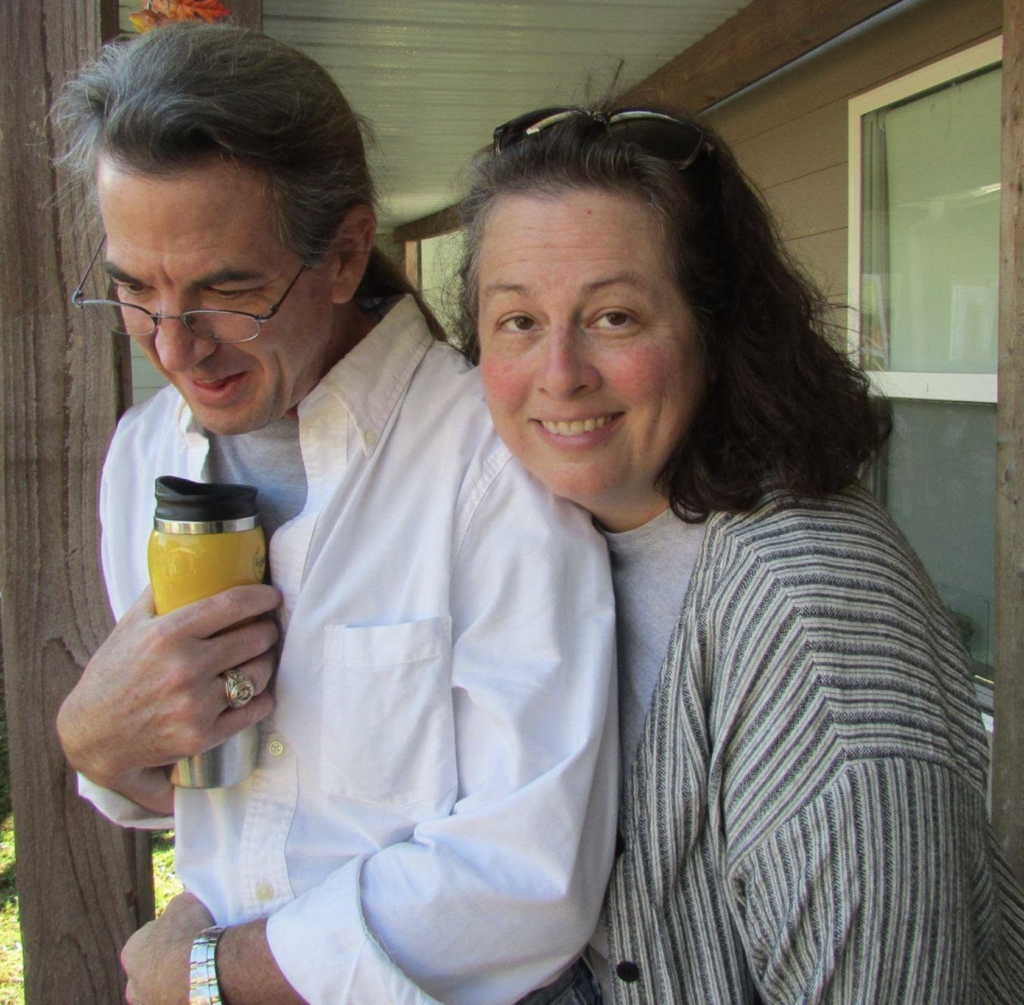
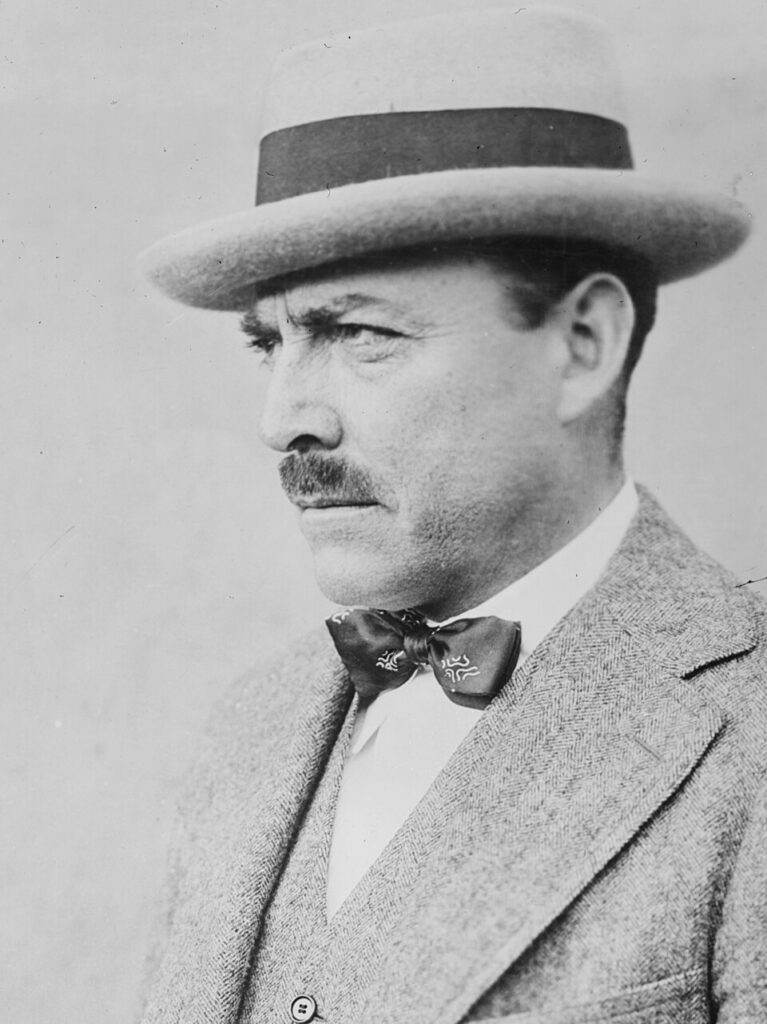
I think, if there’s a last book in me, it’s a biography of Elmer Blaney Harris, Chuck’s great-grandfather, whose work as a writer spanned the transition from vaudeville to Technicolor (he was that long-lived, yes!)—and the film of whose play, “Johnny Belinda,” was nominated for twelve Oscars in 1948, and for her performance as Belinda, won an Oscar for Jane Wyman. Chuck had a very difficult relationship to his doctoral degree, finishing the coursework twice but unable to sit his exams or finish writing his dissertation: he was too anxious, too distracted, too something to complete, as a great many graduate students are. But he was dedicated to his work with Harris, so much so that he left a huge archive of materials that we ported from Illinois to Wisconsin to Florida to Georgia, and that I moved with me to Rhode Island. I have his notes, his thesis (on the same subject), and thousands of pages of journaling, as well as taped interviews with his grandfather, Harris’s youngest son, about his life with his father. In the month after Chuck and I were married, his grandmother Helen, who was the most amazing person I think I’ve ever met, took me aside and said: “Make sure he finishes that degree.” I promised. I could not fulfill that promise. Maybe this will atone, if anything can. It’s the least I can do to keep talking with the person I most loved to talk to.
By the way, Helen is the woman in “Say Five Things” with the faun at the end. The statue is on a shelf here (her picture is beside Chuck’s ashes, neatly fitted into a Borg cube—another story!—on my dresser). I look at the faun all the time and think of her, that moment in her hallway, the way that after her husband died, she lost her sense of taste and ate only Dinty Moore brand beef stew with buttered toast, complaining that nothing tasted like anything at all. I imagine she ate like that for the rest of her life. After Chuck died, eating abandoned me too, for years. The way she died was a scandal that nearly broke Chuck, but that’s another story. Now that his father’s dead, I might write that one, too.
I have found in the past decade that I’ve begun both writing fiction (two partial novels, but you know how that goes, I imagine—they may go nowhere, I may never look at them again) and writing much more closely about Chuck’s last couple of years and death. There might be books there, too, I’m just not sure yet.

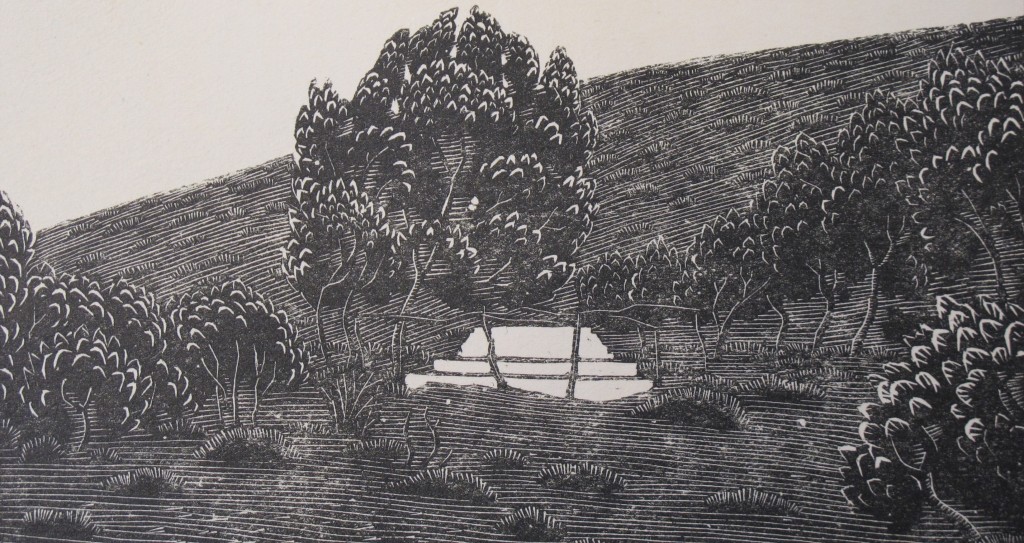
Editor’s Note: It was the poet Rupert Brooke who “died of a mosquito bite,” and who was buried, in haste, at the age of 27, on the Greek island of Skyros. (Find one version of the story in Stanley Casson’s Rupert Brooke and Skyros (With Illustrations by Phyllis Gardner), Elkin Matthews, London 1921.) Brooke’s memorial bears lines from his poem, “August 1914 Sonnet V: The Soldier”:
If I should die, think only this of me:
That there’s some corner of a foreign field
That is for ever England. There shall be
In that rich earth a richer dust concealed;
A dust whom England bore, shaped, made aware,
Gave, once, her flowers to love, her ways to roam,
A body of England’s, breathing English air,
Washed by the rivers, blest by suns of home.
And think, this heart, all evil shed away,
A pulse in the eternal mind, no less
Gives somewhere back the thoughts by England given;
Her sights and sounds; dreams happy as her day;
And laughter, learnt of friends; and gentleness,
In hearts at peace, under an English heaven.

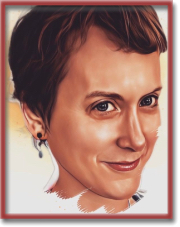
Claire Bateman
Claire Bateman’s books include The Pillow Museum: Stories (Fiction Collective 2); Wonders of the Invisible World (42 Miles Press); Scape (New Issues Poetry & Prose); Locals (Serving House Books), The Bicycle Slow Race (Wesleyan University Press), Friction (Eighth Mountain Poetry Prize), At The Funeral Of The Ether (Ninety-Six Press, Furman University), Clumsy (New Issues Poetry & Prose), Leap (New Issues), and Coronology (Etruscan Press). She has been awarded Individual Artist Fellowships from the National Endowment for the Arts, the Tennessee Arts Commission, and the Surdna Foundation, as well as two Pushcart Prizes and the New Millennium Writings 40th Anniversary Poetry Prize. She has taught at Clemson University, the Greenville Fine Arts Center, and various workshops and conferences such as Bread Loaf and Mount Holyoke. She lives in Greenville, South Carolina. (Please see Bateman’s amazon.com Author’s Page for links to all her publications, and go here for further information about the poet and her work.) (Author Head Shot Augment: René Laanen.)