Home With a Cat

“The first time I’d heard her purring discomfited me, more, I mean, than later when I’d wake up and there she’d be at my ear. I was by myself in our little cottage and sitting on the sofa. The kitten, claws in the tweed, climbed up the side and crouched on the back, beside my right shoulder. Utterly ignorant as I was of cats, I wasn’t sure that purring was what she was doing, so loud was the rasp—almost a growl it sounded like to me. Was she, I wondered, crouching to pounce?”—David Havird
Close Encounters
By David Havird
“Cats liked to occupy liminal spaces: both inside and outside, both tame and wild, both yawn and meow.”—Gail Carriger, aka Tofa Borregaard
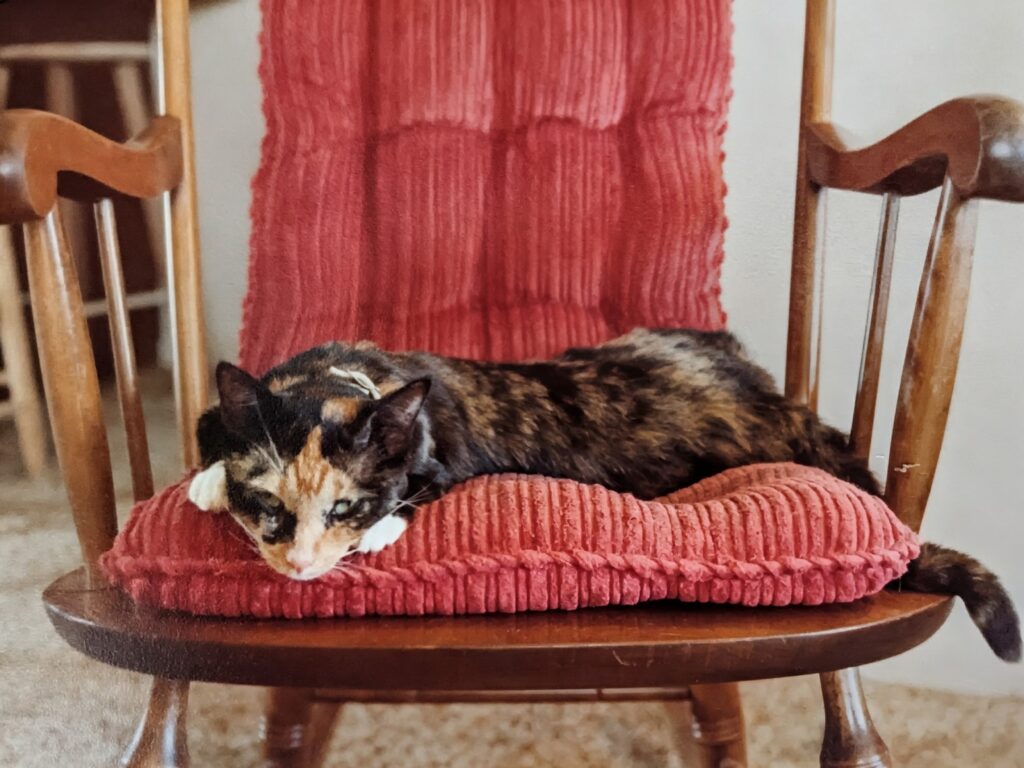
 SHREVEPORT Louisiana—(Hubris)—July/August 2026—Mostly black, but with some white and tan and a smudge of orange on her forehead, she was the most interesting looking of the kittens—also the shyest. “Meeskite,” Yiddish for “a face that could stop a clock,” as we knew from the song in Cabaret, became her name.
It was during the pandemic that I began remembering—not that I’d forgotten—our one cat thanks to some photos not of her nor even from that early time in our life, but rather of a fountain in a mountainside village on Crete, photos taken almost 20 years later, by which time we had a seven-year-old daughter. Homebound by the pandemic and able to travel only in albums that pictured us away, I wound up if not home, where home for us began to be.
We were right out of college, newlyweds at 22, and a job was taking us away from our home state, away from the city where I’d grown up, Columbia, South Carolina, where both of us had gone to college—a six-hour drive away to a small North Florida town that neither of us had heard of: Palatka. Oddly, a friend of my wife’s parents had a sister there. She could help us house-hunt. Whatever place to live we happened to find with her help, we’d be making a home for ourselves, our first. Her family’s cat had just had kittens.
I’d asked for a kitten once when I was a child. A litter had been born under what had been my grandfather’s store, a white-painted clapboard structure on pillars on the other side of the pasture next to my grandmother’s house. My aunt Mabel, an unmarried schoolteacher sister of my father’s, who spent weekends, holidays, and summers there, had tamed the kittens with food, and while I was there with my parents, on what specific occasion I don’t remember, I played with one, a gray one. Some 60 years later, I’m leaning across a wooden picnic table behind the “well house”—I’m holding out a finger; the kitten curls itself around, flops down on the table.
My mother had been traumatized by a cat when she was a girl. She had been sitting on her family’s verandah, her back to the street, when a boy, for whatever reason, meanness, threw from the sidewalk a cat her way. It locked its claws in her shoulders. I begged for that gray kitten. Mother said no.
The adoption of one of those Florida kittens, a calico, became our first act of homemaking.
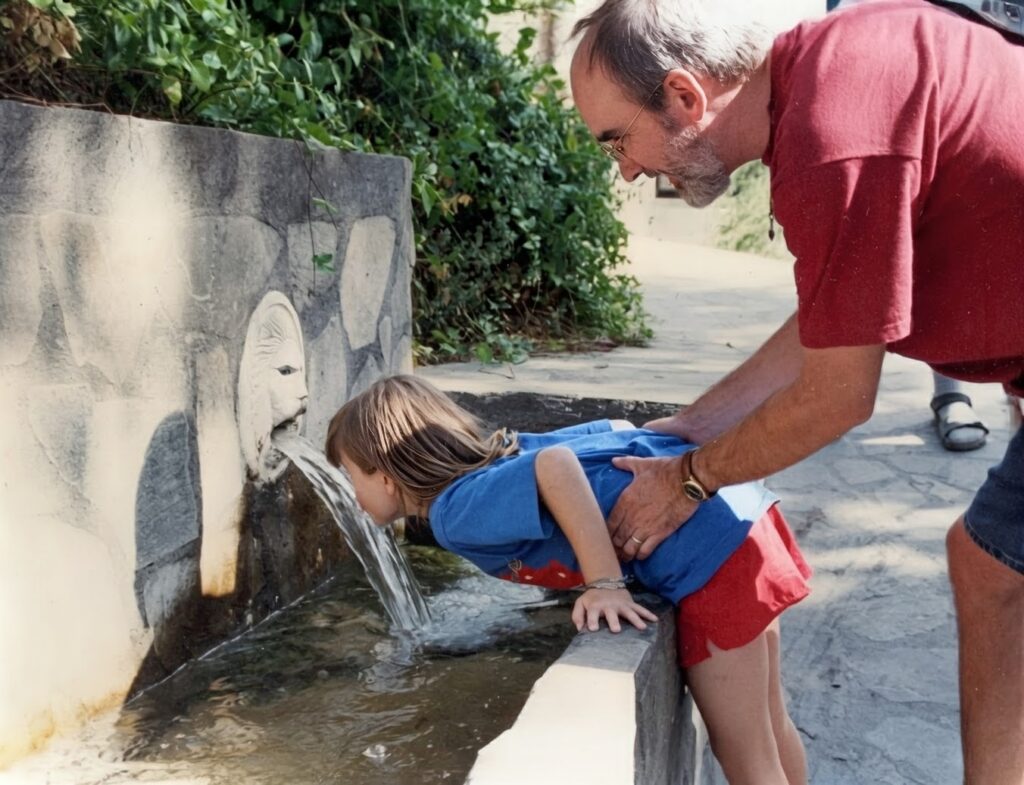
The fountain from which our seven-year-old daughter is drinking in one of those photos (taken even more than 20 years ago)—the fountain, beside a lovely plane-tree-shaded square, was the thing that drew us while touring to Spili: a row of maybe 20 lion heads, Venetian by design, though seemingly made of plaster, imbedded in a low stone wall, a retaining wall it almost looked to be, for the mountainside. With me holding her by the waist, our daughter is leaning over the trough to drink from the mouth of a lion the clean spring water.
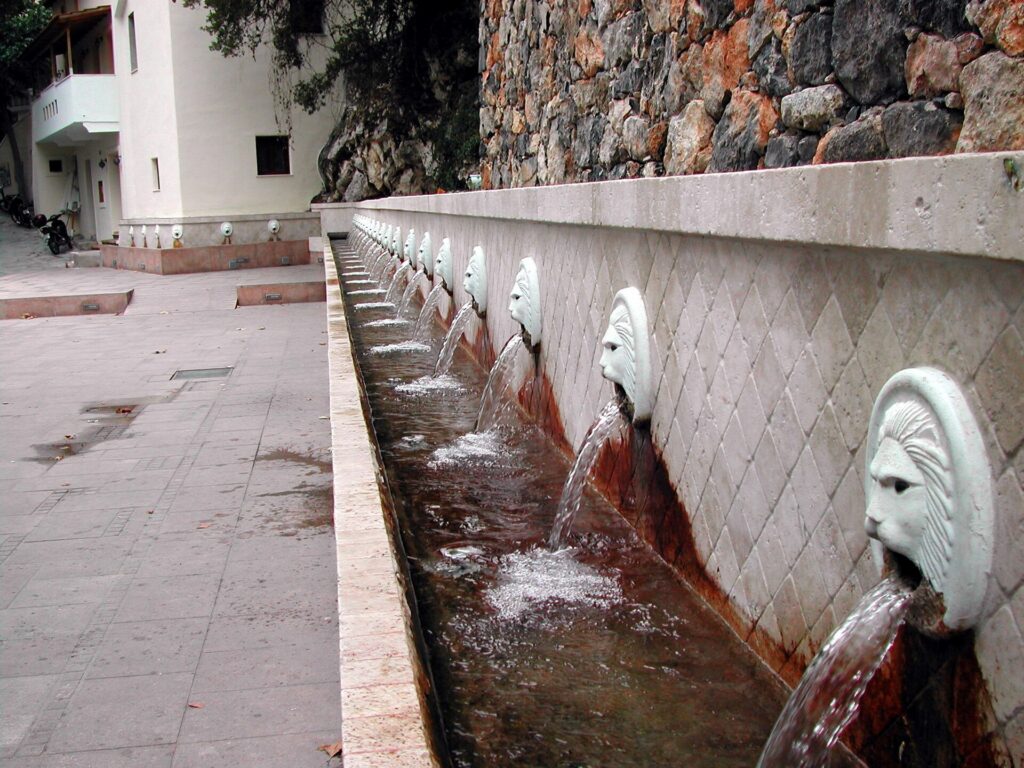

That photo, you see, along with others of that lion-headed fountain, put me in mind of how, as a kitten, Meeskite took to sleeping, curled, in the bathroom sink. This habit amused me at first but then annoyed. I turned on the faucet, and out she shot, a lightning bolt of a cat as in cartoons, its tail in a socket.
I couldn’t have blamed her—or rather my ghost could not—if during the night when I was asleep, she’d snatched away my breath. It did become her habit to spend the night in our bed, and I’d wake up to find her crouched on the pillow beside my head and purring.
The first time I’d heard her purring discomfited me, more, I mean, than later when I’d wake up and there she’d be at my ear. I was by myself in our little cottage and sitting on the sofa. The kitten, claws in the tweed, climbed up the side and crouched on the back, beside my right shoulder. Utterly ignorant as I was of cats, I wasn’t sure that purring was what she was doing, so loud was the rasp—almost a growl it sounded like to me. Was she, I wondered, crouching to pounce?
Her favorite place to nap in the daytime was a Boston rocker with rust-red cushions. This had stood in my bedroom when I was growing up—where I had parked my butt and done my homework or watched TV, a portable TV with rabbit ears, which, like the rocking chair, had moved with us. One afternoon she leapt from the rocker and simply fell to one side, as though that side of her body had lost its feeling. Could she have had a stroke, young cat though she was, a year and some months old? We had to phone the after-hours emergency number—the next time, too! She had, the vet surmised, ingested a blue-tailed “lizard,” a skink whose toxins had temporarily numbed the left side of her body and caused her head to tilt that way and her eyes to jitter. A steroid injection soon set her aright—as did another, some few months later, or could it have been mere weeks?
There was a third incident, which occurred either right before we all three went to bed or else one night when the ornery thing refused to come in when called (as sometimes after we’d been gone for an afternoon)—I don’t remember which. Whatever symptoms she may have experienced during the night, when we weren’t awake to notice, had left her system by morning, all except for the leftward tilt of her head, which made her look forever curious—as what cat isn’t?

Meeskite was going on three when we moved, this time from Florida to Virginia, where I’d continue my schooling. We’d have to meet the moving van tomorrow. My wife had grown up on a farm in South Carolina, and it lay midway between—there we spent the night. Right before bedtime, as was our habit, we let the cat out. When Meeskite didn’t return, there was nothing to do, apart from circumambulating the house in the dark and calling—nothing to do but try to get some sleep. Come morning when she didn’t answer, even when we ventured a ways into the woods across the highway and called, we were beside ourselves. Our initial fear had been that she had been run over—as countless family dogs had been on the two-lane highway in front of the house, rumbling as it did nightlong with eighteen-wheelers. No trace of her there.
What I haven’t told you is that on our way out of that Cretan village, I hit a tabby. It had dashed across a twist in the highway, from right to left—there wasn’t time to brake. Not that I was going fast—not in that “basic” rental of ours. Afterward, I did slow down, of course, and search in the side and rearview mirrors. No trace. I came to wonder if in fact I had run over that tabby. Even so, that night in bed, eyes closed, I pictured the fountain and saw there, in place of the head of one of those lions, the head of a cat, a marble-looking head whose mouth had been smashed, it appeared, by a vandal’s hammer.
Well, she’d show up, my in-laws insisted and we assured ourselves, and there was no choice for us but to hit the road, outrace the moving van to Charlottesville.
It was some time, two or three weeks, before the call came. They’d found “that cat,” my mother-in-law announced. Someone doing yardwork had noticed in a backyard flowerbed some rotten boards—they’d broken through to what he couldn’t tell. But there beneath, in water as in a well—there in the “trap” lay Meeskite. Trap’s what it really was, a boarded-over, forgotten “grease trap” into which wastewater from the old kitchen had drained before the house was remodeled—a concrete shaft, as my father-in-law described, that would have been impossible for even a cat to scale, not to mention a child. When hidden later by the flowerbed, the boards fell out of mind and rotted, and Meeskite, on the prowl, stalking maybe and pouncing, crashed through.
That night on the island of Crete, awake in bed, eyes closed but seeing in place of a lion’s the head of a cat, mouth broken, fountain dry, I managed to contrive a dream, which woke me up, in which a lion crouched beside my bed, between the two twin beds (our daughter’s bed, a foldaway, lay by the sliding-glass doors)—was crouching as though to drink, as I myself had stooped to drink from the fountain, but really to snatch my breath. A rasping sound, whether from my own dry throat or my wife’s or our daughter’s, becoming louder, gasp-like, woke me up.
With that photo in mind of me holding our seven-year-old daughter by the waist while she drinks from that lion’s mouth, I made a poem, which saw the run-over cat as collateral damage during our tactical retreat from a busload of German tourists that suddenly, surrounding us, besieged the fountain.
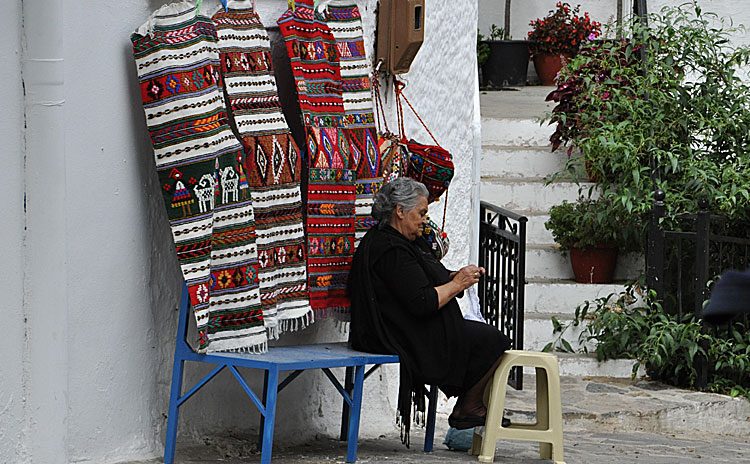
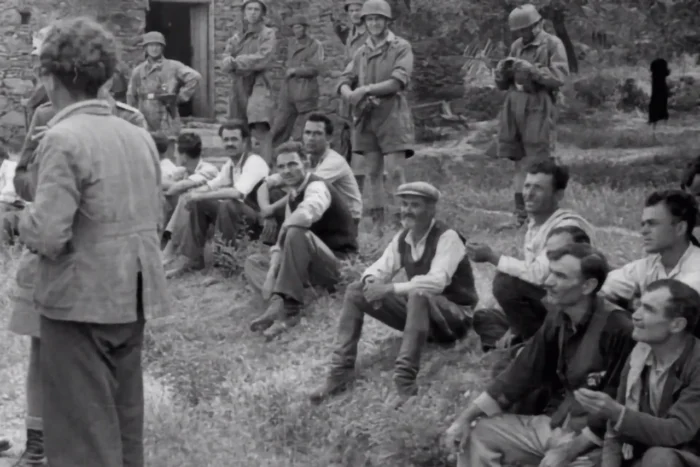
I had sensed a suppressed local hostility to Germans the day before at a bakery (in Margarites) when a sinewy old man had narrowed his eyes and asked me, “Deutsch?” We had visited, three years earlier, another traditional village, Anoghia (the setting, by the way, of a much older poem of mine, “Penelope’s Design”) where there appeared to be a disproportionate number of widows in black wool selling handwoven articles of one sort or another. Every male there and within one kilometer, we learned, had been executed and the village burned by the Nazis in 1944 in reprisal for a guerilla attack on a German detachment.
The order also identified Anoghia as a “transit camp” for the abductors (British) of a German general in 1941—the subject of Ill Met by Moonlight, the 1950 memoir by W. Stanley Moss and the 1957 feature film by Michael Powell and Emeric Pressburger, which starred Dirk Bogarde as Patrick Leigh Fermor, one of the abductors. That scornful-seeming man at the bakery had been old enough to have fought with the andartes. When I replied, “American,” he nodded approvingly, while repeating each separate syllable—for which I was rewarded by the taciturn baker. Afterwards, if for only a day, I took some pride in my nationality. I mistakenly assumed that American forces rather than British, along with Greek partisans, had liberated Crete.
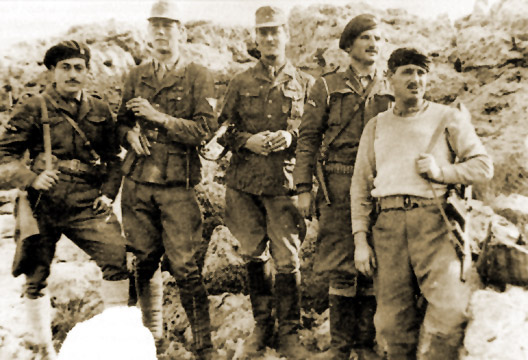

In the poem the tabby became a calico like Meeskite, and one of the fountain’s lion faces became, in the dream at the end, my own.
Collateral Damage
By David Havird
With nowhere to go I find myself in an album.
I’m posing in front of a fountain, a low stone wall
with lion heads in bas relief, like masks—
a hand extended, a stream from one of the mouths,
water that fell through the mountain,
overflowing my palm. Locals were there
with jugs. Our daughter here is leaning across,
hands flat on the lip of the trough,
while I bend over with hands around her waist,
to drink from the mouth of a lion. We’re shorts and tees,
while she’s black wool, a widow, who mimed for our daughter,
“Refresh your face,” eyes crinkling. She’s
outside the frame, while not yet in,
nor ever, the busload of tourists, German,
besieging the fountain. We retreated.
The day before, a different village, whose draw
was its sea-blue pottery. Wife and daughter browsing,
I sought a bakery, there to buy us
a roadside lunch. Dim and acrid it was,
with shelves of baskets lining the left-hand wall.
With tongs the baker, whose arms were rashy-red,
dropped the rolls in sacks. Behind the till,
which sat beside the door, two whiskery men
in ladder-back chairs, one of them playing with beads,
the other smoking, who narrowed his eyes,
the better to ask, if softly, pointedly, “Deutsch?”
Maybe he’d fought as a partisan. Both of them could have,
I figured, alongside the husbands of how many widows?
American, I replied. “A-mer-i-caan,”
he repeated while nodding. The baker motioned.
Hot in there and bright where ovens bulked
and there stood racks of cooling trays—fresh bread,
which he, with tongs, placed in the sacks with the stale . . . .
I’ve traced the route of our retreat from the fountain,
amid hotels, tavernas, markets, homes—
as seen by satellite white concrete roofs
and terra cotta tile, flat roofs and pitched—
from one of which, on the right, a calico, face
an orange smudge, dashed out. No time for me
to brake. In the rearview mirror, despite the thunk
(unheard, thank God, by our daughter with earphones on),
no cat. I’d otherwise have stopped? Later
I squatted to look: a smear, hair black, on the axle.
I lay in bed. The moon cast light through the sheers.
My face, no doubt, was masklike, gypsum,
as were my wife’s and our daughter’s, their breathing hoarse.
A cat, when you’re asleep, will suck your breath,
they tell, or is it the milky breath of a nursling?
A lion crouched by me as though to drink.
The fountain rasped, breath stale, its dry mouth mine.
Charlottesville was never going to be another home for real, however long it took me to get my degree: when in hand, the degree would take us somewhere else. When right away it didn’t, we got ourselves a puppy, while wanting a child, and then, when we quit trying, made a child—with both of whom, a spirited yellow Lab of two and a daughter turning one and trying to walk, we moved a two days’ drive away, to where—three dogs later, daughter on her own (mere blocks away)—we were . . . how long, twelve months or so homebound.
Editor’s Note: David Havird’s poem, “Penelope’s Design,” first appeared in The Seneca Review and in the author’s book, Penelope’s Design: Fourteen Poems.
Penelope’s Design
By David Havird
The Nazis, who occupied Crete,
machine-gunned the men of Anoghia
and torched the town.
The widows took up weaving.
Tablecloths, coverlets, shawls
hang for sale from wires,
while women in black swoop down
as if from telephone posts
on summer tourists—hordes,
odds are, of Germans. You get out
of the rented Fiat Panda,
and buzzards throng.
Yet look at this embroidery,
red birds amid green foliage,
by one who plunged through the cloth
as if beak first with her needle,
leaving within the cotton
weave her sensual self,
while another emerged in black wool.
Now she’s choosing you,
not because you’re you
(or happen to be an American),
but simply because you’ve stopped.
She’d have you choose her work,
and drachmas will prove that you came.
Of course she’ll stay in black,
however scorching the season.
She’ll grasp at the tourists, half of whom
might as well be you
as someone else;
and if that one returned
miraculously home,
would he know her, his wife,
among the anonymous sisters?
Though you could never again
strain uphill to Anoghia
and spot among the pinched widows
the woman whose birds now roost
above your bed at home,
you keep her generous spirit.
And yet those birds overhead
might as well be black,
as night has them appear;
they never sing nor fan
their wings. Beside you your wife,
as if asleep, breathes wordlessly.
You fix your mind on sleep
and dreams, which you never remember.
You’re feeling yourself unravel.
You’re hunting among loose threads
for that one strand, your code,
which only her voice can break
into song. You stream through green,
where she has posed in red feathers.

David Havird
David Havird is the author of three collections of poems, of which the most recent, Weathering (Mercer University Press, 2020), includes prose memoir, about youthful encounters with James Dickey, Robert Penn Warren, Robert Lowell, and Archibald MacLeish, as well as poetry. His poems and essays have appeared in many periodicals, including Agni, The Hopkins Review, Literary Matters, Plume, Raritan, and The Yale Review. A graduate of the University of South Carolina, where he studied under James Dickey, he completed his graduate education at the University of Virginia with a doctoral dissertation on Thomas Hardy. Havird retired from the classroom in 2020 after 30 years at Centenary College of Louisiana. He lives with his wife, the poet and novelist Ashley Mace Havird, and their Carolina dog, Sheba, in Shreveport. (Author Head Shot Augment: René Laanen, Sr.)