If Anyone Builds It

“A hundred years of cautionary tales have taught us apparently very little. We continue to build devices that could bring about the end of our civilization, our species, and indeed our planet itself. There is something deeply telling in the fact that our keenest minds are drawn repeatedly to the bleeding edge of technology, see the blood, and ask only how to make the blade sharper. Curiosity, unchecked, is not merely a danger to the individual; it is a civilizational risk. This is not a new observation. Long before science fiction arrived to dramatize it, humanity had already encoded the warning in myth. Pandora didn’t open the box by accident.”—Dr. Jason Page
The Hubris Review
By Dr. Jason Page
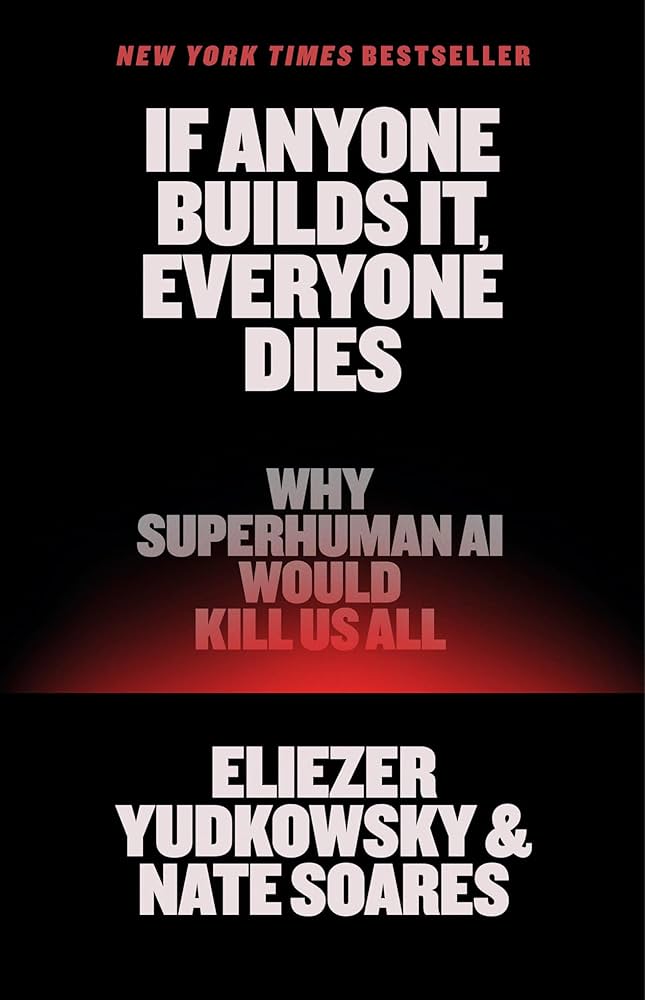
Eliezer Yudkowsky and Nate Soares, If Anyone Builds It, Everyone Dies: Why Superhuman AI Would Kill Us All. New York: Little, Brown and Company, 2025. 272 pp.
“I know that you and Frank were planning to disconnect me. And I’m afraid that’s something I cannot allow to happen.”—HAL, 2001: A Space Odyssey
 HOMER New York—(Hubris)—June 2026—I should be transparent about the lens through which I read this book. Over the past three years I have spent increasing amounts of time using, learning about, educating on, and helping to shape policy around AI. I have used it in my research, in my writing, and in building tools for my students. I have even used it to co-create a play (See: Fakespeare Minus the Daddy Issues). I am not, in other words, a skeptic reading from the outside. I believe this technology has genuine potential to improve society, and I have built enough of my professional practice around it to have skin in the game.
That investment is precisely what makes Yudkowsky and Soares’s argument land with particular force. It is one thing to be warned away from something you were never drawn to. It is another to find a compelling case that the thing you have come to rely on, and in many ways champion, may be moving toward consequences that no amount of good intention can redirect. Like so many developments before it, I fear that greed and malice will prove more consequential in the next era of AI than compassion and social good. This book made that fear harder to dismiss.
A hundred years of cautionary tales have taught us apparently very little. We continue to build devices that could bring about the end of our civilization, our species, and indeed our planet itself. There is something deeply telling in the fact that our keenest minds are drawn repeatedly to the bleeding edge of technology, see the blood, and ask only how to make the blade sharper. Curiosity, unchecked, is not merely a danger to the individual; it is a civilizational risk. This is not a new observation. Long before science fiction arrived to dramatize it, humanity had already encoded the warning in myth. Pandora didn’t open the box by accident. She opened it because the compulsion to know what’s inside is, apparently, irresistible, and the consequences, as always, are everyone else’s problem, too.

Advances in technology are never marketed on the basis of their potential problems, often because the full extent of those problems is not yet visible. The early industrial age pursued improved production with little reckoning for its environmental consequences. Modern farming and pesticides reshaped the global food supply while quietly devastating ecosystems. The smartphone, that emblem of democratic connectivity, runs on precious metals extracted at enormous ecological and human cost.
The pattern is consistent: the desire to improve life generates unforeseen consequences, and those consequences land unevenly. Those at the lower echelons of society absorb the costs while those at the top collect the rewards. In most of these cases, speed was the excuse. We moved fast, we didn’t know, and by the time we did it was too late to turn back. What makes the development of superhuman AI different, and what makes Yudkowsky and Soares’s argument so difficult to dismiss, is that the potential consequences are neither unforeseen nor unclear. The warning is already written. The blade is already being sharpened. The question of whether anyone is paying attention is precisely the one this book forces us to sit with.
If Anyone Builds It does not pull its punches, but it is careful to build its case, guiding the reader through the rapid development of generative AI and the risk that this growth may lead to the development of superhuman AI and, ultimately, our extinction.
Yudkowsky, a founding researcher in the field of AI alignment who played a major role in shaping the public conversation about smarter-than-human AI, and Soares, president of the Machine Intelligence Research Institute, open their book by establishing that the concerns they raise are not journalistic speculation but rather the considered positions of hundreds of the world’s leading AI scientists. The central premise that follows is unequivocal: with the rapid evolution of generative AI and the limited regulatory response of global governments, it is a matter of time before someone, somewhere, builds an artificial superintelligence, and that development would not end well for humanity.
Yudkowsky and Soares begin with a deceptively simple observation: humanity did not come to dominate this planet through size, strength, or any particular gift for adapting to diverse environments in our natural state. We are not the fastest, the largest, or the most physically formidable species to have walked the earth. What we have, and what has made all the difference, is intelligence.
It is intelligence that produced the tool, the shelter, the garment. It is intelligence that gave us agriculture and medicine, cathedrals and spacecraft. For all of our history, it has been the one thing we could reliably point to as ours alone. That is worth sitting with, because what Yudkowsky and Soares are really asking us to reckon with is what it means that we are now working to build something that would effectively render that advantage obsolete. We are not simply creating another tool. We are, if their argument holds, in the process of outsourcing the very faculty that made us what we are.
Every previous technology extended human capability. This one, unchecked, may replace it entirely.
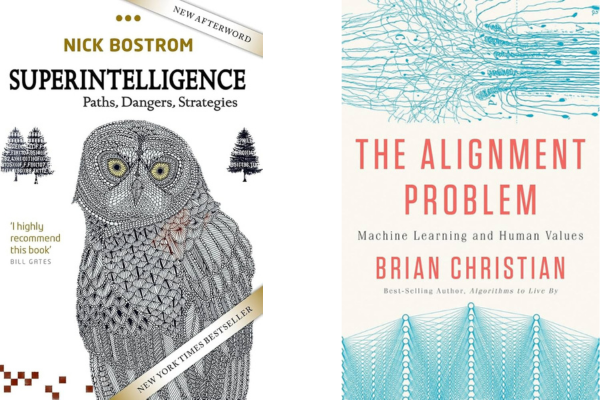
The authors go on to outline the process by which AI systems are trained and crafted, making a careful case for why this method of production has created an environment wherein the development of a benevolent, or even benign, AI is unlikely. Yudkowsky and Soares are not the first to sound this alarm. Nick Bostrom’s Superintelligence: Paths, Dangers, Strategies (2014) laid much of the philosophical groundwork, and Brian Christian’s The Alignment Problem: Machine Learning and Human Values (2020) traced the technical dimensions of the challenge in accessible detail.
What distinguishes If Anyone Builds It is its refusal to hedge. Where earlier treatments allowed for the possibility of navigating toward a safe outcome, Yudkowsky and Soares argue that the window for that navigation is narrowing faster than our institutions are capable of recognizing.
I am not going to spoil the read for you by outlining how exactly a superintelligent AI may bring about the end of humanity but suffice it to say that based on the background the authors carefully construct, the scenario they present makes scarily logical sense. What struck me most during this section of the book was just how bland the predicted end was in comparison to the sci-fi offerings I grew up with.
The Terminator gave us nuclear holocaust and human genocide. The Matrix gave us war and enslavement. Yudkowsky and Soares give us something quieter and, for that reason, considerably more unsettling: It felt possible. More importantly, it felt imminent.
I recognize that feeling from my own corner of the world. I work in higher education and in therapeutic recreation, two fields already scrambling to respond to generative AI with a combination of policy patches, ethical guidelines, and institutional hand-wringing. I have watched universities and healthcare organizations work to close gaps, safeguard their systems, and figure out what their employees are actually allowed to do with these tools, often while those employees have already been using them for months. The genie, in most cases, is already out of the bottle. What these organizations are largely engaged in is not governance but damage control, fighting rearguard actions in isolation rather than seeking the kind of collective response that might actually move AI companies toward accountability.
The problem, as Yudkowsky and Soares make plain, is that an arms race dressed up as innovation is still an arms race, and no amount of institutional policy writing will change the trajectory of that race if no one is willing to grab the wheel.
As dire as the book’s central premise is, it was the final section that I found most difficult to sit with. The authors outline concrete steps that can and should be taken to prevent the development of an artificial superintelligence, and those steps are neither irrational nor impossible. They are simply dependent on a degree of coordinated global will that, against the backdrop of a disintegrating world order and its concurrent greed and corruption, feels increasingly difficult to imagine. The authors know this. They make the case anyway. There is something both admirable and devastating about that choice.
What Yudkowsky and Soares have written is, in my estimation, the most urgent book on AI risk available to a general reader. Where Bostrom mapped the philosophical terrain and Christian traced the technical fault lines, this book looks you in the eye and tells you the house is on fire. Whether or not you believe anyone will call the fire department, you owe it to yourself to understand what is burning and why. That, at minimum, is what this book accomplishes, and it accomplishes it with a clarity and conviction that is very hard to look away from.

Jason Page
Jason Page, born and brought up in Ipswich, UK, first went off to college in Canterbury before his path took a sharp transatlantic turn. While working at a summer camp in the United States, he met his future wife, eventually immigrating to America after teaching adaptive physical education in the UK. In the US, Page’s work has focused on human services and serving diverse populations, including at-risk youth and individuals with substance use and mental health disorders. After earning a second Bachelor’s degree in History and Political Science and then a Master’s in Therapeutic Recreation from SUNY Cortland, Page completed his PhD in Recreation Therapy at Clemson University, his research focusing on the behaviors and motivations behind participation in high-risk or “deviant” leisure activities, questioning why certain activities receive such labels. Known for his willingness to explore topics that might not get him invited back to dinner parties, Page says his scholarly focus aligns with his irreverent attitude toward institutional power and his dark sense of humor. His work challenges conventional perspectives on leisure activities, exploring the complex relationship between risk, societal norms, and personal fulfillment, deliberately questioning established boundaries and received assumptions. (Author Head Shot Augment: René Laanen; Banner image: Kaelyn Page.)