On the Avenue
“My husband is not only a clarinet player born in the Bronx, he is also a man who knows the five boroughs of New York like the back of his favorite reed. I deeply admire the way he plays the Mozart Clarinet Concerto and the zany notes of Stravinsky’s three pieces, but also the way he knows all the highways and byways without using GPS. (‘Turn her off!’ he snaps whenever I consult my phone for instructions.) He prefers to find his own way by sniffing or some other method that I don’t possess or remotely comprehend (given an opportunity to self-navigate I automatically drive in the incorrect direction). So for our trip into the Bronx on a Saturday night for a dinner date and concert I spent most of the ten-mile journey with my eyes squeezed shut and my arms hugging myself. This is because my nervous system is much like that of a small animal’s—a chipmunk, perhaps, or a rabbit.—Kathryn E. Livingston
Words & Wonder
By Kathryn E. Livingston
“The Bronx? No thonx.”—Ogden Nash, 1931
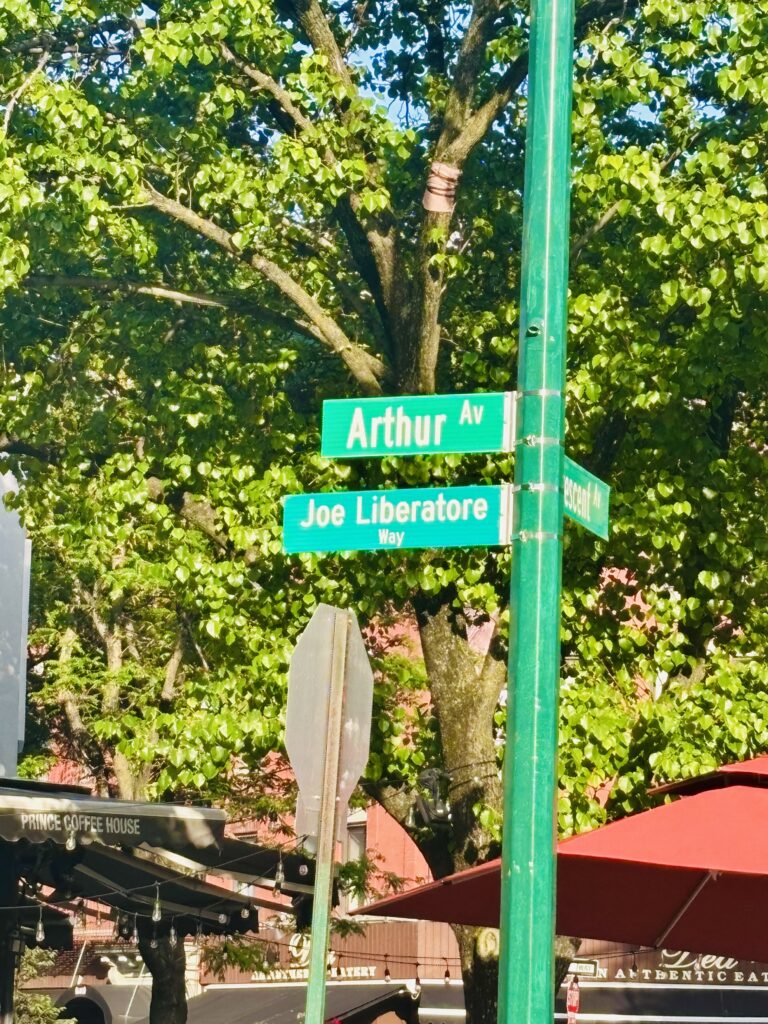
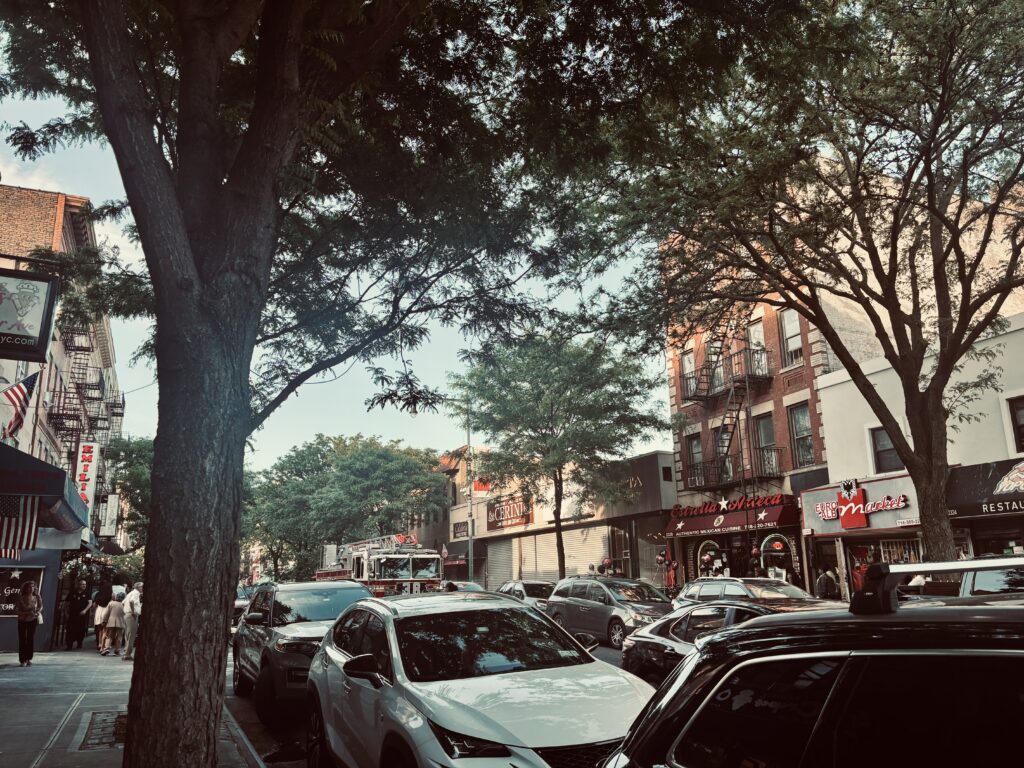
 THE BRONX New York—(Hubris)—July/August 2026—The Bronx, as perhaps you know, is an exciting place. The streets teem with human beings of all shapes and kinds, from all over the world. Cars double-park everywhere. Traffic is a horror. But there is a vibrancy, a pulsing, that reminds me of Beethoven’s frenetic Grosse Fugue, Op. 133. There is no getting away from it or around it; the Bronx is a phenomenon, and it is fully alive.
This busy borough (pop 1.4 million) is approximately ten miles from the mile-square New Jersey town—which doesn’t possess a single high-rise—in which I reside. My town is close to Manhattan as well. With a 25-minute bus ride from my 1906 bungalow to the Port Authority, we live in a perfect location for a musician-and-writer couple seeking a small-town feel for raising three kids, with quick and easy access to Lincoln Center.
I knew nothing about the Bronx, a place I’ve always ignored or feared (A Bronx Tale, anyone?), a rough area except for the zoo (do monkeys fight?), and the botanical gardens. But over the years my clarinetist husband has performed there quite often and frequently returns waxing poetic about a certain restaurant row called Arthur Avenue. He took me there once years ago, and I did long to return. But packed spaces rife with humans have always overloaded my fragile nervous system—I once nearly melted down on a visit to Hong Kong and I’ve done my time (six years) in Washington Heights when we were first married, having moved there from the bucolic New Paltz, NY.
As a young woman I somehow handled looking over my shoulder each time I entered our apartment (which was broken into twice—farewell my beloved electric typewriter and my grandmother’s pearl and sapphire necklace), but I will admit that the bright lights, taxi rides (no Ubers then), The Village, lunching at Un Deux Trois, the crowds, and of course Times Square, where my office was situated—were invigorating. Still, I was glad to move to the burbs where raccoons frolicking in the backyard at night were less frightening to me than screeching subway trains and potential muggers.
My husband is not only a clarinet player born in the Bronx, he is also a man who knows the five boroughs of New York like the back of his favorite reed. I deeply admire the way he plays the Mozart Clarinet Concerto and the zany notes of Stravinsky’s three pieces, but also the way he knows all the highways and byways without using GPS. (“Turn her off!” he snaps whenever I consult my phone for instructions.) He prefers to find his own way by sniffing or some other method that I don’t possess or remotely comprehend (given an opportunity to self-navigate I automatically drive in the incorrect direction). So, for our trip into the Bronx on a Saturday night for a dinner date and concert I spent most of the ten- mile journey with my eyes squeezed shut and my arms hugging myself. This is because my nervous system is much like that of a small animal—a chipmunk, perhaps, or a rabbit.
One of the brass players from New Jersey had taken several busses to get to the gig; his short trip became a two-hour journey (we gave him a lift home). These folks drive all over the tri-state area in all kinds of traffic and still manage to play a soulful Ravel or a heart wrenching Massenet. They astound me. If one thinks that playing an instrument professionally means mastering an art, one is totally ignorant of what the life is really like: hours of travel, often carpooling with other musicians, often dealing with staggering congestion. One night, my husband missed a ballet because a poor, confused individual had wandered across the West Side Highway and been hit by a car (traffic was stopped for an hour). The show must go on (and it did, without the bass clarinet).
But back to the Bronx, and in particular the Belmont section, which includes Arthur Avenue, also known, I’m told, as New York’s “real Little Italy,” where the mostly young and attractive male waiters at longstanding Dominick’s sat us at a table with two women we certainly did not know (come in a large group and you’ll get a table to yourselves, but a lone diner or couple could end up with who knows whose family). I tried to ignore their conversation (“A glass of wine helps you deal with what you cannot change,” advised the elder of the two) as I dug into my gargantuan plate of eggplant parmesan and tasted Mitch’s chicken picatta.
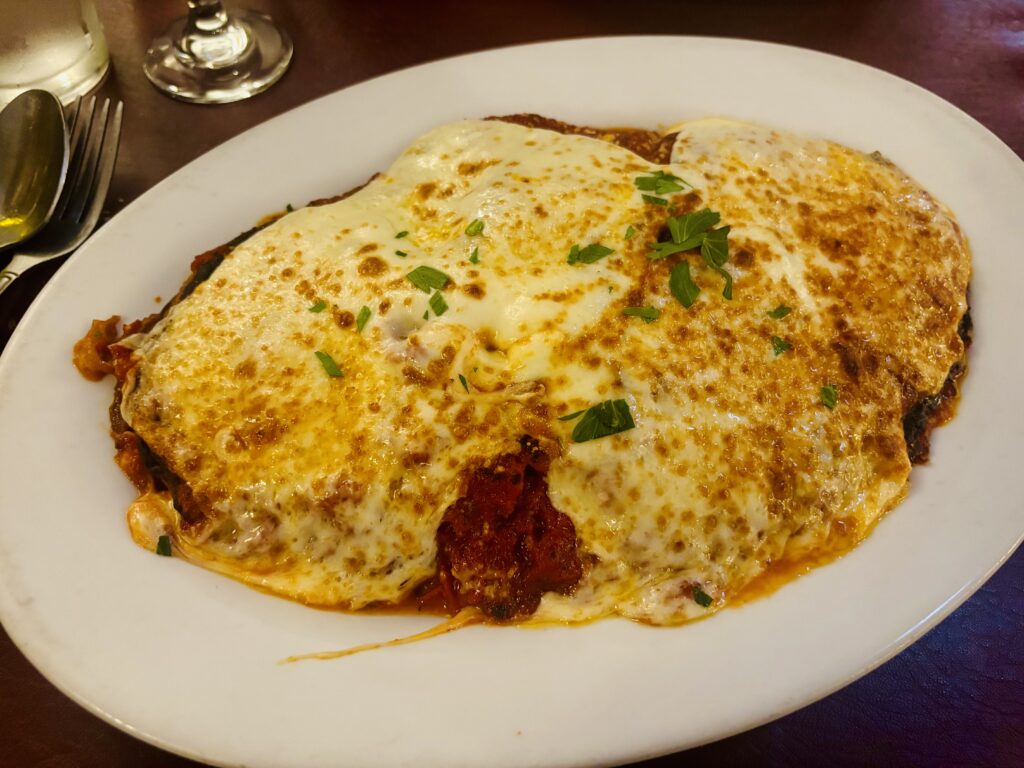
At the end of the meal the waiter doesn’t provide a check. He simply leans in and pronounces the amount you owe. Then you hand him the cash along with a tip and scoot out to make room for other eager awaiting diners. I did stop at a minuscule ladies’ room, commenting to the woman in the other stall that it was certainly cramped. “What do you expect? You’re in the Bronx!” she admonished. Our next stop was a corner pastry shop for a cannoli and iced cappuccino and then on to the concert by the Bronx Arts Ensemble along with a fantastic choir.
At 5 a.m. the next morning, I woke up to the music of mourning doves in my yard. Their song is sorrowful of course but also comforting. I tiptoed downstairs and gazed out the window; a gentle breeze stirred and the leaves in my blackberry patch were dancing. I felt safe and calm, yet I knew that only a few miles from my home the world is cacophonous, noisy, rough and, to someone like me, damn scary. I not only survived but enjoyed another trip to The Bronx, but still I prefer the silent peace of a delightfully dull morning.
These days, I love dull more than ever and as I watched the bees and listened to birdsong, I was aware that in another direction, 19 miles from my house, is Newark, New Jersey, where at the time of this writing there is an ongoing protest against the vile conditions at Delaney Hall, where hundreds of immigrants are interned, having been snatched from our streets by ICE.
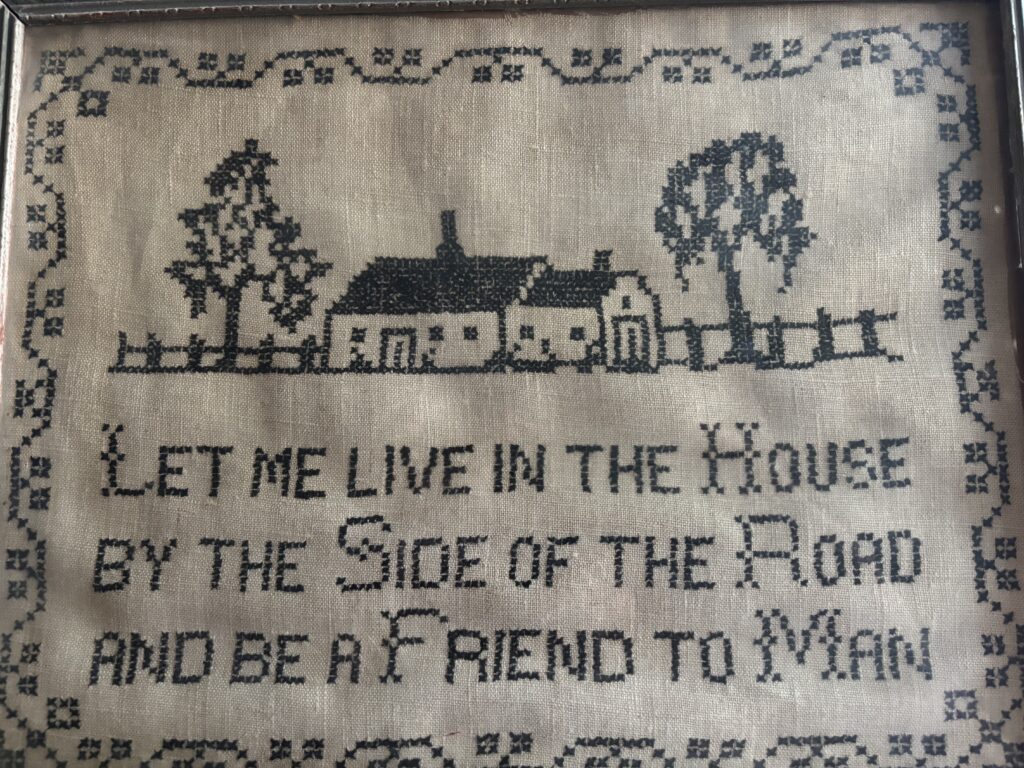
Sorry to end on a sour note, but I find it alarming that peace can exist just a stone’s throw from such torment and inhumanity. I suppose, at my age and in this time, I should be accustomed to this grim reality, but my upbringing is defined by a simple needlework sampler that hung on my parents’ wall and now hangs on mine: In it, a line from a poem written by Sam Walter Foss in 1897 reads, “Let me live in the house by the side of the road and be a friend to man.”
Just as the Beethoven fugue that sounds frenetic, dissonant, and tumultuous, life isn’t even-keeled, and sometimes being a friend to man demands more than waiting for a needful person to pass by. Today, it requires donating, marching, calling, voting, complaining, volunteering, and being active on behalf of ourselves and our fellow humans. So better, I guess, to test one’s nervous system now and then, and get out of the house by the side of the road. Look for some good trouble, and some dissonant notes, and resist the urge—even if you’re a chipmunk like me—to hide and cower.
Editor’s Note: In poetry, as Kathryn Livingston notes above, the Bronx has been immortalized in one of the world’s shortest couplets:
The Bronx?
No Thonx
—By Ogden Nash, The New Yorker, 1931
Nash repented 33 years after his calumny, penning the following poem to the dean of faculty at Bronx Community College in 1964:
I wrote those lines, “The Bronx? No thonx”;
I shudder to confess them.
Now I’m an older, wiser man
I cry, “The Bronx? God bless them!”
And, for those interested, here is the full text of the poem in Livingston’s needlepoint sampler:
House By The Side of The Road
By Sam Walter Foss, 1897
There are hermit souls that live withdrawn
In the place of their self-content;
There are souls like stars that dwell apart
In a fellow-less firmament;
There are pioneer souls that blaze their paths
Where highways never ran—
But let me live by the side of the road And be a friend to man
Let me live in a house by the side of the road,
Where the race of men go by—
The men who are good and the men who are bad,
As good and as bad as I.
I would not sit in the scorner’s seat,
Or hurl the cynic’s ban—
Let me live in a house by the side of the road And be a friend to man.
I see from my house by the side of the road,
By the side of the highway of life,
The men who press with the ardor of hope,
The men who are faint with the strife.
But I turn not away from their smiles and their tears,
Both parts of an infinite plan—
Let me live in the house by the side of the road And be a friend to man.
I know there are brook-gladdened meadows ahead
And mountains of wearisome height;
That the road passes on through the long afternoon
And stretches away to the night.
But still I rejoice when the travelers rejoice,
And weep with the strangers that moan,
Nor live in my house by the side of the road
Like a man who dwells alone.
Let me live in my house by the side of the road
It’s here the race of men go by.
They are good, they are bad, they are weak, they are strong
Wise, foolish—so am I.
Then why should I sit in the scorner’s seat
Or hurl the cynic’s ban?
Let me live in my house by the side of the road and be a friend to man.

Kathryn Livingston
Kathryn E. Livingston was born in Schenectady, New York and lived there in a stick-style Victorian house until she left for Kirkland College (the short-lived women’s coordinate college of Hamilton College in small-town Clinton, New York). In l975, with her BA in English/Creative Writing, she moved to New Paltz to become first a waitress at an Italian restaurant, and then a community newspaper reporter. A few years later, she married a classical clarinetist she had met in high school and moved to Manhattan (Washington Heights), beginning a job as a trade magazine editor the day after their wedding. A few years later, after picking up an MA in English/Education at Hunter College, she became an editor at the visually stunning American Photographer. Motherhood (three sons) eventually brought her to suburban New Jersey, close enough for her husband to moped home for dinner between rehearsal and performance at the New York City Opera. Between baby diaper changes and boys’ homework assignments, Livingston toiled as a freelance writer on the topic of motherhood for numerous mainstream magazines. She also co-authored several parenting books, several photography books, and eventually wrote a memoir of her anxiety-ridden but charmed life and her path to Yoga: Yin, Yang, Yogini: A Woman’s Quest for Balance, Strength and Inner Peace (Open Road Media, 2014). With the kids now grown, and the husband still playing notes, Kathryn enjoys fiddling with words, writing her blog, puttering in her garden, and teaching the occasional Yoga class. (Author Photo: John Isaac/Author Head Shot Augment: René Laanen.)