“The Odyssey” after Christ

“There are not many Christian authors who quote Homer with such frequency or such ease. Fewer still assume so confidently that their readers will recognize Homeric verses without explanation, understand their allusions instinctively, and accept The Odyssey as part of the common intellectual inheritance within which Christianity itself is to be explained. Homer is everywhere in St. Clement’s writings. The question, therefore, for him is never whether The Odyssey should continue to be read. It is how it is now to be understood.”—Dean Kalimniou
Diatribe/North
By Dean Kalimniou
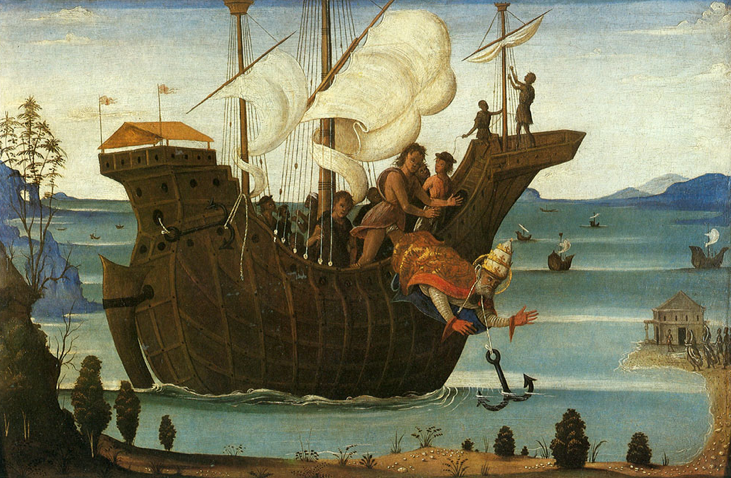
“δεῦρ’ ἄγ’ ἰών, πολύαιν’ Ὀδυσεῦ, μέγα κῦδος Ἀχαιῶν,/νῆα κατάστησον, ἵνα νωιτέρην ὄπ’ ἀκούσῃς./
οὐ γάρ πώ τις τῇδε παρήλασε νηὶ μελαίνῃ,/πρίν γ’ ἡμέων μελίγηρυν ἀπὸ στομάτων ὄπ’ ἀκοῦσαι,/ἀλλ’ ὅ γε τερψάμενος νεῖται καὶ πλείονα εἰδώς.”—Homer, Book I2, The Odyssey
 MELBOURNE Australia—(Hubris)—September/October 2026—Few assumptions have proved more resilient than the proposition that Christianity and the classical tradition existed in a state of perpetual antagonism, that the triumph of the cross necessarily entailed the eclipse of Homer, and that the poems which had educated the Greek world for centuries survived the Christian centuries only despite the Church, awaiting their liberation by the humanists of the Renaissance.
Such a narrative sits uneasily beside the writings of St. Clement of Alexandria. There are not many Christian authors who quote Homer with such frequency or such ease. Fewer still assume so confidently that their readers will recognize Homeric verses without explanation, understand their allusions instinctively, and accept The Odyssey as part of the common intellectual inheritance within which Christianity itself is to be explained. Homer is everywhere in St. Clement’s writings. The question, therefore, for him is never whether The Odyssey should continue to be read. It is how it is now to be understood.
The answer lies in one of the most beautiful images in his Stromateis: “There is one river of truth, but many streams flow into it.” It is an image whose generosity has often escaped notice. Truth remains singular because its source is singular, yet the paths by which humanity approaches it are many. Israel approaches through the Law and the prophets. The Christian Church approaches through Christ. Greece also approaches, through philosophy, poetry, and the patient labor of reason. Homer therefore occupies neither the place of prophet nor adversary, his poems belonging to one of those streams, preserving glimpses of truths whose ultimate source remained hidden from the civilization that produced them. The Odyssey for St. Clement does not become Scripture, yet neither is it dismissed as pagan error. It assumes its place within what the saint understands as God’s long education of humanity.
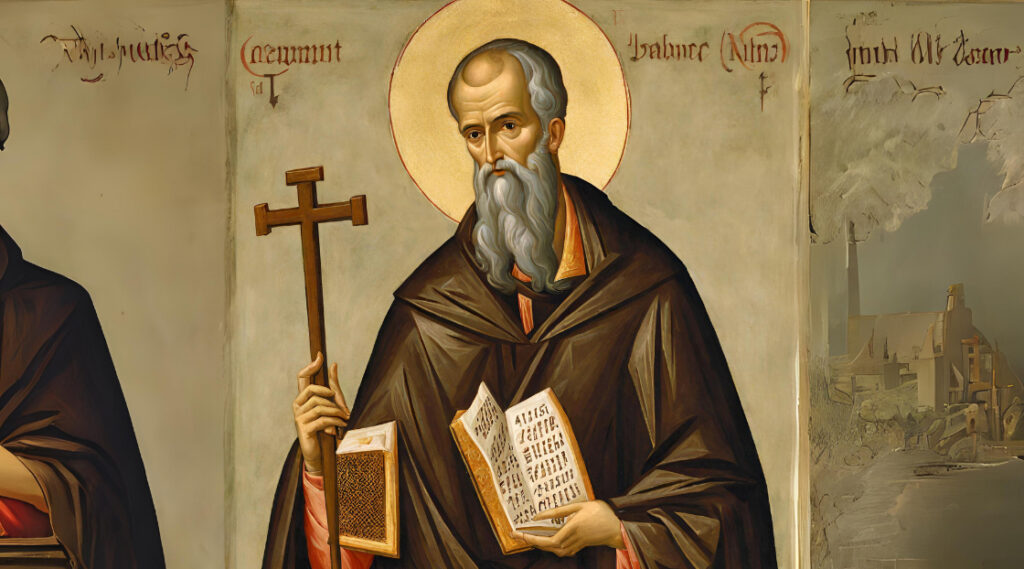
This conviction rests upon St. Clement’s understanding of the Logos. Christ enters history through the Incarnation, yet his existence does not begin there. “Error seems old, but truth seems a new thing,” St Clement observes, only to overturn the paradox immediately: “Before the morning star it was,” and, with the Gospel of John, “In the beginning was the Word.” The conclusion follows with compelling inevitability: “This is the New Song, the manifestation of the Word that was in the beginning, and before the beginning. The Savior, who existed before, has in recent days appeared.” Once that proposition is accepted, Homer can no longer be confined to a world abandoned by God. If the Logos precedes Creation itself, every genuine apprehension of truth participates, however imperfectly, in his activity. The Greek poet, no less than the Hebrew sage, inhabits a universe already sustained by the Word, even if the fullness of that Word has yet to be revealed.
It is precisely here that St. Clement parts company with those Christian writers whose engagement with classical culture amounted to little more than denunciation. He neither suppresses Homer nor apologizes for him. Indeed, he reads him so attentively that The Odyssey becomes one of the principal vocabularies through which Christian theology is articulated. Its images remain recognizably Homeric, although their center of gravity shifts. Helen still offers her Egyptian nepenthes against sorrow. The Sirens continue to sing. Odysseus still sails between danger and homecoming. Yet each episode acquires a further meaning because the voyage itself has been relocated within salvation history. Homer has not changed. The reader has.
The implications of that insight become apparent from the opening pages of the saint’s Protrepticus, his “exhortation to the Greeks.” One might expect St. Clement, having established the eternity of the Logos, to proceed immediately to Homer. Instead, he pauses among the legendary musicians of Greece. Amphion raises the walls of Thebes with his lyre, Arion charms the creatures of the sea, Orpheus subdues wild beasts and even trees yield to the enchantment of his music. St Clement recounts these stories with the ease of a man thoroughly at home in the Greek literary tradition. They are never dismissed as worthless fables, for their enduring appeal reveals something profound about humanity itself: the conviction that beauty possesses the power to transform the world.
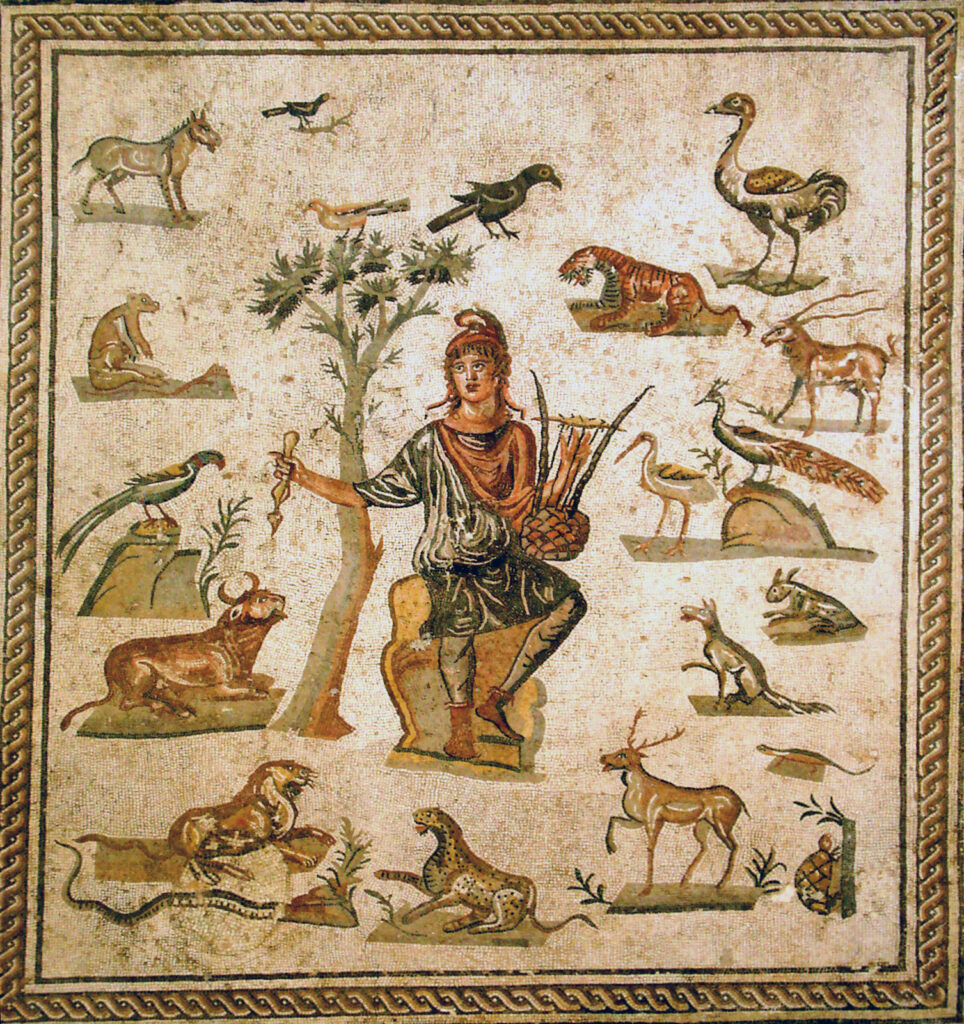
#/media/File:DSC00355_-_Orfeo_(epoca_romana)_-_Foto_G._Dall'Orto.jpg)
Yet beautiful as these songs may be, they remain confined to the realm of myth. They enchant without renewing, delight without healing. St. Clement therefore introduces another musician whose instrument is unlike any the Greeks had imagined: “The instrument of God loves mankind. The Lord pities, instructs, exhorts, admonishes, saves, shields, and of His bounty promises us the kingdom of heaven.”
Music itself has acquired another purpose. The lyre of Orpheus could charm beasts; the song of the Logos restores human beings. St. Clement therefore names Christ’s proclamation simply “the New Song,” an expression whose novelty resides less in chronology than in fulfilment. The Logos who had always spoken through creation, conscience, and reason has now entered history in person. Hence the insistence that follows: “The Word . . . has appeared as our Teacher,” and again, “The Word, who in the beginning bestowed on us life as Creator when He formed us, taught us to live well when He appeared as our Teacher; that as God He might afterwards conduct us to the life which never ends.” The Creator becomes the Teacher before becoming the guide who leads humanity into eternal life. Education itself is drawn into the economy of salvation.
It is difficult to miss the significance of this for St. Clement’s reading of Greek culture. Christ does not appear in order to abolish everything that preceded Him, as though centuries of poetry, philosophy, and reflection had been little more than a catalogue of errors. Such a conclusion would contradict the image of the river with which the Stromateis had begun. If many streams indeed flow towards the same truth, then Greek civilization cannot simply be discarded once the source of that truth has been revealed. Its greatest achievements retain their value precisely because they played their part inhumanity’s continuing education. Homer remains worth reading because Homer helped teach Greece how to think, how to imagine, and how to speak about courage, justice, suffering, and homecoming. St .Clement’s purpose is therefore conversion rather than replacement, inviting his readers to carry Homer with them into Christianity, where the old poem may disclose meanings that neither poet nor audience had previously perceived.
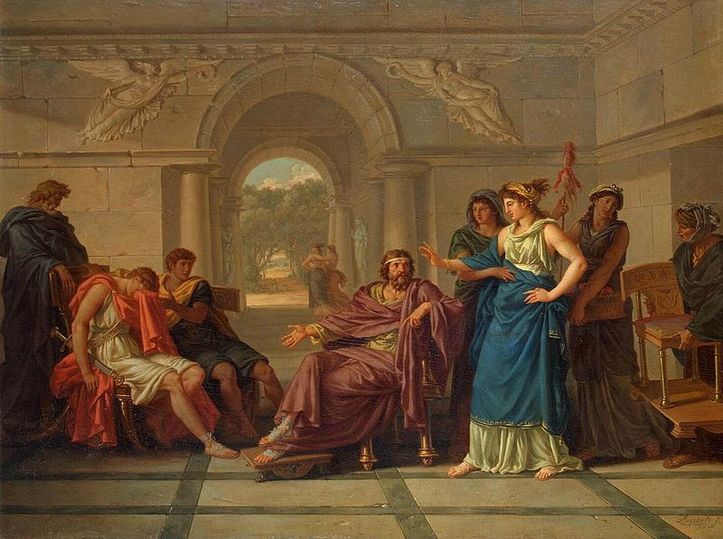

That purpose explains why Homer enters the Protrepticus so naturally. St. Clement never pauses to justify quoting The Odyssey. He assumes that every educated reader knows it already. Homeric verse functions almost as a shared language through which Christian doctrine may be expressed, an approach that reveals considerable confidence in the continuing authority of Greek literature. The poem has lost none of its literary prestige. What has altered is the horizon within which it is interpreted.
The first episode St. Clement appropriates is revealing. He does not begin with the wanderings of Odysseus or the fidelity of Penelope. Instead, he turns to an apparently incidental scene in the fourth book of The Odyssey. Telemachus arrives in Sparta still burdened by the memory of Troy, whereupon Helen quietly pours into the wine her famous nepenthes, “a soother of pain, calmer of wrath, producing forgetfulness of all ills.”
The passage had long exemplified Homer’s fascination with the marvelous, the possibility that grief itself might be suspended through a mysterious Egyptian remedy. St. Clement quotes the line almost word for word, allowing Homer to speak before offering a single comment of his own. That comment changes everything: “Sweet and true is the charm of persuasion which blends with this strain.”
Helen’s medicine remains, yet its efficacy no longer derives from an exotic drug capable of inducing forgetfulness. Healing has passed from pharmacology to the Logos. The true nepenthes become divine persuasion, the Word that quiets the passions by restoring the soul to truth rather than by dulling its memory. St. Clement immediately identifies this healing voice once again as “the New Song.” The transformation is accomplished without violence to the Homeric text. Helen still offers relief from sorrow, yet the source of that relief has quietly shifted. Homer’s image survives intact even as it begins to illuminate a different reality. It is an interpretative method St. Clement will employ repeatedly, reaching its fullest and most memorable expression when Odysseus finally sails towards the island of the Sirens.
The Sirens occupy only a few pages of the Odyssey, yet no episode exercised a greater fascination upon St. Clement. It is here that his method reveals itself in its fullest sophistication, for he neither abandons Homer’s narrative nor simply overlays it with Christian symbolism. Rather, he enters the poem, allowing Homer and the Gospel to speak to one another until the familiar voyage assumes an altogether different destination.
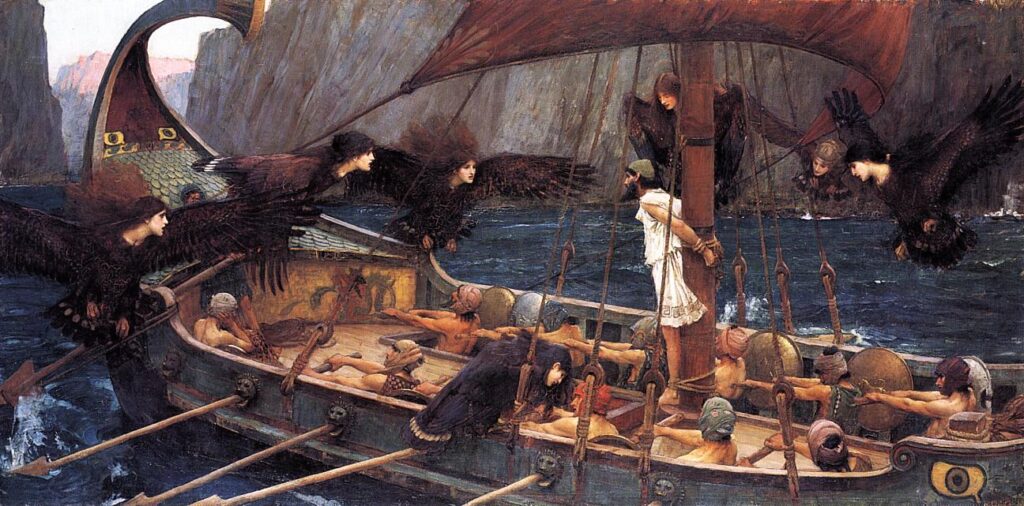
In Homer, the danger of the Sirens lies in their promise of knowledge. Their invitation is irresistible precisely because it appeals to the noblest instinct of the Greek hero. They do not promise pleasure, riches, or power. They promise understanding: “Hie thee hither, far famed Odysseus, great glory of the Achaeans; moor the ship, that thou mayest hear a diviner voice.”
The temptation is intellectual. Odysseus is invited to know what other mortals cannot. Homer therefore presents one of the defining paradoxes of Greek civilization: the pursuit of wisdom, the very quality that distinguishes humanity, may itself become destructive when detached from prudence and self-mastery. Odysseus survives because he refuses neither knowledge nor the journey. Instead, he binds himself to the mast, hears the song, and sails on.
St. Clement recognizes immediately that Homer has described something more enduring than a mythical encounter upon an enchanted island. He therefore shifts the focus before the Sirens themselves have even appeared. The true danger confronting humanity is not curiosity in and of itself, but the quiet tyranny of habit, those inherited assumptions that command obedience simply because they have always been believed. His warning is therefore striking: “Let us then avoid custom as we would a dangerous headland, or the threatening Charybdis, or the mythic Sirens. It chokes man, turns him away from truth, leads him away from life: custom is a snare, a gulf, a pit.”
The observation is characteristic of St. Clement’s entire project. Paganism is dangerous, although its danger lies less in mythology than in familiarity. Error acquires authority through age. Men surrender to it because it is ancient, respectable, and woven into the fabric of ordinary life. In a subtle reversal of the classical reverence for antiquity, St. Clement suggests that age alone guarantees nothing. Truth appears ancient because it belongs to the eternal Logos. Error merely looks ancient because it has endured for generations.
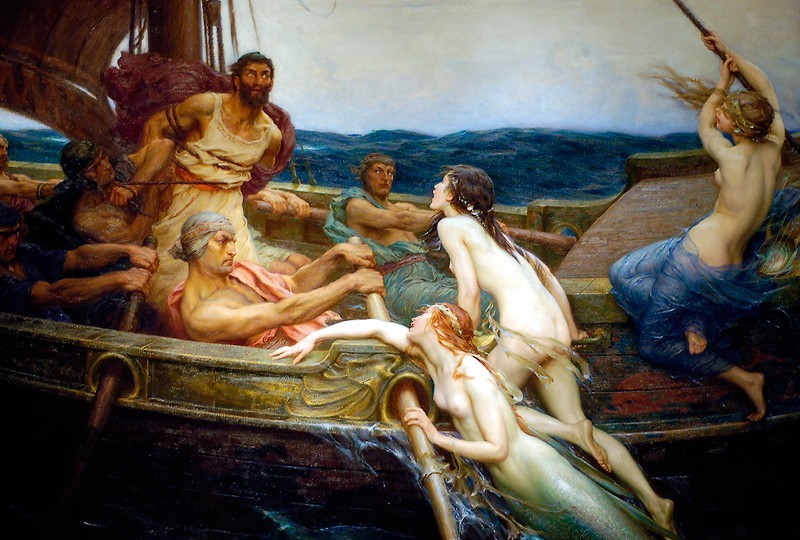
The Sirens therefore become something more pervasive than mythical creatures waiting upon a rocky shore. They are every voice that persuades humanity to mistake custom for truth, eloquence for wisdom, or pleasure for fulfilment. St. Clement’s description grows progressively darker:
“Let us shun, fellow mariners, let us shun this billow; it vomits forth fire: it is a wicked island, heaped with bones and corpses, and in it sings a fair courtesan, Pleasure.”
Pleasure itself has become Homer’s singer. Yet even here St. Clement refuses to abandon the structure of The Odyssey. The remarkable feature of his interpretation is that he leaves Homer’s solution untouched. Odysseus remains the exemplary voyager. The Christian does not destroy the Sirens, silence them, or pretend that their song cannot still be heard. Indeed, St. Clement repeats their invitation almost verbatim: “Hie thee hither, far famed Ulysses, great glory of the Achaeans; moor the ship, that thou mayest hear a diviner voice.”
Then, almost as though answering Homer across the centuries, he writes: “Leave her to prey on the dead; a heavenly spirit comes to thy help: pass by Pleasure, she beguiles.”
What follows is among the most extraordinary acts of literary reinterpretation in early Christian literature: “Sail past the song; it works death. Bound to the wood of the cross, thou shalt be freed from destruction: the Word of God will be thy pilot, and the Holy Spirit will bring thee to anchor in the haven of heaven.”
Everything is recognizably Homeric. Yet each image has quietly entered another narrative. The mast is now the Cross, the helmsman is the Logos, and the harbor is no longer Ithaca but the Kingdom of Heaven. Most striking of all, Odysseus himself has not been replaced. St. Clement could easily have substituted Paul, Peter, or another biblical figure as the model of the Christian traveler. He does nothing of the kind. The Homeric hero continues his voyage, suggesting that the virtues embodied in The Odyssey retain their value once they have been reoriented towards Christ.
Had St. Clement ended his discussion with the Sirens, one might reasonably conclude that The Odyssey served merely as a convenient source of Christian allegory. Yet the Stromateis reveals something far more ambitious. Homer is not simply a poet whose verses may occasionally illustrate Christian doctrine. He belongs to the providential education of the Greek people. The Odyssey therefore occupies a place within sacred history analogous, though never equivalent to that occupied by the Law and the Prophets in Israel. Just as the Jews were prepared through Moses for the coming of Christ, the Greeks were prepared through philosophy and poetry. Homer was one of their pedagogues.
This conviction surfaces repeatedly throughout the Stromateis. Referring to Pythagoras, St. Clement remarks almost casually: “Pythagoras advises us to take more pleasure in the Muses than in the Sirens.” He immediately adds: “Enough for one person to have sailed past the Sirens.” The allusion is brief yet revealing. Odysseus has already shown what wisdom requires. There is no need to repeat the experiment, because the lesson has entered the moral imagination of Greece. Homer has become an educator whose examples continue to instruct long after the poem itself has been composed.
St. Clement returns to the episode once more, observing that “The seductive songs of the Sirens demonstrated a superhuman power, putting all who passed into a state of shock, and inducing them almost despite themselves to accept their words.” Heresy, false philosophy, and inherited superstition succeed for exactly the same reason as the Sirens: they imitate truth sufficiently well to deceive those who lack discernment. Homer had described a permanent feature of the human condition. Christianity merely disclosed its deepest meaning.
It is here that St. Clement’s understanding of divine pedagogy comes fully into view. “He did not now for the first time pity us for our error; but He pitied us from the first, from the beginning,” he writes, before adding that “The Savior has many tones of voice, and many methods for the salvation of men.” Those methods unfold throughout history. “He spake by the burning bush . . . afterwards the prophets uttered their voice . . . . And now the Word Himself clearly speaks to thee.” The progression is unmistakable. God educates humanity gradually, accommodating himself to different peoples, different cultures, and different stages of understanding. Revelation is not a series of disconnected interventions. It is a continuous work of instruction culminating in the Incarnation.
Such a reading has implications extending far beyond The Odyssey itself. It challenges the familiar picture of an early Church intent upon extinguishing the literary inheritance of Greece. St. Clement writes as a Christian theologian whose prose is saturated with Homeric language and whose arguments often assume that his readers know the epics as well as Scripture. The Odyssey for him remains one of the principal texts through which educated Christians learn to think. What changes is the direction in which the poem points. Its authority as literature survives intact. Its religious horizon is transformed. Homer continues to speak, although he now speaks within a world illuminated by the Logos rather than Olympus.
To read St. Clement in this way is also to recognize how inadequate many modern descriptions of the relationship between Christianity and classical civilization have become. They are often framed as a stark opposition, something that St. Clement refuses. His confidence in the Gospel is so complete that he feels no need to impoverish the civilization that preceded it. Homer can remain Homer because truth does not fear poetry. On the contrary, poetry, like philosophy, law, and every other serious human endeavor, becomes one of the means through which humanity gropes towards the Word who has always preceded it.
That is why The Odyssey continues to occupy so prominent a place in the Protrepticus and the Stromateis. St. Clement is writing for Greeks formed intellectually by Homer, and he neither asks them to forget that inheritance nor to apologize for it. He asks them to read it again, demonstrating that a civilization need not erase its past in order to discover a future. The Greek literary inheritance remains visible on every page of his writings, alive, questioned, argued with and, above all, read. The Odyssey emerges from this encounter recognizably the same poem and yet somehow enlarged, its familiar images illuminated by meanings that Homer himself could scarcely have imagined.
It is therefore fitting that St. Clement should leave us with the image that gathers together his entire reading of the poem: “The Word of God will be thy pilot, and the Holy Spirit will bring thee to anchor in the haven of heaven.”
Few sentences better capture his extraordinary achievement. Homer’s ship is still at sea. The voyage is still uncertain. The Sirens still sing. Yet the waters through which Odysseus sails have become, in St. Clement’s imagination, one of the many streams flowing towards that single river of truth.

Dean Kalimniou
Born in Melbourne, Australia, lawyer-poet Dean Kalimniou (also known as Konstantinos Kalymnios) is, among all else, a screenwriter, short story writer, children’s author, and translator well known to Australia’s Greek community. One of the few Australian-born poets writing in Modern Greek, he has published eight poetry collections. As spokesperson for the Panepirotic Federation of Australia, Kalimniou has consistently raised awareness about the plight of the Northern Epirot Greek minority in Southern Albania. As a journalist, Kalimniou has written a column, Diatribe, for Melbourne’s Greek newspaper, Neos Kosmos (New World), since 2001. He also writes regularly for OPA! magazine and New York’s NEO magazine. In November 2007, Kalimniou was awarded a Government of Victoria Award for Excellence in Multicultural Affairs by the Governor of Victoria, Professor David de Kretser. (Author Head Shot Augment: René Laanen.)