The Poetry of Gilbert Allen

“For me, poetry is the psychological equivalent of a chiropractic adjustment. By moving words around and trying to get them in the right places, I bring myself back into a sort of equilibrium. Of course, that equilibrium doesn’t last for very long, and then I’ll get started on another manuscript. I suppose Robert Frost had a similar notion in mind when he remarked that every poem is a momentary stay against the confusion of the world.”—Gilbert Allen
Speculative Friction
By Claire Bateman
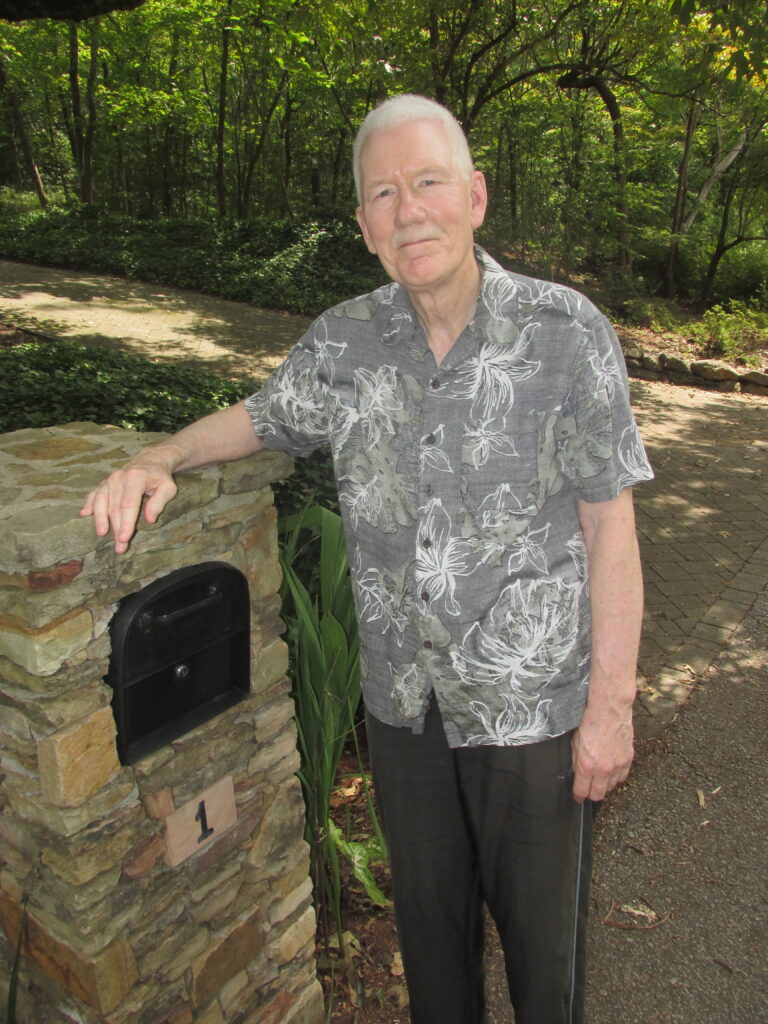
 GREENVILLE South Carolina—(Hubris)—September/October 2026—Born and brought up on Long Island, poet Gilbert Allen has lived on Paris Mountain in Upstate South Carolina since 1977, where along with his wife, longtime teacher and environmental activist Barbara Allen, he has enjoyed gardening on the couple’s three acres of land and serving as a guardian biped for a succession of cats—most recently Ginger Boy.
Allen is the author of two collections of linked short stories and eight volumes of poems, most recently, Stanzas in America, from Measure Press. His long poem “The Assistant” received the Robert Penn Warren Prize from The Southern Review, and his short story “Trash” received Special Mention for a Pushcart Prize.
The Writer’s Almanac, Verse Daily, and Poetry Daily have all featured his poems, and his stories have received the Porter Fleming Award and The South Carolina Fiction Project Prize, as well as a South Carolina Literary Arts Fellowship. Allen is the Bennette E. Geer Professor of Literature Emeritus at Furman University and a member of the South Carolina Academy of Authors, the state’s literary hall of fame. From 1991 until his early retirement from teaching in 2015, Allen edited the Ninety-Six Press, which publishes outstanding work by contemporary South Carolina poets.
Allen writes: “For me, poetry is the psychological equivalent of a chiropractic adjustment. By moving words around and trying to get them in the right places, I bring myself back into a sort of equilibrium. Of course, that equilibrium doesn’t last for very long, and then I’ll get started on another manuscript. I suppose Robert Frost had a similar notion in mind when he remarked that every poem is a momentary stay against the confusion of the world.”

The Janitors’ Concert
By Gilbert Allen
for John Beckford
Before we got there, they’d already folded
the long gray tables, stacking them a half-
dozen deep against the proscenium arch
of the cafetorium. The metal
chairs we usually ate our lunches in
waited for us—empty rows straighter
than any ruler—as we single-filed
class by class, for the awards assembly
marking our graduation to junior high.
I know I won something, like everyone else.
But what I remember is sitting exactly where
Bob Preble had stomped a half-pint milk container
in May, raising a white geyser of laughter.
Now June filled the room with nearly summer.
And then—on that high stage where Mr. Lambert
once held himself cruciform on the curtains
when our band got the music even more wrong
than usual—
the four of them appeared
still in their gray overalls. We wondered where
their barrels were—the ones with tiny wheels—
what last colossal mess they had to clean up.
Walking slowly, leaning into a small arc
widened by their smiles, they started to sing—
these unbarbered men now a barbershop
quartet, their bright voices turning their uniform
drab into the color of sound no symphony
has managed to dim for me in fifty years.
I still can see their faces—black Irish, like
my father, three o’clock shadow—sunlight
from the windows lining the west wall.
Dust motes grace notes suspended in the air
we breathed. They’d probably grown up in New
York City—1920s, along with that
song Heart of My Heart—offering their first music
now to us, to hold in our left shirt pockets
along with our new transistor radios
mimicking their packs of cigarettes.
And when they finished, applause burst from us—
our childhood making its way through our hands
leaving us with nothing but what we’d risen
to become, and no way to know it.
First published in Stanzas in America.

Customer Assistance
An automated villanelle
By Gilbert Allen
We value every caller. Please stand by.
Listen closely for menu directives . . . .
I’m sorry. I don’t understand. Let’s try
to get a few things straight. Can you provide
the full nine-digit zip code where you live?
Thanks so much, Mr. Allen. Please stand by . . . .
Do you know you’re our first priority?
Say yes or press 1 for affirmative . . . .
I’m sorry. I don’t understand. Let’s try
this one more time . . . . Okay. Now verify
your primary account by pressing 5 . . . .
We value every caller. Please stand by.
Remember: It is a crime to falsify
or fabricate the data that you give . . . .
I’m sorry. I don’t understand. Let’s try
to maximize your user quality . . . .
Please hold for our next representative.
We value every caller. Please stand by.
Please hold—
For the Lost Fathers
By Gilbert Allen
Today I’m vacuuming the bedroom carpet—
long overdue—with all the loose furniture
lifted aside, the floor empty as my mind
could make it. I look toward the bureau bookcase
at the Polaroid of my father, pretending
to play an upright piano—a silly gag
a few years before he died—while the word
forgotten seems to breathe from the machine
as if it were a solitary lung
laboring after sixty years of smoking.
I turn it off. I’m one of the few alive
who know his hands couldn’t find the middle C.
So I can’t help imagining this image
beheld by others, centuries from now—
the future holding music visible
but never there. A silent lie. And then
the picture itself, dissolving into dust,
or mold, or fire, within a world that has
forgotten Polaroids, and me, and must
and will forget every last one of us.
I turn the vacuum on, get back to work
and find, next to my father, the blue spine
of Jim McConkey’s Court of Memory,
concluded by “What Kind of Father Am I?”
And in an unrehearsed recitativo
both men insist: Fathers will be forgotten.
But the present always will recall,
remember someone now not of this world—
who once recalled, in his or her own turn,
another being from a world more distant.
Invisible minds holding invisible hands
across the great courtyard of time itself
that does and will reach to infinity
in both directions, making the universe
once and for all whole as the mind of God.
First published in Stanzas in America.
Core Aeration
By Gilbert Allen
It’s touted “to produce a perfect turf.”
But as the buzzing, mud-splattered machine
bumbles back down my driveway—on its way
to a flatbed truck and the next poor patch of green—
my lawn looks like it’s just been bathroomed by
a gaggle of pissed, pellet-pooping geese.
Turds of soil, the size of half-digested
Tootsie Rolls, festoon this living piece
of carpet—that hadn’t been half bad a half-
hour ago. What in God’s name was I
thinking? The perfect is the enemy of
the good, the saying goes. It’s not a lie.
And yet, to make an omelet, you break eggs.
Right now, my frying pan’s filled with raw yolks
unsimmered by the burner of the sun.
But maybe a month of summer (and good soaks)
will serve up something that my eyes won’t gag on.
Till then, I’ll keep my shoes on stepping stones
and wipe my feet like I’m washing my hands
of the whole damn thing. And close the curtains.
The Metaphysics of Presents
By Gilbert Allen
Santa’s apocryphal sack
schlepped through the ages.
What are we given to give?
Attention. But before
that percipient gaze
came the world—its present
indubitable as new roses
beheld through gauze curtains
masquerading as snow
or the lichened maple looming
outside my living room window
risen to life this April
overcoming the odds of winter
awakening joy in its
innumerable children.
First published in Christianity & Literature.

Claire Bateman
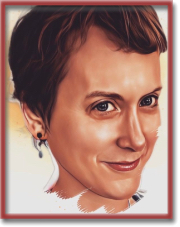
Claire Bateman’s books include The Pillow Museum: Stories (Fiction Collective 2); Wonders of the Invisible World (42 Miles Press); Scape (New Issues Poetry & Prose); Locals (Serving House Books), The Bicycle Slow Race (Wesleyan University Press), Friction (Eighth Mountain Poetry Prize), At The Funeral Of The Ether (Ninety-Six Press, Furman University), Clumsy (New Issues Poetry & Prose), Leap (New Issues), and Coronology (Etruscan Press). She has been awarded Individual Artist Fellowships from the National Endowment for the Arts, the Tennessee Arts Commission, and the Surdna Foundation, as well as two Pushcart Prizes and the New Millennium Writings 40th Anniversary Poetry Prize. She has taught at Clemson University, the Greenville Fine Arts Center, and various workshops and conferences such as Bread Loaf and Mount Holyoke. She lives in Greenville, South Carolina. (Please see Bateman’s amazon.com Author’s Page for links to all her publications, and go here for further information about the poet and her work.) (Author Head Shot Augment: René Laanen.)