The Poetry of Laurence O’Dwyer
“I hesitate to call this work a poem because I don’t really know what constitutes a poem anymore. In many ways I would like it to be closer to a folk tale. I am wary of the artifice of poetry. The simplicity of the folk tale often feels more pleasing to me. If that feels like a heresy, it is only fitting that there is a heresy at the heart of this tale. The German mathematician Gerhard Frey put forward a simple thought experiment: imagine that Fermat’s Last Theorem is false. All sorts of developments spun off from that idea and it was André Weil who formalised many of the details. The final proof that declared Fermat’s theorem to be true relied to a large extent on thinking through the consequences of this heretical idea.”–Laurence O’Dwyer
Speculative Friction
By Claire Bateman
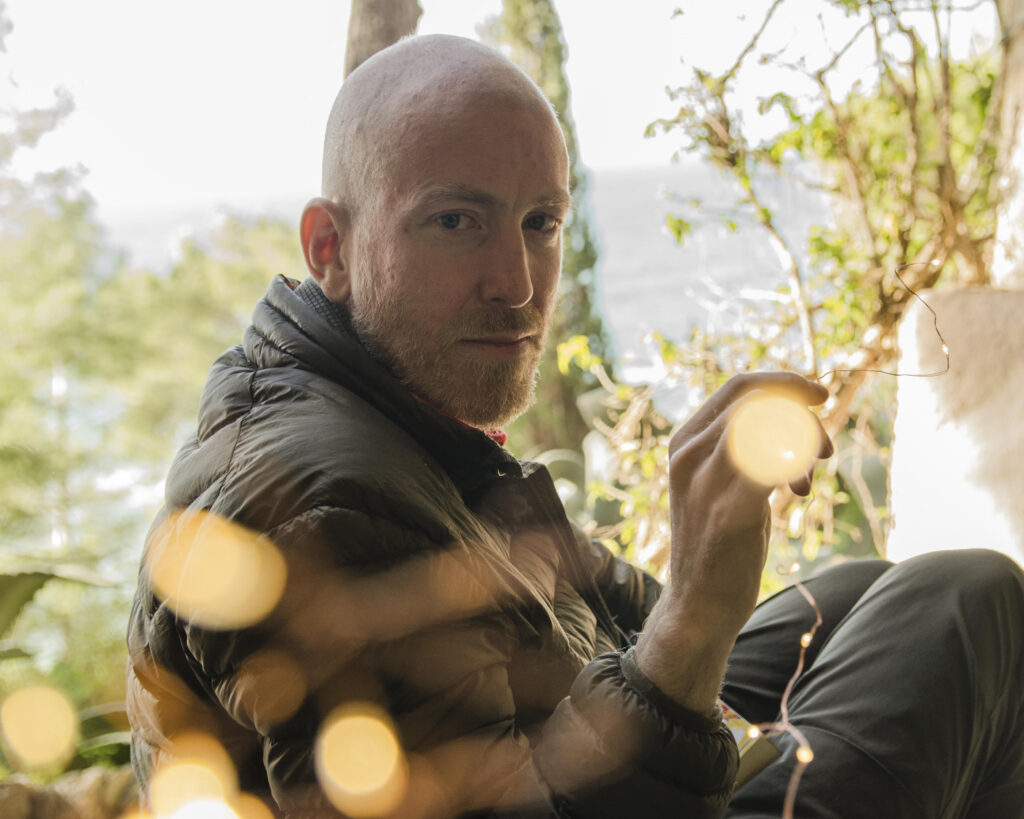
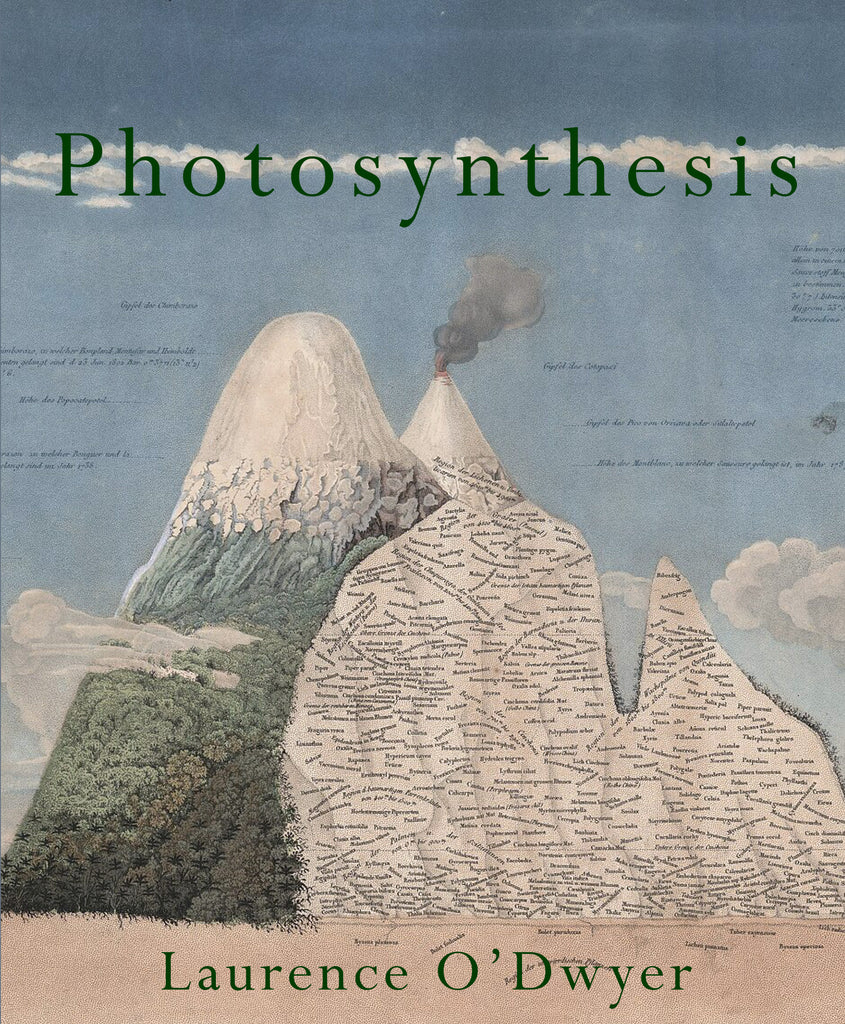
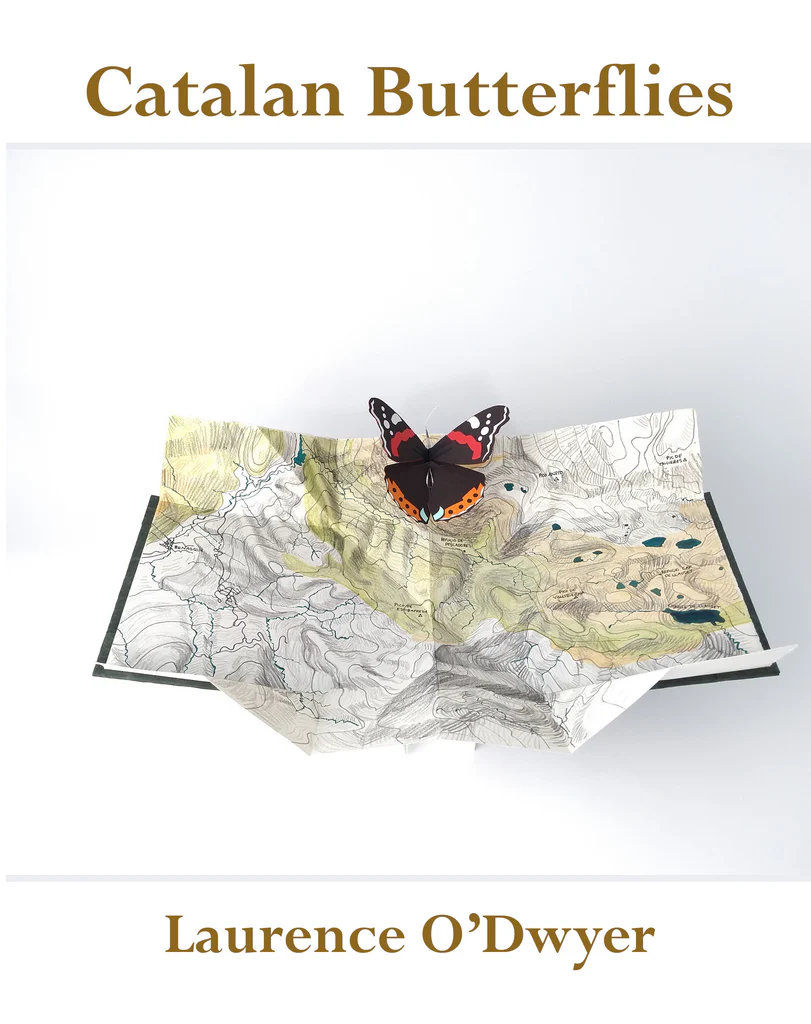
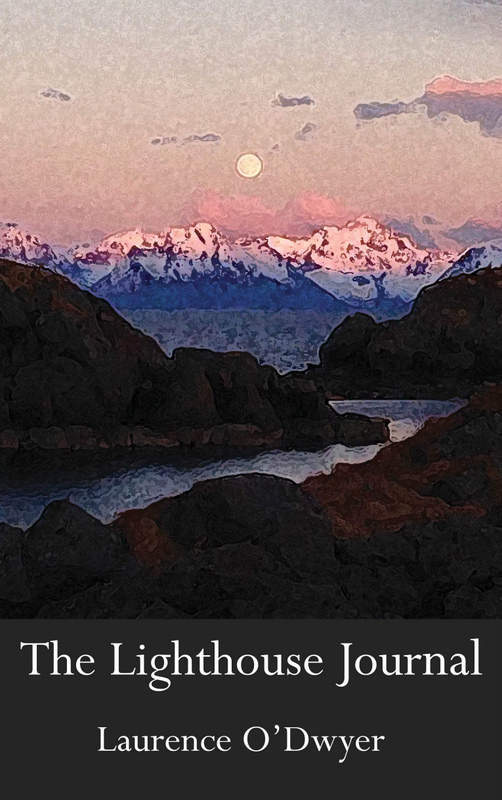
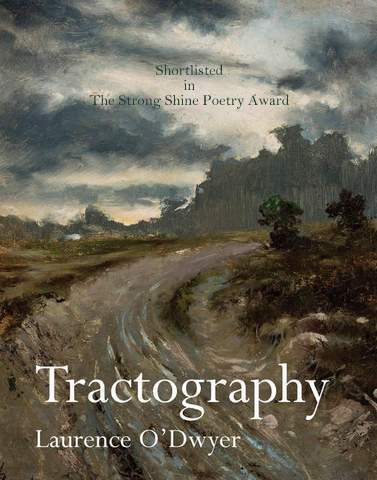
 GREENVILLE South Carolina—(Hubris)—May 2026—Laurence O’Dwyer has published four collections of poetry; Photosynthesis (Templar, 2025), Catalan Butterflies (Templar, 2022), The Lighthouse Journal (Templar, 2020), and Tractography (Templar, 2018). His awards include the Patrick Kavanagh Prize, the Yeovil Poetry Prize, the AUB International Poetry Prize, the Ireland Chair of Poetry Project Award and a Hennessy New Irish Writing Award. He has received a major bursary from the Arts Council of Ireland and fellowships from MacDowell, the Patrick and Katherine Kavanagh Trust, and the Bogliasco Foundation. He holds a doctorate in neuroscience (“in paradigms of memory formation”) from Trinity College Dublin. (Follow the poet on Meta; Substack (“Notes from Onda”); and Instagram.
O’Dwyer writes: “Recently I’ve become fascinated by the way mathematicians talk about discovering new mathematical landscapes. They can often be quite bad at explaining their ideas which in itself can be endearing. Listening to someone like Peter Scholze trying to explain his creation (or discovery if we believe that these landscapes already exist) of perfectoid spaces, I can’t help thinking that he sounds like someone who is struggling to paraphrase his own poem. And surely, what he has created (or discovered) is something that is as beautiful and shimmering as a nearly perfect poem.
“I was trained as a neuroscientist, so the world of science has always been close to me. I’ve always felt a little saddened or frustrated by the constant, sometimes trivial, remark: oh, you were a scientist but now you work in poetry, how strange! It might not always be meant in a trivial way, but I don’t really know why these two worlds should be strangers to each other. Science is beautiful and any true scientist develops an ability to make imaginative leaps that are very close, if not almost identical at a synaptic level, to the leaps that the very best poems make.
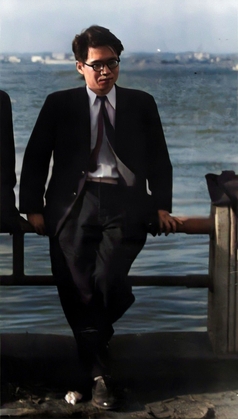
“So this piece is an attempt to describe how the scientific mind works in ways that any poet should be able to relate to. It tells the story of Fermat’s Last Theorem with Yutaka Taniyama cast as the hero. Andrew Wiles, the man who actually proved the theorem, and Goro Shimura, Taniyama’s friend, are the supporting actors. Goro Shimura’s beautiful, simple and moving article about the life and suicide of his friend inspired the tone and pitch of the piece.
“When I say simple, I think of how the word complex has a specific meaning in science. It is very different from the word complicated. Complicated things are ugly and pretentious. They are needlessly cluttered with too many steps. Complex things are made of simple axioms that add to make something beautiful. That is the aesthetic that I am searching for.
“For the cross-talk between art and science, I have been thinking about Darwin and how he came to dislike poetry. He told his children that he felt that the artistic part of his brain had atrophied because he had trained his mind to grind down vast quantities of facts that he would then spit out as theories or conjectures.
“In his youth he loved Shelley, Byron, Milton. He loved Shakespeare, especially the historical plays. Fifty years later he wrote: ‘I cannot endure to read a line of poetry: I have tried lately to read Shakespeare and found it so intolerably dull that it nauseated me.’ I know that feeling.
“But I’m not so sure that Darwin is correct in his idea of atrophy of the artistic part of his brain. He thought that the flaw was in him but maybe the flaw was in the literature he was reading. Either way, the whole thing made him sad.
“I was schooled in physiology and neuroscience. I still love that world but I had to leave it. I left it to focus full-time on literature but now I find that poetry is not enough. Or at least, I don’t want to carry on writing as though decades of studying science left no artistic impression on me.
“More and more I can see why the Greeks were mesmerised by the beauty of geometry, why they saw it as a divine revelation. A clean mathematical proof has the perfume of ice about it and ice was a precious quantity in ancient Athens. The French philosopher, Simone Weil, was very much drawn to this kind of austere perfection. She seems to be one of the few artists who made explicit use of geometry in her philosophy. For example, when thinking of Euclid and Pythagoras she wrote: ‘Only the mystical conception of geometry could supply the degree of attention necessary for the beginning of a science.’ In large part, her love of geometry was inspired by her brother, André Weil—one of the great mathematicians of the 20th century—who has a cameo in this story.
“I hesitate to call this work a poem because I don’t really know what constitutes a poem anymore. In many ways I would like it to be closer to a folk tale. I am wary of the artifice of poetry. The simplicity of the folk tale often feels more pleasing to me. If that feels like a heresy, it is only fitting that there is a heresy at the heart of this tale. The German mathematician Gerhard Frey put forward a simple thought experiment: imagine that Fermat’s Last Theorem is false. All sorts of developments spun off from that idea and it was André Weil who formalised many of the details. The final proof that declared Fermat’s theorem to be true relied to a large extent on thinking through the consequences of this heretical idea.
“In my own doubts about poetry, I worry that I’m missing something or maybe I’m just confused. I feel that there’s a whole other universe available to the poet and I would like to see beings or thoughts or creations pass through a wormhole from one universe to the other. At first this may be difficult and dangerous but in time maybe we will pass back and forth easily and at the speed of light.
“In this way I hope we can find a way towards another literature or landscape because at the moment it seems to me that there is a form that I am looking for that does not yet exist.”

The Taniyama-Shimura Conjecture in 53 Moves
By Laurence O’Dwyer
(1)
This is the story of Taniyama, a mathematician who made so many mistakes. His friend,
Goro Shimura, said that he was gifted because he usually made mistakes in the right
direction.
I envied him for this and tried in vain to follow his example, but I soon realised that it is
difficult to make good mistakes.
(2)
After the war their teachers were tired, their lectures were boring. The heart was as charred
and burnt out as the city so Taniyama and his friends amused themselves by coming up with
impossible equations. That’s how the Taniyama-Shimura Conjecture was born.
(3)
Every elliptical curve is a modular form in disguise.
(4)
Modular forms are crystals inside of crystals, a palace in the Thousand and One Nights—a
mise en abîme, vertigo of infinity—the vizier reads a story about a vizier reading a story in
the Thousand and One Nights . . .
(5)
Elliptical curves are incomprehensibly complex because every point on their surface is the
solution to an equation. They give rise to symmetries that can only exist in the mind of a
mathematician. I was going to say magician.
(6)
In Japan, at a crossroads I see that one sign says Tokyo 75, another says Kisai 65.
This does not mean that Tokyo and Kisai are 10 kilometres apart.
(7)
Taniyama grew up in the town of Kisai. As a young man, he wore, almost exclusively, a blue-
green suit with a metallic sheen. His father had bought the material from a travelling
salesman but because of the luster, no one in the family dared to wear it. Taniyama was not
worried about his appearance so he had a suit made from the strange material.
(8)
Kisai is 30 kilometres from Tokyo.
(9)
Taniyama and Shimura were making a bridge between different mathematical worlds. The
tools were not yet available to finish the job but they were the first to draw the blueprint.
(10)
With pleasing honesty, they wrote:
We find it difficult to claim that the theory is presented in a completely satisfactory form.
In any case, it may be said, we are allowed in the course of progress to climb to a certain
height in order to take a view of our destination.
(11)
A cable-stayed bridge is the most beautiful of all. It is taut like a musical instrument, a pyramid
of strings, ready for the wind which gives it a musical colour.
The water that passes under the bridge is thinking of Euclid and transects, glints of light and
the curve of the sun. A cable-stayed bridge is erect and formal like a classical statue of pure
erotic thought.
(12)
Decades after Taniyama’s suicide, a German mathematician proposed a heretical and
seemingly unrelated idea: What if Fermat’s Last Theorem is false?
(13)
Few are the minds that want to imagine such a heresy but if you follow the thread to the
end, it means that there are elliptical curves that are not modular forms.
(14)
But Taniyama had said that is impossible!
(15)
Exactly.
(16)
So if Fermat is false, then Taniyama must also be false.
(17)
Said another way—if Taniyama is true then Fermat is also true.
So we have a way to attack Fermat. All we have to do is find a proof of Taniyama!
(18)
Not so fast. The German did not prove his arguments. He was not sure.
He made a map. He pointed to a wormhole.
Make a map, find a new world.
(19)
Andrew Wiles drifts away from his childhood dream of solving Fermat’s Last
Theorem because sensible people—such as Cambridge dons—tell him it is impossible.
So he devotes his graduate years to elliptical curves. He has never heard of the
German heresy because it has not yet been nailed to the door. He has never heard
of the wormhole between Taniyama and Fermat because it doesn’t exist.
(20)
Shimura, reflecting on the substantial undertaking of a mathematician said that his friend
must have found great pleasure in this hard fighting and bitter struggle.
(21)
At any given time there are so many disparate minds working on so many problems—the
number is essentially limitless. Most of them are destined to die in isolation. But every now
and then one idea fuses with another.
(22)
One afternoon, a colleague tells Wiles that the heresy has not only been nailed to the door
of the cathedral, it has now been proved.
I was electrified. I knew at that moment that the course of my life was changing.
(23)
Contrary to popular belief the gods do nothing to help or hinder our progress.
The wind blows the Armada one way or the other.
(24)
After giving up on Fermat, what a curious twist of fate that elliptical curves are precisely
what he needs to solve his childhood obsession. With the exception of his wife and his
daughters—all else is excluded.
(25)
We need to limit ourselves to widen the circumference of our lives.
(26)
Why does no one else set off on this journey? Everyone knows that if the Taniyama-Shimura
Conjecture can be proven then Fermat will fall.
(27)
Here is the paradox: so shy and self-effacing yet Wiles’ belief is staggering. He knows he
cannot tell anybody. It’s not secrecy per se—though that is part of it. It’s not that they will
think him mad—though they will. Humility and arrogance make a strange alloy. But when
arrogance dissolves, the dream floats on the surface and the metal is the purest on earth.
(28)
It is midwinter. There are high mountains and the snow is deep. Setting off from a palace
the vizier tells him: there are wolves, the snow comes up to your shoulder, there is war.
I can guarantee you will die.
(29)
If he covets the prize he will not succeed. He has to go deeper than that.
This is the mathematics of folk-tales.
(30)
Such different characters—Wiles and Taniyama—one so meticulous and orderly, a family
man; the other a bachelor, full of mistakes but such good mistakes as his friend said.
(31)
His shoelaces were always loose, and he often dragged them on the ground; since he was
incapable of keeping them securely tied . . . he decided not to concern himself about tying them
again when they got loose.
(32)
If life is not worth living then nature is not worth knowing.
(33)
Until yesterday, I had no definite intention of killing myself. But more than a few must have
noticed that lately I have been tired both physically and mentally. As to the cause of my
suicide, I don’t quite understand it myself, but it is not the result of a particular incident, nor
of a specific matter. Merely may I say, I am in the frame of mind that I lost confidence in my
future.
(34)
The man who dreamt of a cable-stayed bridge and the wind playing its strings.
A mathematician who believed in magic.
A logical magician.
(35)
Taniyama and Shimura used to make fun of their professors. Such and such would say: Ah
young man, I see that you’re working on Siegel’s Quadratic forms. You may not know it, but
it’s Minkowski’s work that matters.
Shimura thought that these professors were trying to imitate their elders who in turn must
have been fond of equally meaningless statements. Little did they know that Taniyama had
leapfrogged them a thousand times.
(36)
There is a photograph of Taniyama in a tram as he’s going to a conference in Nikko with
three other mathematicians. Everybody has a manuscript or a sheet of paper. André Weil
has his eyes focused on an equation. Jean-Pierre Serre is leaning in to say something.
Everyone is moving urgently forward. Taniyama looks tense and alert. There is a phrase in
physics that might apply to the scene: explosive relaxation.
(37)
Taniyama was due to start work in Princeton but he never left Japan. The superintendent of his
apartment found him dead on Monday, 17th November, 1957.
After his suicide that effervescent group that had amused themselves with impossible
equations fizzled out like elements in fireworks.
(38)
Of Misako Suzuki, I know nothing, only that Shimura was surprised at his friend’s
engagement. He thought that she was not his type but he felt no misgivings.
They were due to move into a new apartment.
She wrote: We promised each other that no matter where we went, we would never be
separated. Now that he is gone, I must go too in order to join him.
(39)
She took her own life three weeks after Taniyama’s suicide.
(40)
Science is made up of facts, as a house is made of up stones. But a collection of facts is a
heap of stones.
(41)
Wiles worked in complete isolation. The hard fighting and bitter struggle that Taniyama had
found great pleasure in.
(42)
After six years of secrecy he needed to confide in someone. He needed to prepare for the
final leap and he did so with unusual cunning. He checked his proof by disguising it as a
series of lectures. The students came for a few days before drifting away. When you don’t
know the purpose of something, it’s impossible to hold interest. By the end of the first
week, his colleague, his confidant, was the only one left. This had been his
intention all along. To rehearse the proof in plain sight without anyone knowing.
(43)
Cambridge in June. After three full days presenting his paper in a lecture theatre with the
windows open, the flow of equations was as long as the Amazon. At the delta he floated awhile.
Where the sweet water mixes with the salt of the ocean he said: I think I will stop here.
(44)
Like any folktale there’s a twist in the end. An error was found.
Exposed to public scrutiny and on the brink of disaster, Wiles tried and failed to fix his proof.
(45)
He had been announced to the world as the genius who had solved the most coveted prize
in mathematics. The tabloids love the scandal of a failure or a fraud.
(46)
Maybe not the best year of my life, he said. Maybe the worst but the work he had done in
solitude got him through those months of unwanted glare.
(47)
One last time, just for himself, before giving up, he went line by line through the proof.
A trick he had tried for another problem in a different corner of the matrix, a trick he had
abandoned three years ago, would solve the problem in this corner of the carpet.
(48)
Error upon error change sign, the infinite Rubik’s Cube turning all green on one side, all blue
on the other—everything was solved.
(49)
For twenty minutes he looked at the solution. He left his desk and walked around the
department. When he came back it was still there.
(50)
What a curious expression—as though it might get up and run away. It was still there.
(51)
When ice-crystals form, they float on the surface. All other liquids sink when they freeze.
Taniyama was unique like that. The mathematician disappears but his modular forms—
crystals inside of crystals—are floating on ice-cold water.
(52)
Wiles needed to use the magic of Taniyama, the mathematician who was in control of all
the good mistakes. But Taniyama had no control over the bad mistakes. Despite this he always
tried to help his fellow mathematicians, especially younger ones. Unlike the professors who
said, Ah young man, you may not know it, but it’s Minkowski’s work that matters, his advice
was never pretentious.
(53)
I cannot help but be moved, almost to tears, by the end of Shimura’s beautiful article about
his friend in which he concludes:
And yet nobody was able to give him any support when he desperately needed it.
Reflecting on this, I am overwhelmed by the bitterest grief.
References:
Shimura, Goro (1989), Yutaka Taniyama and his time. Very personal recollections. The Bulletin of the London Mathematical Society, 21 (2): 186–196
Shimura, Goro, and Yutaka Taniyama. Modern number theory. Kyoritsu Pubi, Tokyo (1957)
Horizon: Fermat’s Last Theorem. Directed by Simon Singh, BBC, 1996. (Note: Go to Singh’s page, here, for more information. The film is not currently viewable in the US.)
Andrew Wiles on the morning he discovered how to fix his proof of Fermat’s Last Theorem.

To order copies of Claire Bateman’s books, follow these links: The Pillow Museum (2025), Wonders of the Invisible World (2023), Locals: A Collection of Prose Poems (2012), Scape (2016),Coronology (2009), Leap (2005), Clumsy (2003), The Bicycle Slow Race (1991).

Claire Bateman
Claire Bateman’s books include The Pillow Museum: Stories (Fiction Collective 2); Wonders of the Invisible World (42 Miles Press); Scape (New Issues Poetry & Prose); Locals (Serving House Books), The Bicycle Slow Race (Wesleyan University Press), Friction (Eighth Mountain Poetry Prize), At The Funeral Of The Ether (Ninety-Six Press, Furman University), Clumsy (New Issues Poetry & Prose), Leap (New Issues), and Coronology (Etruscan Press). She has been awarded Individual Artist Fellowships from the National Endowment for the Arts, the Tennessee Arts Commission, and the Surdna Foundation, as well as two Pushcart Prizes and the New Millennium Writings 40th Anniversary Poetry Prize. She has taught at Clemson University, the Greenville Fine Arts Center, and various workshops and conferences such as Bread Loaf and Mount Holyoke. She lives in Greenville, South Carolina. (Please see Bateman’s amazon.com Author’s Page for links to all her publications, and go here for further information about the poet and her work.) (Author Head Shot Augment: René Laanen.)