Two Weeks West: Father, Daughter & the Myth of the Open Road

“Bill Bryson was joking, mostly, about Ohio. But buried in that joke is something true about the American road trip. It has always been equal parts myth and monotony, freedom and flat stretches of interstate you simply have to get through. In this reflection, I trace that myth back to its origins, and forward to a two-week drive I took with my own daughter, the summer before she left for college.”—Dr. Jason Page
Off the Page
By Dr. Jason Page
“In the morning I awoke early and experienced that sinking sensation that overcomes you when you first open your eyes and realize that instead of a normal day ahead of you, with its scatterings of simple gratifications, you are going to have a day without even the tiniest of pleasures; you are going to drive across Ohio.”—Bill Bryson, The Lost Continent: Travels in Small-Town America
The Road Before Us
 HOMER New York—(Hubris)—September/October 2026—Perhaps it has always been part of the American psyche, this need to explore, to see what lies over the horizon. After all, the history of the Americas is one long record of people in motion, from the earliest human settlers moving south from Beringia some 16,500 years ago, to the European migrations east to west during the age of discovery. But while those migrations left their mark on human history and culture at large, it was the 20th century that gave rise to something more personal, the great American road trip.
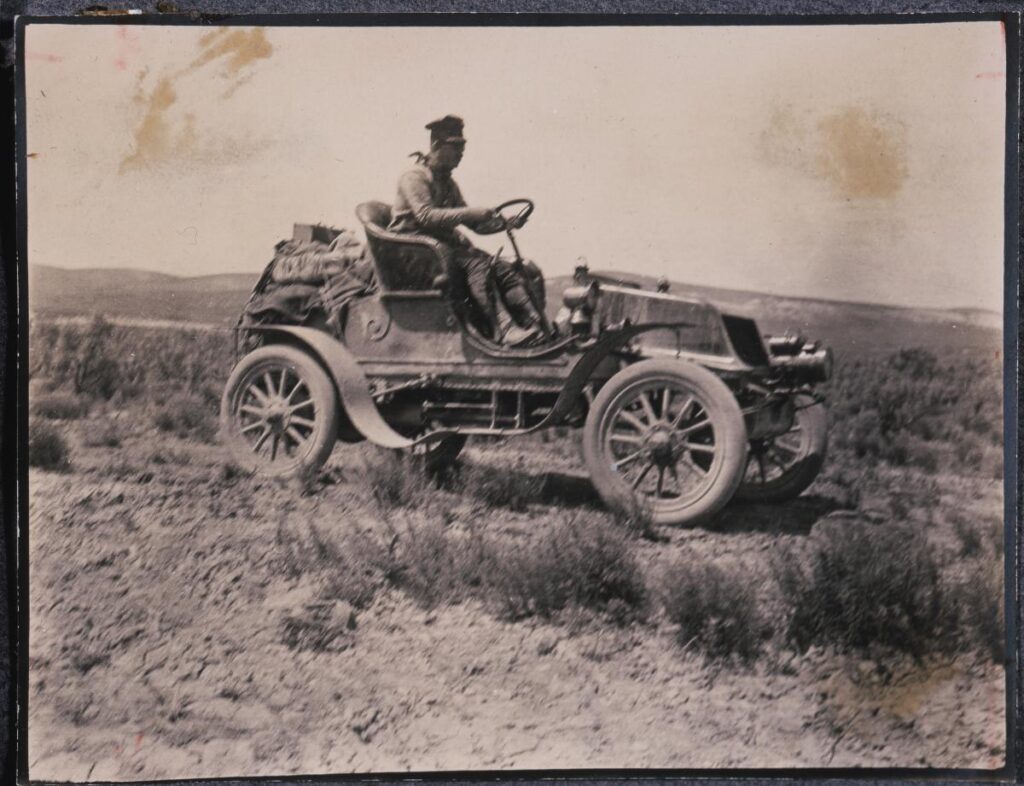
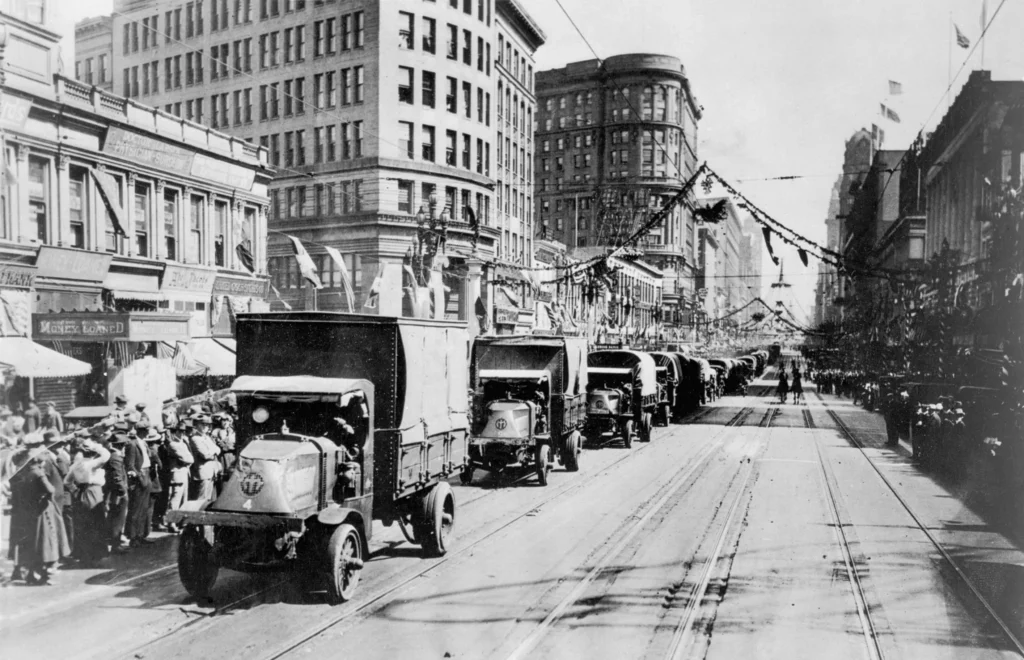
The first transcontinental drive was accomplished in 1903 by Dr. Horatio Nelson Jackson, mechanic Sewall Crocker, and their dog Bud, who took 63 days to travel from San Francisco to New York. My choice of the word “accomplished” is deliberate. The party crossed trails, rivers, mountain passes, and alkali flats, tracing the Union Pacific Railroad west across the country. Sixteen years later, in 1919, things had not improved much. Dwight D. Eisenhower took 62 days to cross the country as part of a US military convoy.
Over the following decades, America’s love affair with the automobile shifted into gear as mass ownership became possible through improved production. Henry Ford’s assembly-line vehicles dropped in price to $260 by 1925, putting a car within reach of everyday working families. As ownership spread, infrastructure followed, with motels, roadside tourist cabins, and improved highways springing up along the way. The establishment of Route 66 in 1923, the 2,448-mile “Mother Road” between Chicago and Santa Monica, marked the first major step toward a more connected country.
Progress stalled for the next 20 years, first because of the Great Depression, then World War Two. But history has a way of circling back, and in 1956 President Eisenhower signed the Federal-Aid Highway Act, funding the 41,000-mile Interstate Highway System, a project inspired in part by his own early convoy crossing. Combined with the postwar boom, it sent more people than ever out onto the road to see the national parks, the roadside attractions, and the wonders the country had to offer.
The Mythology of the Miles
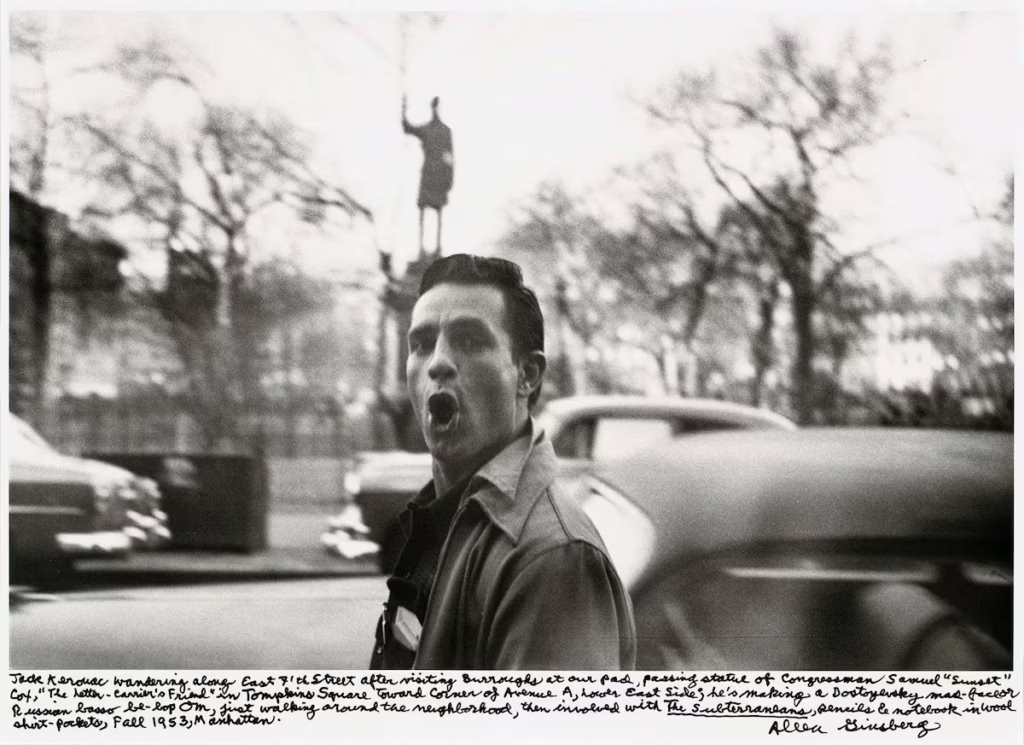
Beyond the history lies a much larger mythology, one steeped in colonial ideals, rugged individualism, New Age self-discovery, and the pursuit of the American dream. Turning history into lore requires great storytellers, and the American road trip has never lacked for them, from Twain and Steinbeck to Bryson and Offerman. Goodreads’ “Road Trips in America” list runs to some 82 titles, from classic travel memoirs to literary journeys to practical guidebooks, among them Steinbeck’s Travels with Charley, Bryson’s own The Lost Continent, Kerouac’s On the Road, and William Least Heat-Moon’s Blue Highways. Each uses the road as a lens for understanding American landscape, culture, and identity.
Taken together, this plethora of sources and rose-tinted histories has built a cultural backdrop in which the American road trip stands for spiritual awakening, rebellion, solitude, and personal autonomy. The road is a place that symbolizes freedom, but it has also been a place of restriction. Framed as a universal freedom, it has nonetheless highlighted racial and gender divides, documented most starkly by Black travelers navigating segregation during the Jim Crow era, for whom the open road was never quite as open.
The road is a place for nomads, permanent and temporary. It inspires comedy and horror in equal measure. In short, the road is a place that seems to demand exploration from anyone with a degree of wanderlust.
The Road We Chose
Last fall, on our way back home from a weekend away, my wife and daughters and I began discussing what our eldest, K., would like to do after her high school graduation. K’s first idea was a trip to the UK to see family. That idea slowly evolved into something else entirely, a longer trip, but closer to home, to see this country before college. The conversation happened in October, and little more was said about it until April, when she and I finally sat down to plan it properly.
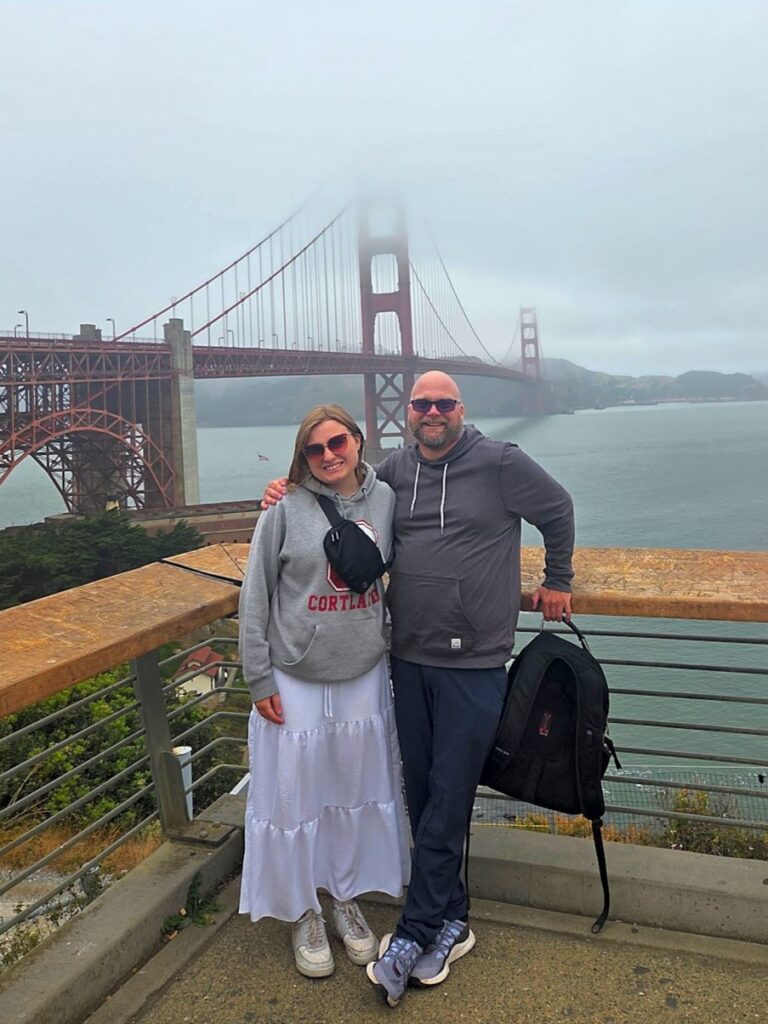
K. decided our destination would be San Francisco, though she was otherwise at a loss for what the trip should include. Further conversations led us to a route that took in some quirkier, less traveled spots alongside the more obvious ones. Essentially, our route would take us in a wide circle around the country, crossing the Midwest, then dropping down into Utah, Nevada, and California, before coming back along a southerly line through Arizona, New Mexico, and Texas, crossing the Mississippi, and heading up to South Carolina. I can honestly say that in the planning, I had no real sense of how vast this undertaking would be. Once we were on the road, it came into sharp focus.
As we traveled, much of the mythos of the American road trip came back to me, the freedom of the open road, the autonomy of making our own plans, the solitude of just the two of us on the highway. But we also found community, in conversations with other travelers at gas stations and diners, and something close to awe at the way the landscape kept changing, tracing not just the geology of the country but its cultural and political history, too.
More than that, though, this trip gave us a space in which to connect, to build the kind of memories that stick. It was the sort of trip I, with the power of hindsight, might have liked to take with my own dad—two weeks alone with him, no set itinerary, just the road ahead. We never had that. He wasn’t the kind of father to hand a teenager the map and the keys and see where it went. He had grown up in a different Britain, with a different idea of what a father and son were, and I’m not sure either of us would have known what to do with two weeks together. Ours was just not that kind of relationship. That absence, I think, is part of what made this trip feel so necessary. As much as this trip was about showing my daughter the country, it ended up teaching me something about the country I grew up in, too.
That sense of two countries, the one I grew up in and the one I was now driving through with her, came into focus one afternoon on I-90. Heading west toward Sioux City, my daughter behind the wheel, singing along to “Jack and Diane,” I felt that same pull the road has always had on people. We came over a rise and the whole highway opened up ahead of us, straight and empty, hers to drive. She is headed to college. I am headed into riding along, more than driving.
Conclusion
Bryson was right, in his way. Ohio does go on forever, and there are stretches of interstate that offer nothing but silos and gas station coffee. But that was never really the point of the road trip, and it never has been. The point is what waits on the other side of the boring stretches, my daughter singing along to Mellencamp, a stranger in a diner giving us advice on the next part of our journey, the sun coming up over the Mojave.
Jackson and Crocker drove across a country that barely had roads, chasing something that did not yet have a name. So, in her own way, is my daughter, who will be behind a different wheel by August, on a different kind of road. What the mythology gets right is that the trip changes you. What it leaves out is that it can change you together, if you are lucky enough to have the right person in the passenger seat. Somewhere on I-90, watching the road come up over that rise, I understood that the freedom I felt was never really about the driving. It was about being part of the journey.
Editor’s Note: Stay tuned for future chapters of “The Page Road Trip of Summer 2026.”

Jason Page
Jason Page, born and brought up in Ipswich, UK, first went off to college in Canterbury before his path took a sharp transatlantic turn. While working at a summer camp in the United States, he met his future wife, eventually immigrating to America after teaching adaptive physical education in the UK. In the US, Page’s work has focused on human services and serving diverse populations, including at-risk youth and individuals with substance use and mental health disorders. After earning a second Bachelor’s degree in History and Political Science and then a Master’s in Therapeutic Recreation from SUNY Cortland, Page completed his PhD in Recreation Therapy at Clemson University, his research focusing on the behaviors and motivations behind participation in high-risk or “deviant” leisure activities, questioning why certain activities receive such labels. Known for his willingness to explore topics that might not get him invited back to dinner parties, Page says his scholarly focus aligns with his irreverent attitude toward institutional power and his dark sense of humor. His work challenges conventional perspectives on leisure activities, exploring the complex relationship between risk, societal norms, and personal fulfillment, deliberately questioning established boundaries and received assumptions. (Author Head Shot Augment: René Laanen; Banner image: Kaelyn Page.)