Brother Angelico’s the Man

“That process of soul-waking (as distinct from Keats’s ‘soul-making’) finds an analogy, as the monologue unfolds, in Lippi’s defense of his art—its realism (truthfulness, he’d say) as opposed to the spiritualized naturalism of Angelico’s art, which subordinates body to soul. Lippi’s intuition is that the soul reveals itself in beauty, a virtue manifest in everything when truly seen. But even if ‘there’s beauty with no soul’ (a dubious proposition in Lippi’s view), ‘If you get simple beauty and naught else,/You get about the best thing God invents:/That’s somewhat: and you’ll find the soul you missed,/Within yourself, when you return him thanks.’”—David Havird
Close Encounters
By David Havird

“The heads shake still—‘It’s art’s decline, my son!/You’re not of the true painters, great and old;/Brother Angelico’s the man, you’ll find;/Brother Lorenzo stands his single peer:/Fag on at flesh, you’ll never make the third!’”—Robert Browning, from “Fra Lippo Lippi”
 SHREVEPORT Louisiana—(Hubris)—May 2026—There was at the far end of the gallery in the Palazzo Strozzi a vibrant, monumental altarpiece depicting Christ’s descent from the cross, but it had already drawn a crowd—it was Saturday, January 17; everyone there had a timed ticket for 10:00—and so my eyes, if not also my wife’s, turned to a smaller but no less vivid painting on the left-hand wall, an altarpiece depicting The Annunciation.
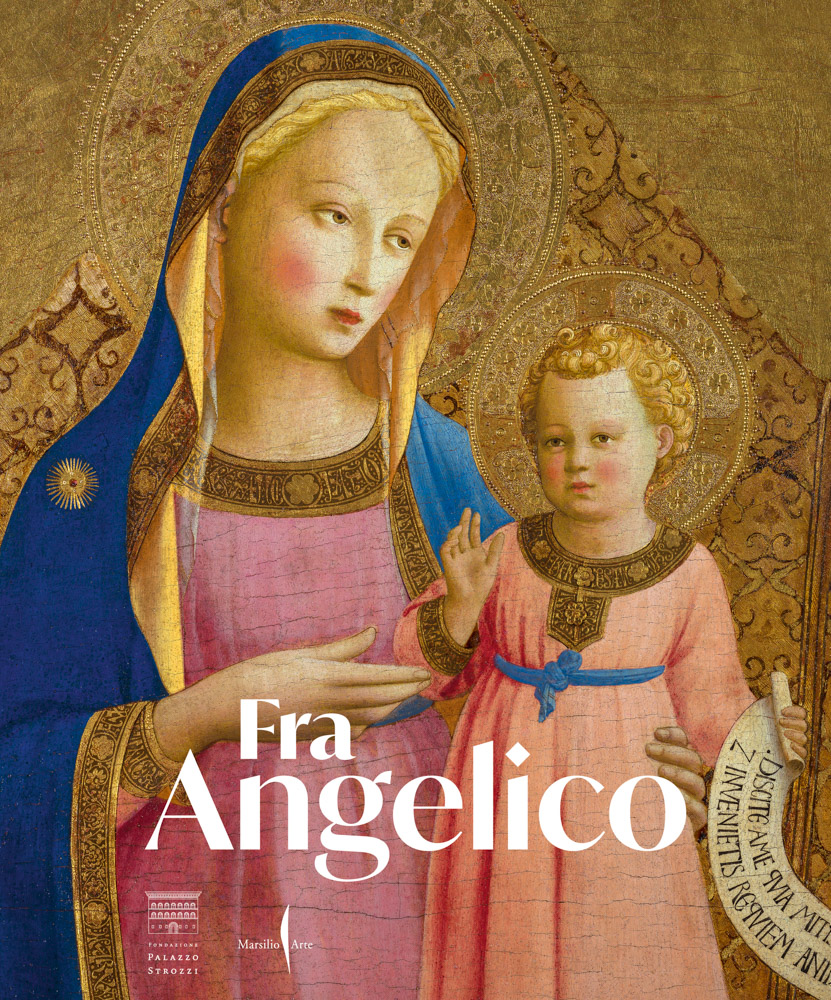
Fewer than four months earlier we had given Florence, my wife and I, one and a half days at either end of ten days in Italy (a week of which we spent in the Tuscan countryside). Banners featuring a blond, rose-cheeked Madonna with a placid expression, clad in a blue and gold hooded mantle and reddish shift, her right hand gesturing deferentially toward her similarly blond, curly-haired child-man (a detail, as it turned out, of the Franciscan Triptych, an altarpiece by Fra Angelico)—these hung, without our paying much attention to them, from a massive structure of brownish rusticated stone, the Strozzi palace, a few minutes’ walk from the Duomo. The religious art of the early Renaissance had never interested me; Florence was miserably crowded even in late September (as it hadn’t been when we were there together almost 50 years earlier)—we had no intention of returning.
No sooner were we home than a lavish, engagingly sensitive review by Jason Farago appeared in the New York Times of this “once-in-a-generation exhibition,” as the subhead described it, which had opened there right as we were leaving. In Fra Angelico, this exhibition’s subject, Farago found—and the portfolio of gorgeous photographs also persuasively argued—“the sublime promise that things will get better, between this day and eternity, and human works will make it so. No points for guessing why,” Farago concluded with a confiding wink, “but this year I perceived a new utility to Angelico’s better world, made visible in forms and fashions that affirm that no fall is permanent.” It soon became imperative for me to see it for myself, and with the promise also of less dense crowds in winter—the exhibition ran until January 25—my wife proved game.
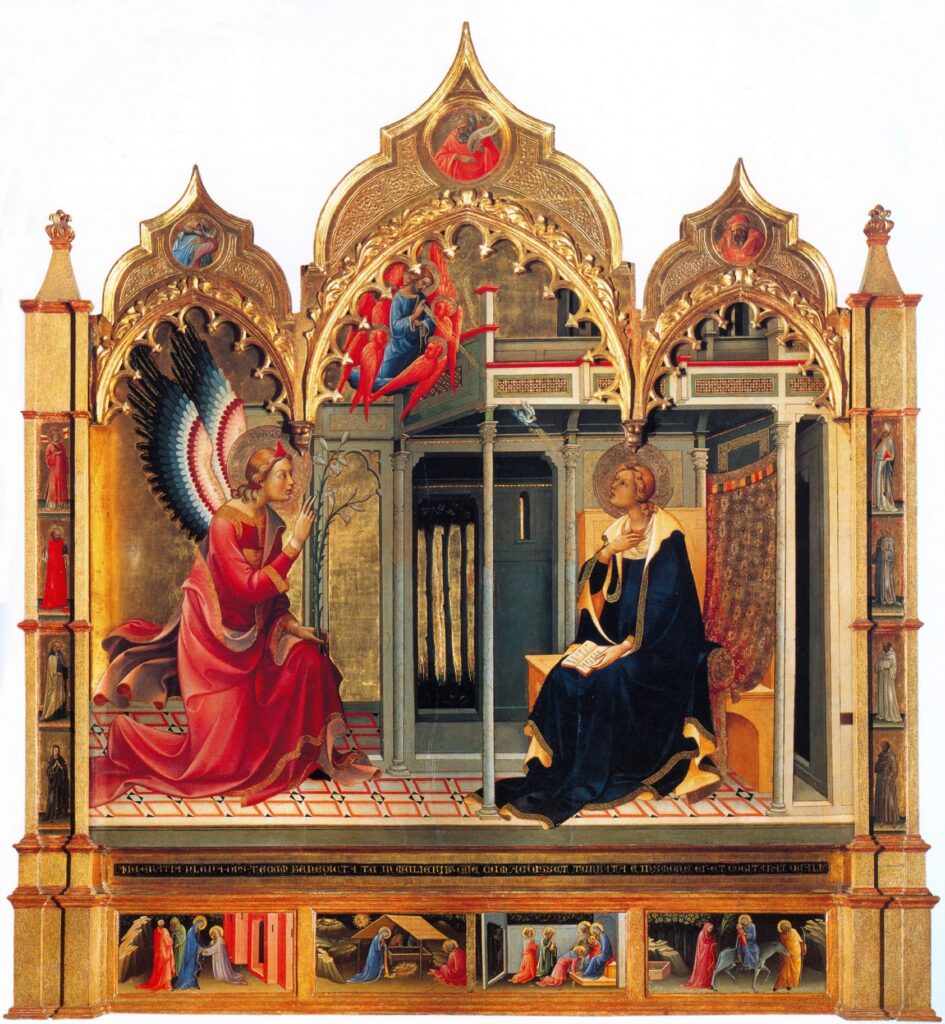
As I soon saw, The Annunciation (the Bartolini Salimbeni Altarpiece) wasn’t by Angelico at all, but rather Lorenzo Monaco. Gold is the dominant color, but there, on the right side of the scene, is Mary in a dark blue garment sitting with her left hand holding an open book on her lap, while her right hand, in a gesture that asks, “Who, me?” while hinting at receptivity, has pressed its fingers to her chest. The angel in red, while looking no less feminine than Mary (blond like her with a crown braid up-do), gestures informatively with upraised right hand while kneeling, his wings, with bands of feathers (gold, white, red, and deepening shades of blue), unfurled, erect. Meanwhile, the Holy Spirit in the form of a dove is scooting toward Mary on rays emanating from the raised right hand of a figure in the middle arch—there are three arches—a younger-looking male than God the Father, sporting as he does a short beard and shoulder-length brown hair. It appears that the second person of the Trinity, by means of the third, which has drawn her gaze, is impregnating The Virgin with himself, an incarnation of the prophetic Word, as written in that book which no doubt had captivated her until the divine messenger appeared. In the pinnacle above this arch, there is Isaiah holding a scroll that reads, Ecce Virgo (“Behold, a virgin” from Isaiah 14: “Behold, a virgin shall conceive, and bear a son, and shall call his name Immanuel”).
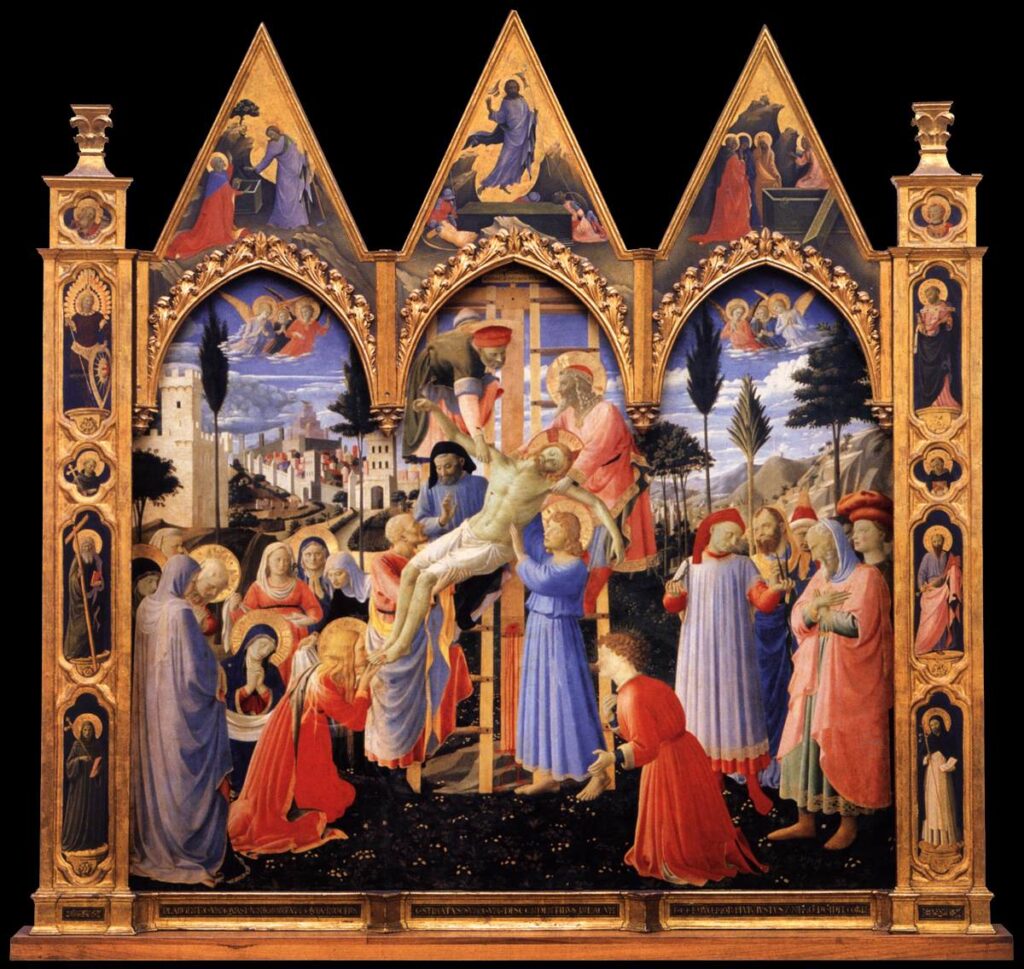
A generation older than Angelico, who was born around 1395, Lorenzo Monaco died in 1424, leaving unfinished, in fact, that other altarpiece, The Deposition of Christ from the Cross. Its central panel, the narrative scene, is Angelico’s work, completed apparently in the early 1430s. I should have remembered that “Brother Lorenzo,” though he and Angelico belong to different monastic orders, “stands” as Angelico’s “single peer” in Robert Browning’s “Fra Lippo Lippi,” one of my favorite poems—and together stand, the blessèd Angelico the more so (his “impulse” being, as Hegel discerns, “a cloistral purity of emotion”), in contrast to Brother Lippo (Filippo Lippi), as an Annunciation of his in this exhibit brought beguilingly to mind. (I’ll discuss both this Annunciation and the poem later.) Lippi’s monologue, as tipsily delivered to guardsmen who’ve apprehended him “past midnight . . . at an alley’s end/Where sportive ladies leave their doors ajar,” composes in effect a self-defense against Mrs. Jameson’s moral criticism, in her Memoirs of the Early Italian Painters (1845), that here was a painter “profoundly versed in the knowledge of the human form . . . without any other aspiration than the representation of beauty for its own sake.” (A prolific writer of non-fiction, notably art history, Anna Jameson befriended both Robert and Elizabeth Barrett Browning.) Lippi’s Prior demands, “Give us no more of body than shows soul”—as does Angelico: “Brother Angelico’s the man, you’ll find.” Interrogating that imperative, Browning’s Lippi defends “The value and significance of flesh.”
Meanwhile, that monumental Deposition of Christ from the Cross “unfolds,” as Michela Young describes it in the catalogue, “before a distant view of Jerusalem,” whose “turreted walls” bring Florence to mind, as does the “contemporary Florentine clothing” of some of the human figures, “witnesses to Christ’s sacrifice.” (Astonishingly beautiful and erudite, this catalogue, by the way, edited by Carl Brandon Strehlke, with Stefano Casciu and Angelo Tartuferi, and published by Marsilio Arte, is a steal at $75.) Angelico, as I’ve learned, pioneered not only linear perspective but also emotional realism, here with respect to the interaction of those witnesses. (“Fra Angelico invented emotional interiority in art,” Cody Delistraty, who sent me to Hegel, asserts in the Paris Review.) The naturalistic presentation of that “conversation” as a part of the story is also an innovation. The effect, as Young continues, is to “invite the viewer into intimate contact with the sacred scene.”
You’ll have understood that I am not an art historian, and in any case the art in general of the Italian Renaissance has never excited my interest except as it figures in such poems of Browning’s as “My Last Duchess,” of course, “The Bishop Orders His Tomb at Saint Praxed’s Church,” “Fra Lippo Lippi,” and “Andrea del Sarto.” The poet’s apartment in Florence—his and his wife, the poet Elizabeth Barrett Browning’s residence from 1847-1861—was, along with the Uffizi Galleries, a priority for me to visit this past September. When first seen by Ashley and me as newlyweds in 1977, the apartment (Casa Guidi—in a 16th-century palatial building) was a gutted shell. I remember force-feeding into a slotted box a modest contribution (of how many thousand lire, worth how few US dollars) towards its restoration, which was completed in 1995. I’m with James Dickey, who admits in Self-Interviews, “I never have been able to disassociate the poem from the poet.” My attitude about poets—artists in general, dead ones as well as living—is like Malcolm Lowry’s. Lowry, as Dickey puts it, “is really interested in the work because it leads him to the man”—Nordahl Grieg, for instance, “a Norwegian poet who wrote about the sea,” whom Lowry read “and went to Norway just to meet.” Now, I can’t say that it filled me with reverential joy, but it was gratifying to stand in that restored apartment, amid its pale green walls and period furnishings (some few pieces of which had belonged to the Brownings), my feet on the russet carpet.
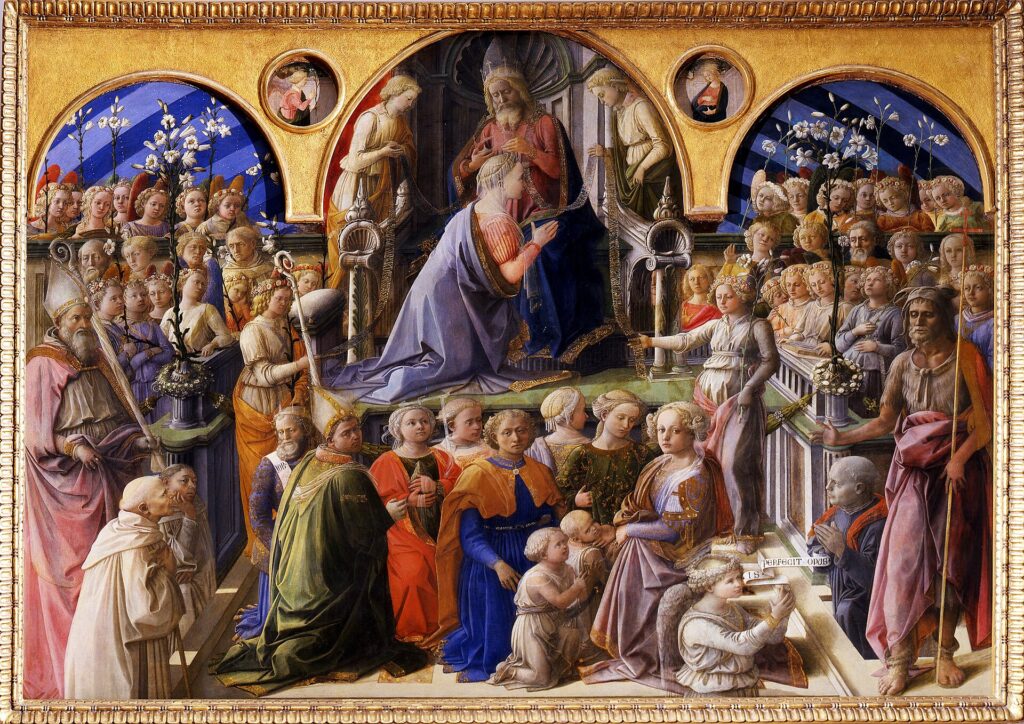
I also remembered, when touring the Uffizi in September, gazing in 1977 at Filippo Lippi’s Coronation of The Virgin, especially at the artist’s self-portrait: on the left side, the younger tonsured monk, looking contemplatively (hand to lower face) out of the painting. It mattered to me that the artist himself was there—as it mattered to Browning as well. Only he misidentifies him in “Fra Lippo Lippi” thanks to an ambiguously worded scroll unrolled by an angel for a monkish-looking fellow kneeling on the right, in bluish habit and red scarf, hands prayerfully together—the one who perfecit (completed, did thoroughly, brought about) the work. Or rather Browning’s Lippi misidentifies himself when describing at the end of that dramatic monologue the elaborate painting he envisions as reparation, in six months’ time, for his night out. He imagines himself appearing suddenly, “As one by a dark stair into a great light,” amid the “pure company” attending the coronation, only to sense his right to be there questioned by the “celestial presence,” whom, however, “a sweet angelic slip of a thing” promptly addresses, protesting on his behalf: “He made you and devised you, after all.” Feeling self-conscious still—while mischievously winking at the listening guardsmen—Lippi makes an analogy between his imagined intrusion there and an assignation such as he might have risked, the woman being not unlike “the little lily thing/That spoke the good word for me in the nick,” with whom he “scuttle[s] off,” out of the painting as it were, when “in there pops/The hothead husband.”
That first Annunciation, the altarpiece by Lorenzo Monaco, must have alerted my eye to Annunciations, for there were two others that drew my gaze before I came to the one by the engrossing Brother Lippo: the Montecarlo Annunciation Altarpiece by Fra Angelico (and Workshop, which contributed to the predella, the horizontal panel of narrative scenes below the main panel) and The Annunciation and the Expulsion of Adam and Eve from Paradise by Giovanni de Paolo, a contemporary from Siena. Perhaps the most obvious feature in common is the presence of Adam and Eve (who do not figure in Lorenzo’s Annunciation). In Fra Angelico’s they are tiny, grayish figures in the receding distance as seen through and just below the crown of the first of two archways in the left-side wall, the archway through which the angel has entered. A picket fence separates the yard, where there is a large lily in bloom, from the flowering landscape beyond. Barely discernible is the outstretched arm of a figure, an angel that seems to be patting Adam on the back, rather than shoving him, as he walks towards Eve, who waits, arms crossed, on a brownish, barren shelf.

Giovanni positions his Adam and Eve also on the left, outside the open room where angel and Virgin meet, but, given their size, not nearly so far in the distance. (Spatial distance in both pictures implies distance in time.) Their angel, his torso bare, his loins clothed in the most diaphanous of fabric, is shoving with both arms a naked Adam who looks back at him, eyes wide, the insult felt apparent. With arms outstretched towards Eve, who’s also naked, his legs in full stride now, Adam has bumped against her. They have exited Eden through a doorway in a wall (at the edge of the panel), but thanks to the announcement taking place in the interior foreground, the landscape, a New Eden, that receives them is hopping with rabbits as well as flowering.
An especially notable feature of Giovanni’s Annunciation is the presence of Joseph. A smaller figure in a right side panel, this baldheaded graybeard (far older than his virgin wife) is sitting in a separate brick-floored room on a stool and warming his hands at a fire, which implies a later season, as the figure’s size implies distance in time—nine months later, as Giulio Dalvit understands it in the catalogue, December 25, nine months since the Feast of The Annunciation on March 25. Like the flowering garden with its rabbits, the blazing hearth evokes a fertile womb whose fruit, so to speak, is the light of spiritual restoration.
As for The Annunciation itself, which embodies the present action, it takes place in a loggia whose archways in both altarpieces give on that grassy landscape. Fra Angelico’s Mary has been reading no doubt the same prophetic book as Lorenzo’s: in the roundel between the two archways (which frame the angel on the left, Mary on the right) a baldheaded Isaiah has unfurled a scroll whose Latin prophesies the virgin birth, while a light-encircled dove hovers above the Virgin’s blond head, which wears only a halo. The book lies open on her knee. Gabriel, dressed in red and gold, leans towards her, almost bowing, the tips of his impressive golden wings extending a little beyond the archway through which he’s entered the loggia. Arms crossed, he’s speaking from the heart. Clad in a red shift and blue mantle, Mary bends slightly towards the angel, the better to take in his announcement, arms crossed, hands open. The look on her face conveys that, as well as receptively hearing, she’s actively listening.
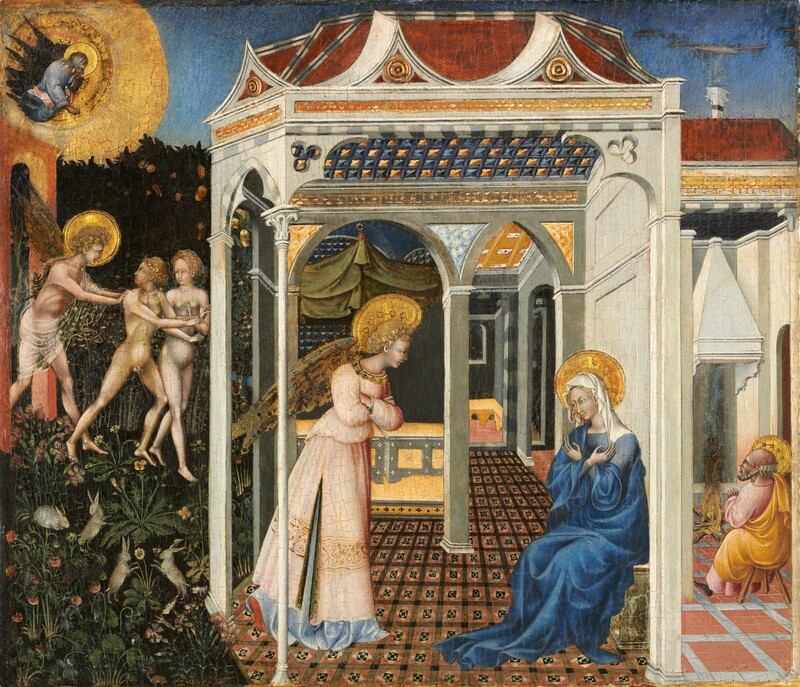
There is no book in Giovanni’s Annunciation to indicate that Mary, while also sitting (in dark blue drapery, her blond head loosely veiled in white, haloed in gold), has been reading. The sun-encircled graybeard in the upper left-hand corner, right above the angel shoving Adam, appears to be God the Father—there is no prophetic scroll unrolling (nor, for that matter, any dove descending) from his extended hand, which may, in any case, be simply authorizing the expulsion of Adam and Eve from Paradise. Gabriel, wearing a pale reddish long-sleeved dress with side splits, which reveal a light blue chemise, leans towards Mary, his arms tightly crossed, left hand in armpit: he appears to be frankly announcing, telling it like it is. Her own arms loosely crossed, hands receptively open, she passively stares at his arms instead of meeting him eye to eye.
Even when turning the pages of the catalogue past Angelico’s Montecarlo Annunciation and then Giovanni’s and coming on Filippo Lippi’s Martelli Altarpiece, you cannot but be jolted by its vitality as embodied especially by the figure in impulsive motion that is Fra Lippo’s Mary. It is hard, for me at least, to discern the type of clothes she’s wearing: a blue empire waist gown along with a thick blue-gray wraparound, which may have an olive green lining, that hangs from her hips to the floor while a full-length cape (olive green or blue-gray) with an embroidered trim covers her shoulders and a diaphanous veil her haloed head. She was standing at a wooden lectern, mounted on what looks like a marble base, much of which is hidden by one of the piers, the one on the right, supporting the archway—standing there reading when suddenly not one angel but three of them swooped into the arcade. She has swiveled slightly to her right, her upper body turning and bending towards, while looking down at, Gabriel, her weight resting mainly on her right leg, whose shape from upper thigh to foot is sensually visible. The angel, whose face, with upturned eyes, has about it a boyish earnestness (in contrast to Mary’s no-nonsense look), has knelt beside her—framed, that is, by the same archway as frames her—the green tips of his wings, which are silver at his shoulder blades, extending beyond the central pier. He wears a red cloak (like a Greek himation) over a silver-gray tunic while holding in his right hand, which rests on his knee, a lily whose stiff stem angles away from Mary. Nevertheless, as if to forestall an offering, she holds her right hand, open, palm down towards him, level with and only a few inches from his nose, her left hand raised in obvious surprise.
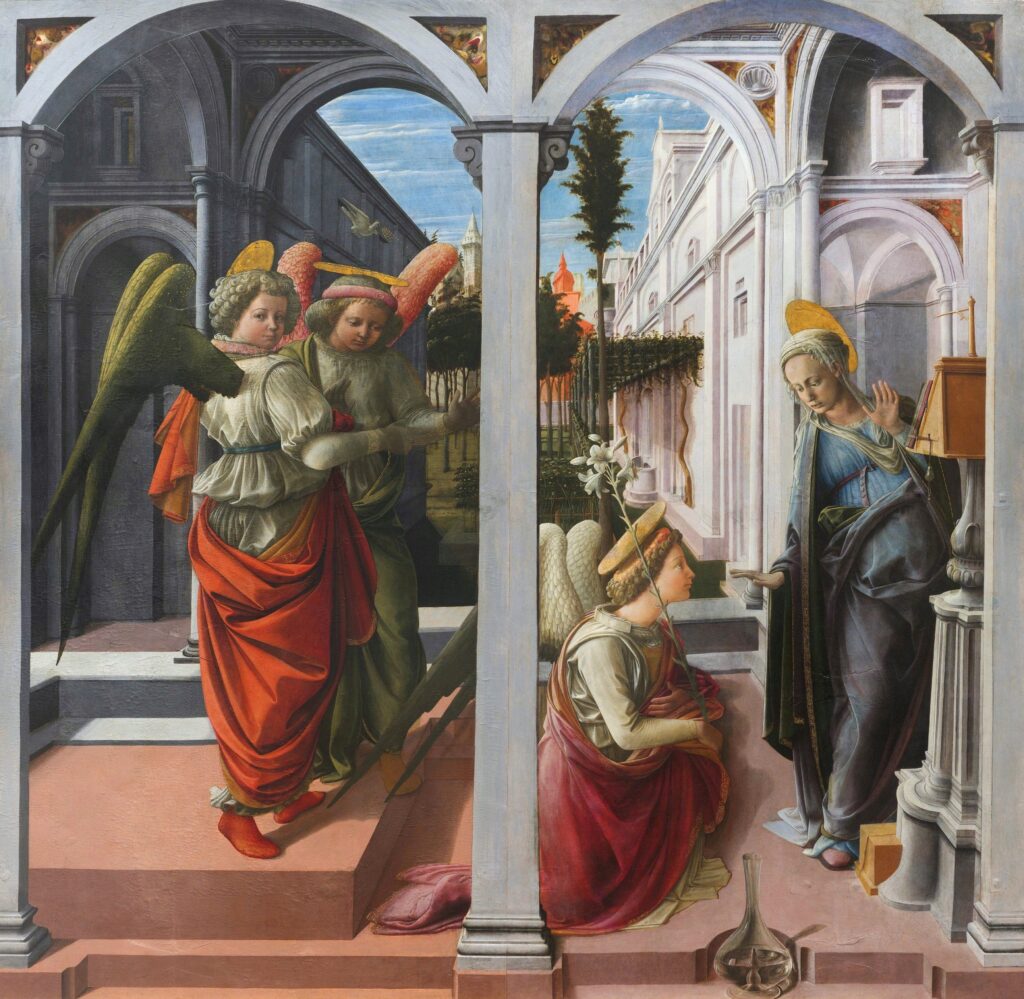
I should observe in passing two features in addition to Mary’s dynamic pose that enliven the scene and transform us from onlookers into active participants in something like a dialogue. Seen through the left archway are two angels similarly attired, one of whom, while turning away from us, is looking back, meeting us eye to eye. His look, when it fell on me at the Strozzi, told me soberly, confidentially, that I was witnessing a private meeting, one that surely I’d foreseen. Also, Lippi’s use of a linear perspective with steep orthogonals, whereby the background recedes to a hidden point beyond the central pier, works with what’s in the background to draw in viewers and create familiarity. As Christopher Daly points out in the catalogue, “Colourful stone buildings recede sharply into the distance, providing—when viewed in situ—an illusionistic view through the church . . . and onto the cloister on the other side of the chapel’s exterior wall”—when viewed, that is, in the Basilica di San Lorenzo’s Martelli Chapel, this altarpiece’s permanent home in Florence.
I had already begun to study this Annunciation when Ashley entered the gallery. “Without thinking, give me your impression,” I asked her. “What’s her body language saying?” Mary’s, I meant, regarding the angel.
“Get away from me,” she said. Later she joked knowingly that Mary was maybe allergic to lilies, which symbolize the Virgin’s radiant purity.
An elderly, rabbit-faced woman (with white fur hat on, fuzzy coat, silver flats) had overheard our conversation. What had impressed me so, I explained, was how believable as a woman this Mary was—sexy, even—unlike the stylized others, all of whom were sitting. You could imagine this one dancing, like Salome, I said. The woman nodded. “She’s not yet a saint”—a clear-seeing way of putting the issue, the operative word being “yet.”
Already that phrase of Browning’s Brother Lippo, “The value and significance of flesh,” had sprung to mind. “Fra Lippo Lippi” is a 392-line poem—I can do hardly more than summarize it here. Lippi, whom it has surprised the night watch to “catch,” torches having revealed him to be a monk, proceeds to account for the likelihood that he’s been whoring. He was immured for three weeks in the house of his patron “A-painting for the great man” (who happens to be the banker that in fact rules Florence), “saints and saints/And saints again.” The celebratory sounds of carnival—laughter, music, song, traffic of feet—reached him through an open window, and out and down a ladder of knotted bedclothes he scrambled in pursuit: “flesh and blood,/That’s all I’m made of!” he exclaims, self-deprecatingly excusing this impulse of his. How did he come, this monk, to be such a “beast”? It never was his choice to take religious vows. Born into poverty and orphaned at two, he “starve[d] in the street” until an aunt, unable herself to care for him, took him, when he was eight, to the convent. There he “renounce[d] the world, its pride and greed,” but not—the handover taking place at “refection-time”—its “bread.” Along with a full belly came leisure-time (stolen, albeit, from Latin lessons), during which he doodled faces, immature manifestations in artistic form of lessons gleaned from begging: “when a boy starves in the streets/ . . . /Why, soul and sense of him grow sharp alike,/He learns the look of things”—comes to recognize, from visual cues, a promising prospect with regard not merely, the phrasing implies, to alms but charity, charity as an ontological phenomenon: almsgiving as a sign of the giver’s participation in divine being and recognized as such by the beggar’s soul. He’s not, as he thus reveals, all flesh and blood, however beastly his farewell to flesh has been tonight.
That process of soul-waking (as distinct from Keats’s “soul-making”) finds an analogy, as the monologue unfolds, in Lippi’s defense of his art—its realism (truthfulness, he’d say) as opposed to the spiritualized naturalism of Angelico’s art, which subordinates body to soul. Lippi’s intuition is that the soul reveals itself in beauty, a virtue manifest in everything when truly seen. But even if “there’s beauty with no soul” (a dubious proposition in Lippi’s view),
If you get simple beauty and naught else,
You get about the best thing God invents:
That’s somewhat: and you’ll find the soul you missed,
Within yourself, when you return him thanks.
Beauty in art awakens the soul, which reveals itself in thanksgiving to God, whose works, as Lippi further maintains, we won’t have “loved” (a revelation of soulfulness we also “missed”) until we saw them painted, “things we have passed/Perhaps a hundred times nor cared to see.” The world, Lippi insists, is nothing to renounce: “it means intensely, and means good:/To find its meaning is my meat and drink,” a figure of speech that ties together the desperation of the starving “urchin” to find the good in others and the analogous aim of the mature artist to find it in his subjects and to render it, nor “let a truth slip,” in such a way as induces “wonder” (“the basis of Worship,” as Browning’s friend Carlyle declares) and “thanks” to God. The world, as Lippi sees it, is
. . . the garden and God there
A-making man’s wife: and, my lesson learned,
The value and significance of flesh,
I can’t unlearn ten minutes afterward.
As these lines imply, flesh is the principal medium for the expression of human love—divine love too: perhaps Lippi’s “meat and drink” hints at the Eucharist’s “body and blood” of Christ. (The Eucharist is by definition a thanksgiving meal.)
For Browning’s Lippi, who uses his artistic creed, however religious his faith in it may be, to excuse his carnal indulgence, the act of painting, even when intended as atonement (as with his Coronation of the Virgin), becomes, at least to some extent, a creative sublimation of morally transgressive impulses. That “cloistral purity of emotion” which impelled Angelico, according to Hegel, “love severed from the world,” was not exactly the impulse that set our Lippi to work. I liked believing anyway that Lippi’s Mary, while not “yet” a saint, embodied nonetheless Eve’s second chance at sainthood.
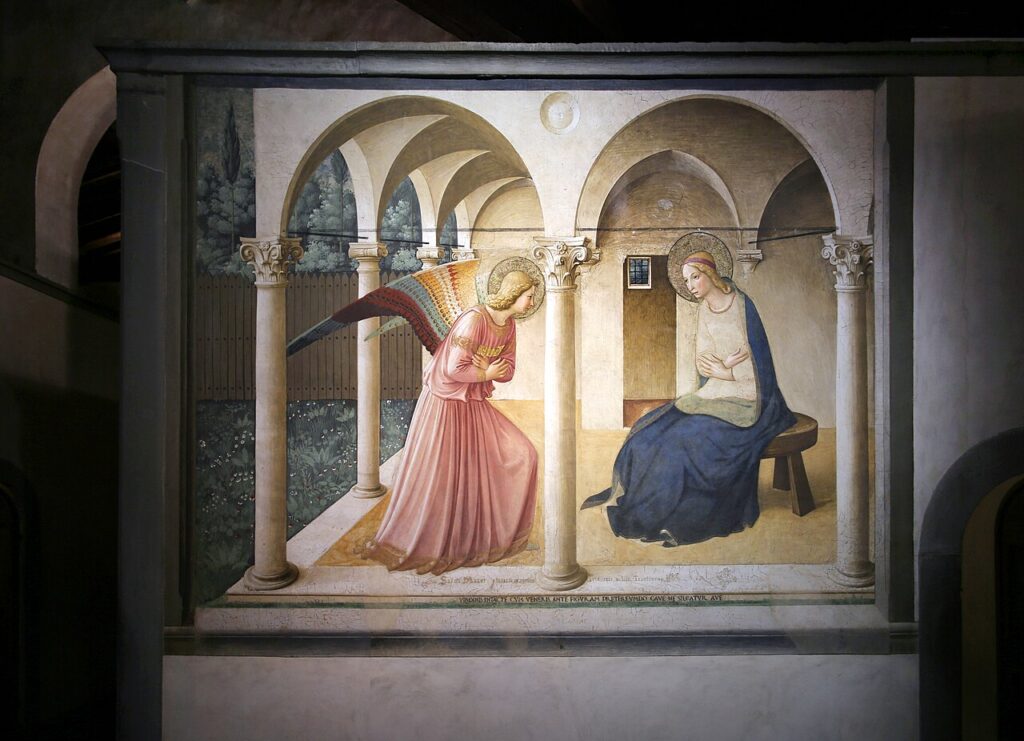
Given my delight in encountering the human source of the work of art, it was no surprise that of the two “principal venues” of this exhibition, the “former Dominican convent” (now the Museo di San Marco, 15-20 minutes by foot from the Palazzo Strozzi), Angelico’s residence for maybe as many as seven years (1438-1445)—where his “frescoes, which represent a distinct and central phase of his artistic career, can be found throughout the conventual spaces” (as Stafano Casciu describes this venue in the catalogue)—entranced me as the Strozzi’s traditional museal setting hadn’t quite. Add to the almost palpable presence there of the artist the later illustrious footsteps in which I was walking—those, as Delistraty observes, of Ruskin, Henry James, Rilke, and Mark Rothko (an exhibition of whose paintings is on view at the Strozzi and San Marco even as I type)—and you can begin to imagine how “transportative,” to use Ashley’s apt description of our experience, was my tour especially of the first-floor dormitory, which began and ended at a stairwell that opens on Angelico’s most famous, serenely transcendent Annunciation.
#/media/File:Beato_angelico,_Annunciazione_del_corridoio_Nord,_1440-50_ca._01.jpg)
Sunday morning, January 18, found us there. You view the scene as through a window, an “Albertian-type window” (as Marco Mozzo terms it in the catalogue), framed as it appears to be by gray beams. While rendered spatially near, there’s nothing overt about it—a gesture of shock, the tractor beam of an eye on you, a plethora of symbols for decoding, steep orthogonals—nothing that grips to pull you in. What did catch my eye right away was the angel’s right wing—only the tip of the left is visible—its colorful bands of feathering (gold and blue and red) glittering as they did, thanks to some reflective mineral, which threw off light from a nearby window. In the 15th-century’s flickering, candlelit corridor, the effect would have been preternatural.
As Mozzo points out in the catalogue, “The spatial composition has its ideal centre in the face of the Virgin”—there your eye should go. Boasting Corinthian columns, two archways into a loggia greet you. Angled more towards you (almost straight on), the one on the right shows her sitting on a wooden stool. The room is otherwise bare. She is wearing an off-white, round-collared gown and a voluminous blue cloak that hangs from her shoulders and covers her legs without revealing their shape. You must infer the presence of knees from the fall of the cloak—on them no book. (Nor phallic dove aloft.) The way the cloak’s pale lining has turned down where it covers her lap elongates her torso, which is breastless. She has, in a gesture of evident acceptance, crossed her arms, hands open, “over her abdomen, where she will carry Christ in her womb,” Strehlke observes in the catalogue. She leans, head lowered (blond, her hairband mauve), eyes fixed on the angel’s. There is, slightly to the left of the figure (and right of center), a doorway to another, shallow room, through which a small window, more or less level with Mary’s head (minus its halo), is visible. The composition’s vanishing point is there.
The angel, whose blond head, also haloed, is on a slightly lower level than Mary’s because he is respectfully bowing, occupies the left archway. He wears a gold-embroidered pinkish robe with a gathered, if not pleated, skirt. His arms, folded as they are, hands open, across his chest, convey sincerity as well as respect. His otherworldly wings extend to the edge if not a little beyond the edge of the loggia, which, angling rightward, opens with three archways (the middle one of which is supported by Ionic columns) onto a green, white-flowering space enclosed by exactly the type of privacy fence that separates our back yard from our neighbor’s. That enclosure, the audio guide informed me, symbolizes Mary’s virginity while also evoking Eden. (The Latin term for this space, hortus conclusus, comes from Song of Songs 14, Canticum Canticorum in the Vulgate: “A garden inclosed is my sister, my spouse.”) Symbolically, The Annunciation inaugurates the New Eden, with the now-incarnate God becoming the new Adam—a theological eyebrow-raiser, given that this Adam (who is one with the Father that sired him) is the new Eve’s son.
Beyond the fence is forest, which signifies—or so I think—the world at large, whose responsible maintenance or clearing for fields, the aim of which is the restoration of Eden, requires the faithful work of hands, The Incarnation notwithstanding. (Nor am I forgetting that Joseph and Jesus after him were carpenters, whose trade depends on a harvest of trees.) That forest, which is also what’s outside the room at the back’s small window, is where the vanishing point, the symbolic focus of the artist’s creative labor, finds its location.
Nothing dramatic demands your participation. (Even the Latin inscription running along the square edge of the loggia’s floor assumes a respectful distance kept, instructing you as it does to hail Mary). Rather, the intense stillness of the fresco insists that the scene, the miracle, will always be out there, taking place in a liminal, cultivated enclosure outside your window, surrounded by forest, the world, which surrounds you too. Serenely self-involved, it invites you to stand at the window forever and gaze—if not always in body, then in mind. If you happen to know “The Annunciation” by Edwin Muir, it is impossible not to recall the poem’s concluding lines: “These neither speak nor movement make,” Muir writes of the angel and the “girl,” “But stare into their deepening trance/As if their gaze would never break”—as Mary’s does, I suppose, in nine months’ time when it becomes entranced by her newborn son’s. (That son of hers, who’s no less human than divine, will also, like the forest, need the care of hands.) Meanwhile, the “deepening trance” in this Annunciation communicates a stillness that demands of you the utmost discipline to attain: “Be still,” the Psalmist speaking for God demands, “and know that I am God”—such stillness, which promises refuge, as Mary here embodies, saint that she is already.

David Havird
David Havird is the author of three collections of poems, of which the most recent, Weathering (Mercer University Press, 2020), includes prose memoir, about youthful encounters with James Dickey, Robert Penn Warren, Robert Lowell, and Archibald MacLeish, as well as poetry. His poems and essays have appeared in many periodicals, including Agni, The Hopkins Review, Literary Matters, Plume, Raritan, and The Yale Review. A graduate of the University of South Carolina, where he studied under James Dickey, he completed his graduate education at the University of Virginia with a doctoral dissertation on Thomas Hardy. Havird retired from the classroom in 2020 after 30 years at Centenary College of Louisiana. He lives with his wife, the poet and novelist Ashley Mace Havird, and their Carolina dog, Sheba, in Shreveport. (Author Head Shot Augment: René Laanen, Sr.)
2 Comments
David Havird
It’s possible, even likely, that William Carlos Williams also visited the Museum of San Marco in Florence, and did so in March 1910 in the company of his younger brother, Edgar, who was studying architecture at the American Academy in Rome. In a poem, “March,” in Sour Grapes (1921), Williams likens the month to “Fra Angelico/at Fiesole, painting on plaster!” Fra Angelico did initially reside at the Dominican convent in Fiesole, which is three or so miles northeast of Florence, before moving to San Marco, and it’s no less likely that Williams and his brother went there as well. But the poet’s description of the fresco, though he locates it “in a monastery/with plaster walls—in Fiesole/on the hill above Florence,” can only apply to the Annunciation at San Marco: “a virgin—in a blue aureole” (which is not, of course, the right word for the blue cloak draping the Virgin’s left shoulder and lap):
sitting on a three-legged stool,
arms crossed—
she is intently serious,
and still
watching an angel
with coloured wings
half kneeling before her—
and smiling—the angel’s eyes
holding the eyes of Mary
as a snake’s holds a bird’s.
On the ground there are flowers,
trees are in leaf.
Perhaps the ironic analogy, which compares the angel’s eyes to those of a snake that hypnotizes its prey (this snake’s being the Virgin Mary), reflects the poet’s ambivalent attitude to Christianity. Or is the analogy merely inapt?
Don Belt
Hi David,
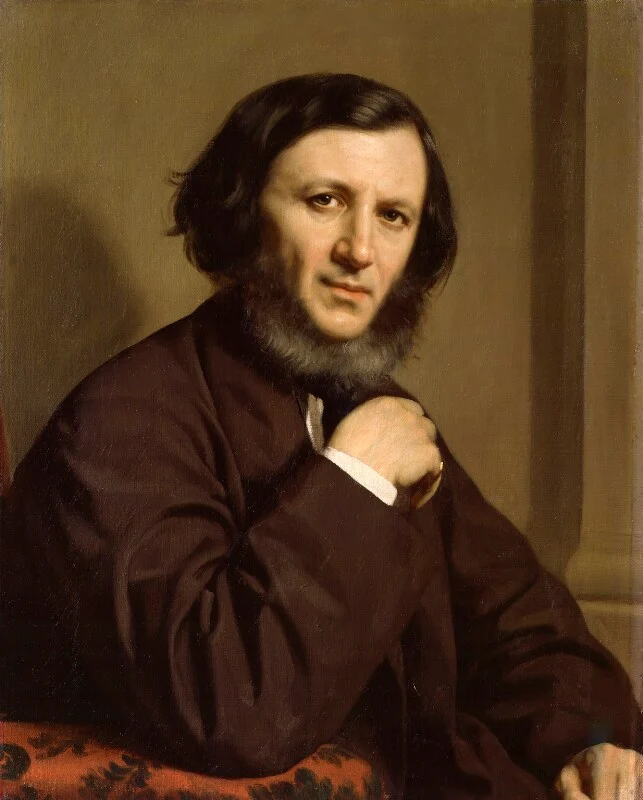
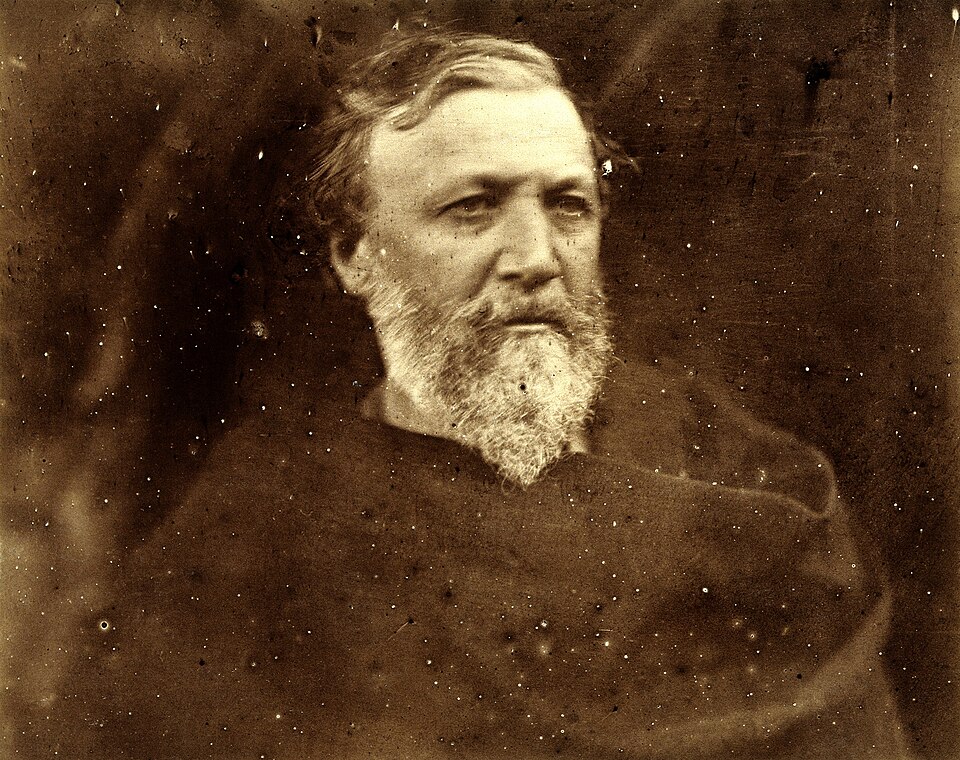
I enjoyed this piece immensely, including that amazing photo of Browning in 1865. I’d forgotten (or maybe I never knew) that the couple had a home in Florence. I was there a few years ago…sorry to miss it.
Your vivid descriptions of these paintings reminded me of a sublime gallery of images of Mary from around the world, displayed in the courtyard of the Church of the Annunciation in Nazareth. If you and Ashley are ever traveling in Galilee in northern Israel, it’s worth a trip to Nazareth to take them all in. Here’s a sample of the mosaics: https://guideposts.org/angels-and-miracles/miracles/gods-grace/the-annunciation-images-of-mary-from-around-the-world/.
All the best,
Don