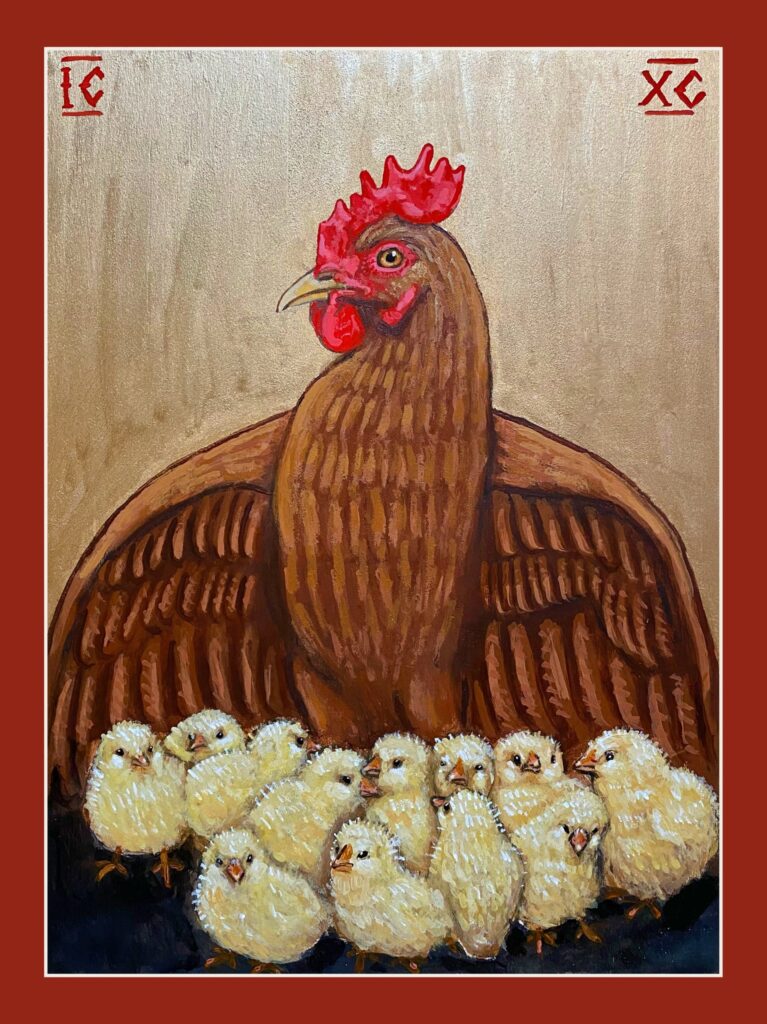
Lola & Her Mother Hen: Luke 13: 31-35
“Chris transported Lola to and from work safely in a backpack and ensconced her in a dog stroller to keep the chicken safe while she was out on the farm working. Using an old metal music stand and some canvas, Chris fashioned a sort of sling so that Lola could remain weight-bearing but also supported. The women filled a litter box with dirt so Lola could dust-bathe, eat, and continue learning to be a chicken. Over time, Chris became Lola’s legs. Lola went to work and social gatherings with Chris and sat on the kitchen counter in her backpack while Chris made dinner. Chris and Lola were virtually inseparable, and that little chick that once fit in the palm of Chris’s hand . . . became her heart.”—Rev. Robin White
Wing + Prayer
By The Reverend Robin White
 PENDLETON South Carolina—(Hubris)—May 2026—Let me tell you a story about a mother hen.
My beloved friend Chris lives in Ithaca, New York, where she has worked, for years, at the Farm Sanctuary in nearby Watkins Glen. One day, visiting a local feed and farm store during their “spring chick days,” she just had to have a look. Among the 13 little puffs of chick magic in a wire-bottomed cage, Chris was alarmed to see that one of the baker’s dozen was face down and very clearly not doing well.
Chris asked to be given the fledgling so she could take him to the Cornell Vet school, but there even the amazing Dr. Ricardo de Matos wasn’t able to save the chick, and instead humanely euthanized the little being.
Chris then went right back to the store to purchase the chicks that remained, just six. And so began her journey of raising bantam chickens . . . in her spare bedroom.
They grew, were healthy, and Lola, a sweet little lemon-chiffon chick, soon began sprouting snowy white feathers. When it was warm enough, in late May, and the chicks could come out from under their heat lamp, Chris and her partner Karen took them outside so that they could explore grass, bugs, and dirt, and learn to dust-bathe. Soon, however, Chris realized that Lola wasn’t keeping up with her siblings. She would peep an alarm, and the other chicks would all scurry back to her. A day or so later, Lola stopped eating.
Chris made another trip to the Cornell Vet school. Though they couldn’t figure out what exactly was wrong with Lola, they gave her an antibiotic and she resumed eating, seemingly back to normal until she began staggering. Soon, Lola lost the ability to walk altogether. Not surprisingly, Karen and Chris began creating workarounds to help Lola “retain a chickenness.”
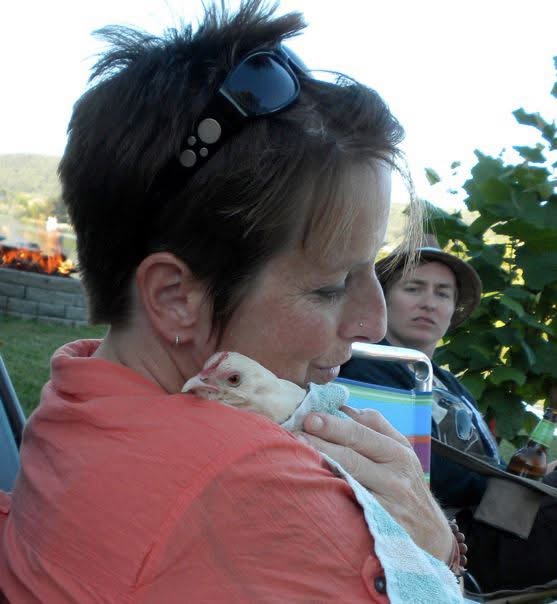
Chris transported Lola to and from work safely in a backpack and ensconced her in a dog stroller to keep the chicken safe while she was out on the farm working. Using an old metal music stand and some canvas, Chris fashioned a sort of sling so that Lola could remain weight-bearing but also supported. The women filled a litter box with dirt so Lola could dust-bathe, eat, and continue learning to be a chicken.
Over time, Chris became Lola’s legs. Lola went to work and social gatherings with Chris and sat on the kitchen counter in her backpack while Chris made dinner. Chris and Lola were virtually inseparable, and that little chick that once fit in the palm of Chris’s hand . . . became her heart.
One day, Karen put Lola down outside near the coop filled with the other chickens and left her alone for only a minute to go inside. In that blink of an eye, a hawk swooped down and snatched Lola away. Chris, devastated, began searching for Lola immediately. Knowing that a hawk takes its prey to a secluded spot, she scoured the area, begging and pleading for any attending spirit to help her find Lola alive.
Soon, she began simply to pray that she would find Lola’s remains and, as though a voice were directing her, she headed into the brush, down the road a bit from their house. There, she found what was left of her beloved Lola.
A friend remarked, “Lola didn’t live the life of a chicken, but her death was a chicken’s death.” And it was probably small comfort to Chris at the time but, because of Lola, the other chickens on the property had been spared.
Despite her grief, Chris had to admit that Lola’s time on earth had been splendid. In her memory, she had Lola’s image tattooed on the inside of her arm.
Chris, the nurturing mother hen, had given Lola as good a life as was possible, and Lola, the vulnerable and seemingly powerless chicken, had given her life to preserve the brood in the garden.
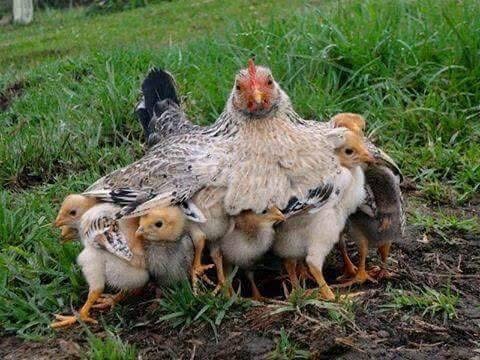
Jesus as mother hen (Luke 13: 31-365) may not be a metaphor any of us would have chosen. Why not a lion or a bear, or even a hawk, something at the top of the food chain? Chickens don’t even have a lot in the way of defenses: no teeth or claws; not even much of a beak. Surely there is a better analogy. And yet, a mother hen, her feathers puffed out, sheltering her chicks beneath her warm body is how Jesus describes himself: a creature whose love and courage stand in stark contrast to the power of teeth and claws.
In a world choosing might over right, where the Department of Defense is renamed the Department of War, Jesus’ metaphor would be seen as “weak” by most. With our feathers flying, and our chicks, worldwide, scrambling for cover, it looks very much as though the hawk, the fox, the apex predator has won. And, as we are told over and over, it’s all about “winning.”

I love what preacher Barbara Brown Taylor says about this text in Luke:
“[The hen] had refused to run from the forces, and she had refused to become one of them. Having loved her own who were in the world, she loved them to the end. She died a mother hen, and afterwards she came back to them with the teeth marks on her body to make sure they got the point: That the power of foxes could not kill her love for them, nor could it steal them away from her. They might have to go through what she went through in order to get past the foxes, but she would be waiting for them on the other side, with love stronger than death.
“I have never really thought about the church as a mother hen, but I am thinking about it now. The church of Christ as a big fluffed up brooding hen, offering warmth and shelter to all kinds of chicks, including orphans, runts, and maybe even a couple of ducks. The church of Christ planting herself between the foxes of this world and the fragile-boned chicks, offering herself up to be eaten before she will sacrifice one of her brood. The church of Christ staying true to whose body she is, by refusing to run from the foxes and refusing to become one of them.”
Luke tells us that Jesus, on his way to Jerusalem, grieves for the city that kills the prophets and stones those who are sent to it. . . . The Gospel writer Luke mentions “Jerusalem” 90 times in his story: however, there is no previous account in Luke of any ministry in Jerusalem. For Luke, Jerusalem is the symbolic center of the universe; because of this, it needs to be emphasized that the action of God, the offering up of Jesus, happens but is rejected—right there in Jerusalem.
Jesus, having just been warned about Herod’s plan to destroy him, looks out upon the Holy City and sees clearly, writ large, that interstitial gap between Divine desire and human unwillingness.
Take a moment, close your eyes, and visualize that familiar image on the ceiling of the Sistine Chapel, The Creation of Adam, by Michelangelo, God’s and Adam’s fingers almost touching. That small but significant space in-between is what Jesus grieves . . . .
In his grief, he longs to occupy that space, to be a mother hen sheltering and preserving her fragile chicks beneath her wings; the chicks certain of their safety in her care. As he makes his way into Jerusalem—the city that will devour him—Jesus will indeed fill that hollow space and it will overflow with his love.
All too often, the church is so consumed with self-preservation that it fails to be the church of Jesus Christ; the church willing to give itself up in order to protect others; the church willing to be devoured for the sake of the chicks.
As we hold in the palms of our warm, privileged hands the weak, the sick, and the vulnerable, may we feel their heartbeat as our own.
As the church—but not only as the church, as human beings in community with one another—may we seek to live not as the world lives but, rather, as Christ lived, for the sake of the fragile, suffering, pariahs of our planet.
May we gather up all those who long for protection as well as those who need it but may not yet recognize their need. May the church become warm, constant heart that expands, filling the empty space.
May we in our place of safety assemble beneath our warm bodies all who come near, lest we forget that, nailed up there on the cross, Jesus gathers us all in . . . under God’s wings.

Editor’s Note: In researching images for this column, I came across an April 2025 CNN article about Rev. Barbara Taylor Brown that I feel complements Rev. White’s. It is titled “The Easter story helps an ‘outcast’ preacher find her way back home,” by John Blake, and may be found here.

Robin White
The Rev. Robin Kaye White grew up in a farming community in Central New York State: she is descended, on both sides of her family, from dairy farmers, and is most alive, still, in rural North American landscapes. A voice major, she studied Music at Ithaca College; then earned her MDiv at Lancaster Theological Seminary and did graduate work at Princeton Seminary and The Theological Institute of Advanced Theological Research in Jerusalem, Israel. Ordained in the Presbyterian Church (USA), White was recently a Co-Moderator of the National Board of More Light Presbyterians. In the summer of 2023, she served as Bridge Pastor at Mount Auburn Presbyterian Church in Cincinnati Ohio. White is passionate about liturgy—“the work of the people”—and preaching. In her sermons, she strives to illuminate the original context of scripture and tease out its messages for the fraught present. She has had the privilege of “holding space” for the dying and their loved ones and experiences this ministry of presence as a gift: she is most willing to go with people as they journey to desert places. She states: “I have lived my life by adhering to Paul’s words in his letter to the church at Rome, ‘Rejoice with those who rejoice and weep with those who weep.’” She is just as likely, though, to quote Rachel Held Evans as St. Paul: “This is what God’s kingdom is like: a bunch of outcasts and oddballs gathered at a table, not because they are rich or worthy or good, but because they are hungry, because they said yes. And there’s always room for more.” A Lesbian-Pescaterian-Presbyterian, Reverend White is most alive out of doors, whether hiking, biking, kayaking, golfing . . . or just sitting on a rock. (Banner and Author photos: E.B.-Herring; Author Head Shot Augment: René Laanen.)