Burning Up at Both Ends
Planetary Hospice
By Dr. Guy McPherson
“A heatwave in Antarctica might seem remote from everyday life. But what happens there has global consequences. Antarctica holds most of the world’s freshwater, locked in vast ice sheets. Even short-lived warming events can influence snowfall, surface melt and the stability of floating ice shelves that hold back glaciers. When these ice shelves weaken, glaciers can accelerate into the ocean, contributing to sea level rise that affects coastlines worldwide. Perhaps most importantly, the 2024 heatwave shows how climate change is transforming not just average temperatures, but extremes. Atmospheric processes that have always existed can now have a far greater impact in a warmer world.”—Haosu Tang, Climate Scientist, University of Sheffield
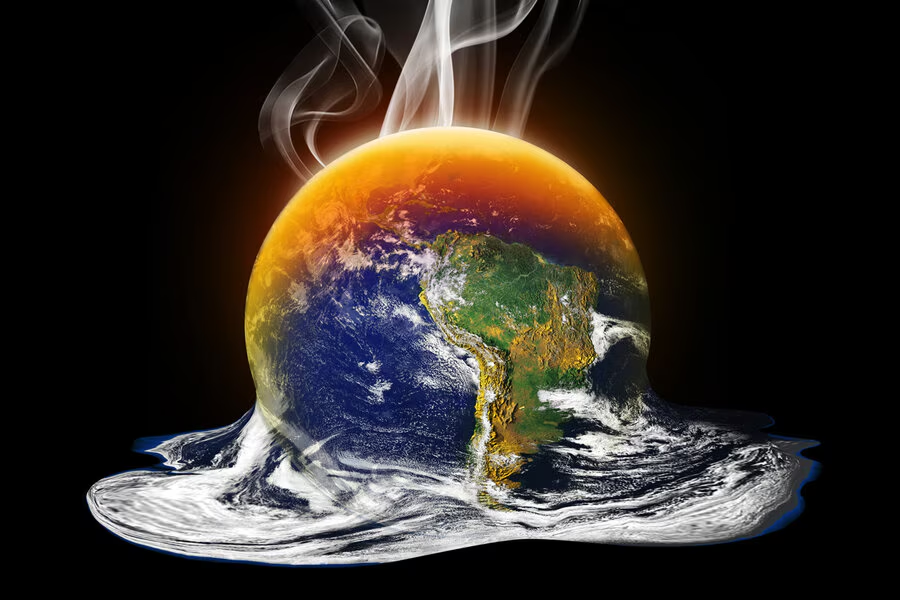
“Some say the world will end in fire,/Some say in ice./From what I’ve tasted of desire/I hold with those who favor fire./But if it had to perish twice,/I think I know enough of hate/To say that for destruction ice/Is also great/And would suffice.”—Robert Frost, “Fire and Ice”
 BELLOWS FALLS Vermont—(Hubris)—July/August 2026—I have frequently spoken and written about the Arctic Ocean as the planetary air conditioner. Recently, I have been reporting on the importance of Antarctica in regulating this planet’s temperature. It has become clear that the temperature of both poles is critical to the maintenance of habitat for all species on Earth.
“An article in The Conversation, titled How Antarctica warmed by 28°C in the depths of winter—and what it signals for the decades ahead. Published on 24 April 2026, the piece includes an embedded link to a peer-reviewed, open-access paper in the renowned Nature series of peer-reviewed publications. I’ll refer to this paper later. The first five paragraphs of the article in The Conversation provide abundant information:
“In the middle of the Antarctic winter, during months of darkness when temperatures often dip below −30°C, the continent warmed dramatically.
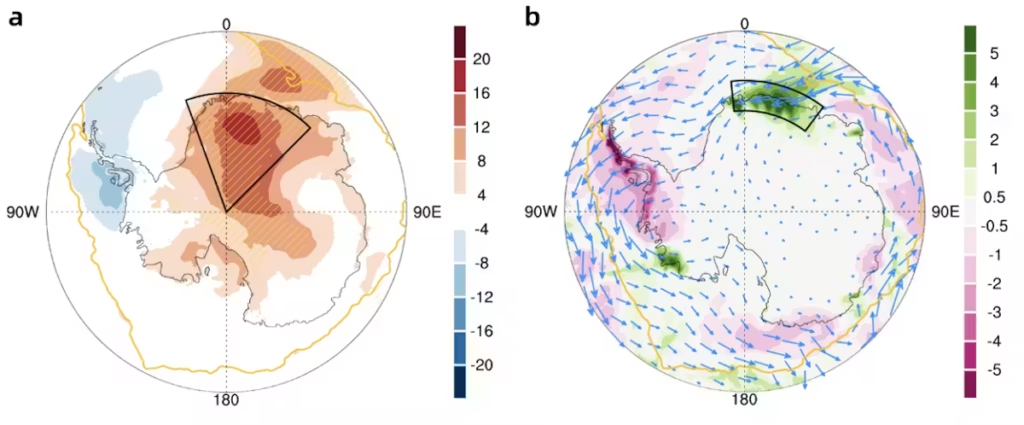
“In July and August 2024, temperatures in parts of East Antarctica rose by up to 28°C above average and stayed high for more than two weeks. To put that in perspective, a similar anomaly in the UK would push January temperatures into the mid-30°-Cs.
“In a recent study, colleagues and I show the Antarctica heatwave was not simply unusual weather. It was a rare atmospheric disturbance, amplified by human-caused climate change, offering a glimpse of what could become more common in the decades ahead.
“This was not an isolated event. It followed a heatwave in March 2022, when temperatures in some Antarctic areas soared by nearly 40°C above average—one of the largest temperature anomalies ever recorded anywhere on the planet.
“Together, these events point to a clear shift: extreme warming is no longer confined to traditionally vulnerable regions.”
The next subsection is titled How the heatwave unfolded. It provides an excellent overview of the situation in five paragraphs:
“In 2024, the extraordinary winter heat began with a weakening of the Antarctic polar vortex—a band of strong winds high in the atmosphere that usually keeps cold air locked over the continent. In July 2024, this vortex became distorted, allowing unusual warming in the stratosphere, where temperatures rose by more than 15°C in early July, with another surge in early August.
“These changes in the upper atmosphere set the stage for what followed.
“A persistent high-pressure system developed over East Antarctica, opening a pathway for a long, narrow plume of warm, moisture-rich air—known as an atmospheric river—to move deep into the continent. This air mass transported heat from lower latitudes into the Antarctic interior —something that rarely happens in winter.
“Clouds associated with the system acted like a blanket, trapping heat near the surface and preventing it from escaping back into space. Instead of a brief spike, the result was a prolonged and widespread heatwave.
“At the same time, Antarctic sea ice was near record lows and the surrounding Southern Ocean was unusually warm, likely linked to the same large-scale atmospheric conditions and helping to sustain the flow of heat into the continent.”
The final subsection introduces who deserves the blame. Titled A warming signal from the coldest place on Earth, it includes these six paragraphs:
“Natural variability helped trigger this heatwave. But it unfolded in a climate system already altered by human activity.
“Our analysis, using computer simulations to compare today’s climate with a world without human influence, shows climate change made the 2024 winter heatwave both stronger and more likely. Such extreme weather would have been exceptionally rare in the past, but today it is already significantly more likely—and could become up to 20 times more frequent by the end of the century under high emissions.
“A heatwave in Antarctica might seem remote from everyday life. But what happens there has global consequences.
“Antarctica holds most of the world’s freshwater, locked in vast ice sheets. Even short-lived warming events can influence snowfall, surface melt and the stability of floating ice shelves that hold back glaciers. When these ice shelves weaken, glaciers can accelerate into the ocean, contributing to sea level rise that affects coastlines worldwide.
“Perhaps most importantly, the 2024 heatwave shows how climate change is transforming not just average temperatures, but extremes. Atmospheric processes that have always existed can now have a far greater impact in a warmer world.
“This is why Antarctic heatwaves matter. Even the most remote and coldest parts of the planet are being transformed by global warming. And what happens there—through rising seas and shifting climate patterns—has consequences way beyond the poles.”
The final phrase perfectly sets up the peer reviewed paper in the renowned Nature series of publications. Published in npj Climate and Atmospheric Science, the peer reviewed, open access publication is titled Unprecedented 2024 East Antarctic winter heatwave driven by polar vortex weakening and amplified by anthropogenic warming. The paper was created by 13 scholars and published on 1 April 2026. The Abstract provides an excellent overview:
“During July-August 2024, East Antarctica experienced the most intense winter heatwave in the 46-year satellite era, with regional mean surface air temperatures across Dronning Maud Land exceeding the climatological mean by more than 9° C for 17 consecutive days. To explore the physical drivers and quantify the anthropogenic contribution to this unprecedented event, we propose a multi-model, multi-method attribution framework integrating regional climate model-based storyline attribution, circulation analogues, and large-ensemble probabilistic attribution. The results show that a pronounced weakening of the stratospheric polar vortex initiated a quasi-barotropic high-pressure anomaly, which enhanced meridional heat and moisture transport and accounted for approximately 50 percent of the observed surface warming. Across different models and attribution methods, synthesis of the attribution results indicates that anthropogenic warming intensified the event by approximately 0.7° C and more than doubled the likelihood of such exceptional winter heatwaves in the current climate. Probabilistic attribution further indicates that, compared to a natural climate without human influence, the likelihood of such events increases from 2-3 times today to ~6 times under moderate emissions and up to 26 times under high emissions by 2100. These findings reveal how human-induced warming is transforming even the coldest regions, with implications for ice shelf stability and predictability of future Antarctic extremes.”
It has become increasingly clear that both poles on this planet matter. The abrupt warming of Antarctica matches that of the Arctic region. The abrupt, irreversible warming of both poles serves as further evidence that the designed-to-fail Intergovernmental Panel on Climate Change was correct when it concluded that anthropogenic climate change is abrupt and irreversible. The IPCC, created during the Ronald Reagan administration, reached this conclusion with two reports published more than six years ago.
Editor’s Note: Dr. McPherson’s columns always necessitate for me a deep dive into primary sources. The first article he references above was written by Haosu Tang, a Research Assistant in the Dept. of Geography and Planning at the University of Sheffield, UK. Tang obtained his PhD in Meteorology from the Institute of Atmospheric Physics (IAP), Chinese Academy of Sciences, in 2023. After completing his doctoral studies, he worked as an assistant researcher at IAP before joining the School of Geography and Planning as a Research Associate. He is currently contributing to the Processes, Impacts, and Changes of ANTarctic Extreme weather (PICANTE) project, where his research focuses on identifying and understanding the large-scale drivers of Antarctic extreme events. His work involves attributing these events to anthropogenic climate change through statistical and storyline approaches, analyzing changes in their frequency and intensity, and investigating trends and variability in the large-scale drivers using projections from multi-model large ensembles.

Guy McPherson
Dr. Guy McPherson is an internationally recognized speaker, award-winning scientist, and one of the world’s leading authorities on abrupt climate change leading to near-term human extinction. He is professor emeritus at the University of Arizona, where he taught and conducted research for 20 years. His published works include 16 books and hundreds of scholarly articles. Dr. McPherson has been featured on television and radio and in several documentary films. He is a blogger and social critic who co-hosts his own radio show, “Nature Bats Last.” Dr. McPherson speaks to general audiences across the globe, and to scientists, students, educators, and not-for-profit and business leaders who seek their best available options when confronting Earth’s cataclysmic changes. Visit McPherson’s Author Page at amazon.com. (Author Head Shot Augment: René Laanen.)