The Funeral That Wasn’t
Eating Well Is The Best Revenge
By Diana Farr Louis
“He was literally a godsend, highly intelligent, fun to talk to on any subject from Heather Cox Richardson to Gustave Mahler, and a good cook whose specialties were anything with tomatoes, pasta, ice cream, and birthday cakes. But after Harilaos slipped away on 10 December, Michael slowly started on his own downhill trajectory. He continued writing his memoir, which he sent chapter by chapter to Amherst, his alma mater, but not with the same verve. And realizing that any venture in Albania was out of reach, he told me that ‘life without a project was not worth living.’”—Diana Farr Louis
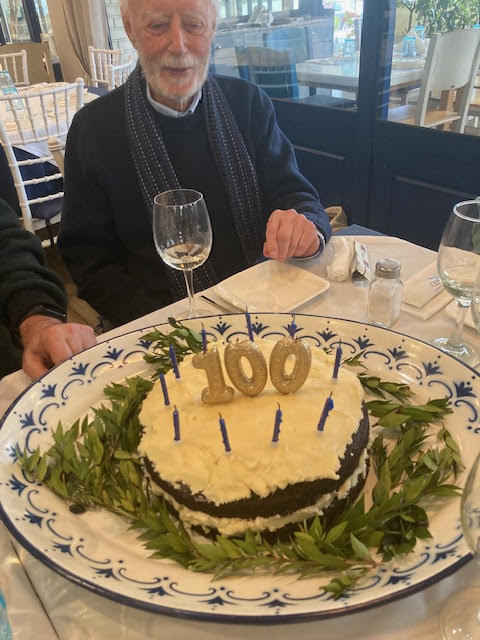
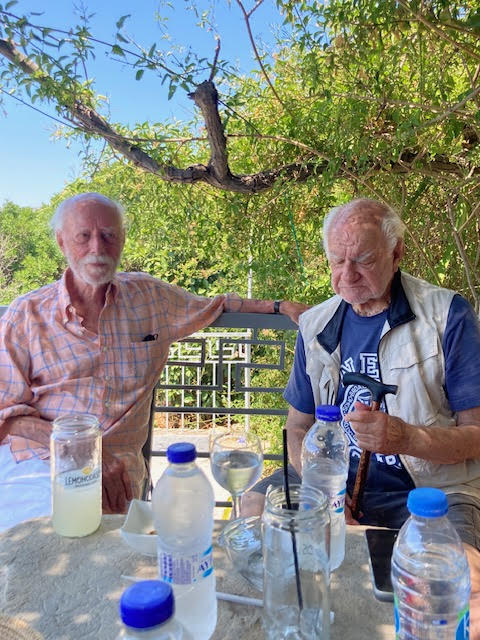
 ATHENS Greece—Hubris—July/August 2026—Last summer, my husband’s last, we were able to enjoy two and half months in our island home on Andros thanks to an unlikely geriatric ménage à trois: Harilaos aka Joy of the People was 100, our friend, Michael Sisk, sometimes referred to as “young Michael” because he was merely 90, and me, half a decade younger.
Michael Sisk, an American who had dedicated his life to producing operas and festivals in Athens and other parts of Greece, Paris, the US, and Egypt, had no family and a meager pension. But he thought of us as family and, on July 8, 2024, landed on my son’s sofa “for a few days,” hoping to organize an opera festival in the ancient theater of Butrint, Albania (not far from the controversial, proposed Kushner resort). The first opera was to be Purcell’s Dido and Aeneas since, according to myth, Aeneas founded Butrint on his way back from Troy to Italy. A splendid idea, it was obviously a pipe dream, given his age, Trump’s slashing of aid to just about every organization that did not benefit him personally, and the state of the theater itself. But I am convinced that Providence sent him to be a companion to his dear friend whom he’d known since 1968, when he was living on Hydra.
He was literally a godsend, highly intelligent, fun to talk to on any subject from Heather Cox Richardson to Gustave Mahler, and a good cook whose specialties were anything with tomatoes, pasta, ice cream, and birthday cakes. But after Harilaos slipped away on 10 December, Michael slowly started on his own downhill trajectory. He continued writing his memoir, which he sent chapter by chapter to Amherst, his alma mater, but not with the same verve. And realizing that any venture in Albania was out of reach, he told me that “life without a project was not worth living.”
In early March, he was rushed to a public hospital in Athens with a cardiac crisis and had another stent put in, bringing the total in his heart up to eight. Ten days later, he was released to my son Petros, whose living room became unlivable, floor and tables piled high with pills, water and laxative bottles, tissues, etc., etc. Michael could not walk farther than the kitchen and could not eat more than a few mouthfuls of anything, even food he craved like pastitsio (baked macaroni), and was often found on the floor.
What were we going to do with him? We could not afford a care home, and we wanted to be able to go back to the island this summer. Michael solved the problem, leaving gracefully and quietly, without warning, during the night of 29 May. The wonderful undertaker who had done such a splendid job with Harilaos’s funeral came to the rescue, sent a doctor to produce the certificate of death, and then came himself with two strong men to discuss the funeral and take the body away.
Because of Michael’s impecunious state, Spyros advised that the funeral take place at the Zographou cemetery, between Pangrati and Mt. Hymettos, since it is the largest in the Athens area as well as the cheapest. He told us to be there at 11 and, by some miracle, we were there on the dot, even before Spyros. We waited another 15 minutes for a dear old friend to come, a friend we’d met on the day Petros and I arrived in Maroussi on June 4, 1972.
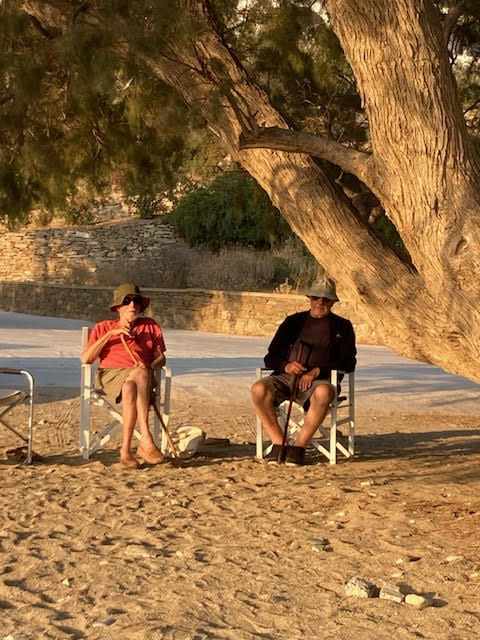
And then we six mourners set out, in the heat, down a small slope and up a much longer slope until we finally got to the relatively flat, camel’s way. A few cars passed us and a motorbike going the other way. Who knew? But we trudged along and finally got to the far end of the cemetery where trucks, including a garbage truck, were parked.
We waited for a priest but none came. We waited some more. Then finally Spyros had to join the two laborers to pick up the simple, shiny brown wooden coffin with a nice white cloth border, and put it into the grave. We approached and threw in our white roses, bought before we entered the cemetery. And the workmen shoveled the loose dirt over the coffin.
“Thank you, Michael,” I whispered, “for all your help with Harilaos, and for leaving so quietly and gracefully.”
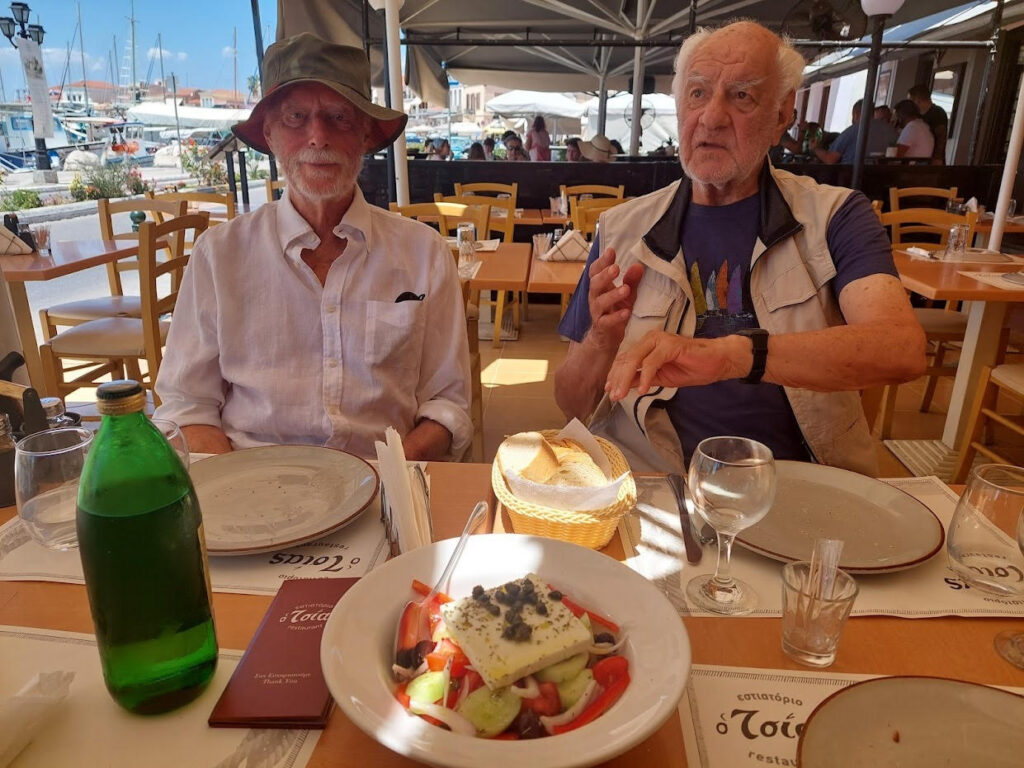
And now what? We waited some more. Spyros called the cemetery authorities, repeatedly. The priest was somewhere else. No, he couldn’t be there right now. No, no one else was available . . . .
Finally, we gave up and a vehicle with a very high step arrived to take us back to the entrance. I couldn’t manage the climb and wanted to walk anyway. So Petros and I had a pleasant downhill amble back to the entrance and then headed to a sort of cafe across the street for coffee or lemonade and the obligatory bit of sweet, some very nice honey biscuits.
Meanwhile, Spyros and Giorgos had set off to find the priest. They were gone for at least half an hour and when they finally joined us, they had an unacceptable story of hide and seek. I wish I’d been paying better attention to all the details that Giorgos recounted. He and Spyros seem to have gone on a wild goose chase. Yes, the priest was there, but then he wasn’t, he was somewhere else, oh, he must be over there, etc., etc.
Finally, they found someone who demanded to see the official death certificate, which Spyros produced. There it writes that Michael was Protestant, and according to Greek Orthodox Christian regulations, he would be classified as a heretic and have no right to be buried on sacred Orthodox land. However, he was Episcopalian and, as such, in a different category but the doctor who wrote the certificate had simply written “Protestant.” And it seems that the priest was annoyed that he was only going to perform a very simple blessing, which is normally done 40 days after a funeral. And that there would be no church service. Obviously, he wanted his cut—we were scandalized at this very un-Christian behavior. He would have gotten something for his services, but he chose to withhold them. I hasten to add that the undertaker had never experienced this before.
The next day, Spyros told Petros that a priest had gone in the morning to perform the blessing. I can only imagine Michael and Harilaos chuckling over this story with a glass of celestial wine in some corner of the hereafter.
Recipe
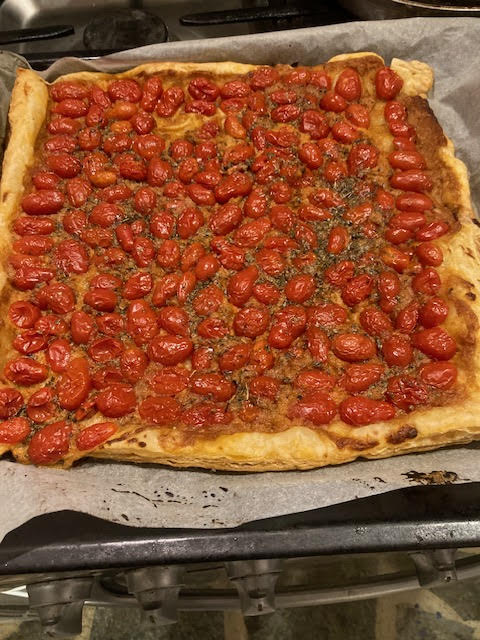
Michael Sisk’s Tomato Tart
Among Michael’s vast repertory of goodies, sweet and savory, this simple tomato tart will never be forgotten. He prepared it, along with tapenade dip and his signature vanilla ice cream, using a mixer he’d given us decades before, for a farewell party for some UK friends.
Frozen pie dough of your choice
Enough cherry or oval tomatoes to fill the pan
Olive oil
Sea salt and freshly ground pepper
Dried oregano for sprinkling
After defrosting the pastry, lay it out on a baking sheet that you have covered with parchment paper to prevent sticking. Brush the pastry with olive oil. Slice the tomatoes in half and place them next to each other on the oiled pastry. Sprinkle with salt, pepper, and oregano, place in a hot oven, and bake until the pastry edges start to brown, and the tomatoes are soft.
Slice and enjoy.
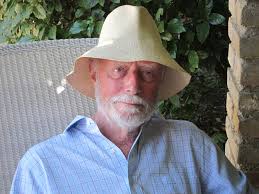
Editor’s Note: There follows here a biography of Michael Sisk.
Beginning with the mechanic’s play-within-a-play from A Midsummer Night’s Dream at age 14, Michael Sisk has pursued a career as an international theatre and opera director, dramaturge, producer, and sometime impresario in Europe and the United States. His first professional productions, in his early 20s, were in Europe: Anderson’s Petrified Forest for the US State Department Cultural Project in Paris and Saroyan’s The Cave Dwellers in London. Back in the US, he directed the New York premiere of the Ghelderode plays in 1963 and in 1964, founded the first US professional Regional Repertory Theatre, The Morris Rep, in Morristown, New Jersey, where he pioneered the diverse play list—Sophocles to Beckett; drama to opera—which the developing regional theater movement was to embrace.
Moving back to Europe in the 1970s, he was joined by Maestro Thomas Schippers and composer John Corigliano to produce the Corfu International Festival on the eponymous Greek island. The festival brought the New York Pro Music, Tomazewski’s Polish Mime Theatre and many young American artists to the lovely Kopanous Theatre he built for the festival and to which he would return 40 years later.
Asked by President Anwar Sadat to create an international festival to celebrate the opening of Egypt to the West, Mr. Sisk spent the latter 70s and early 80s in Egypt developing the program and complex planning for the festival site to be built in Luxor. He brought Zubin Mehta, Maurice Bejart, Twyla Tharp, and many other artists to Egypt to assist in event planning which eventual dark developments in the Middle East thwarted. But his Aida for Karnak with the Arena Opera di Verona was realized and the Hassan Fathy designs for the Nile Festival Village are widely studied as a model of indigenous architecture adapted to contemporary use.
Returning to Greece, Sisk established the Nafplion Chamber Music Festival before moving to Paris in the late 80s and 90s, where he joined the American Cathedral as Artistic Director and created a gospel music concert series with the Smithsonian Institution featuring many gospel pioneers, and also in classical music including the Boston Symphony Chamber Music Orchestra. For Bernadette Chirac’s Festival d’Art Sacre, he recreated the medieval Jeu de Daniel which originated at the American Cathedral and was invited to the Tokyo Festival and the Athens Festival where it was performed in the ancient Herodeon on the Acropolis.
In 1995, with the French and American governments, Sisk commissioned the oratorio, Death has no Dominion, by American composer, Owen Burdick, to commemorate the signing of the armistice which ended World War II. It was performed in Reims Cathedral for an audience including surviving veterans and SHEAF officials present at the signing.
With the turn of the century, Sisk established the French American Centre for the Arts at Espace Pierre Cardin, the former Theatre des Ambassadeurs, on Paris’ Place de la Concord. He introduced the Joffrey Ballet, the Lincoln Center Chamber Music Group, New Orleans’ Preservation Hall Jazz and many others to France. After the events of 9/11 suspended international projects, he produced two operas for the Athens Festival with his long-time artistic partner, Oscar nominated film designer, Denny Vachlioti. Handel’s Hercules was performed at Ancient Nemea, the first performance permitted on an ancient Greek archeological site, before appearing at Athen’s Herodeon. Semele, also conducted by David Stern, starred the young soprano, Danielle de Niese.
The success of Hercules’ on-site performance led to the establishment of the Lyrici Dionesia Opera Festival dedicated to producing Greek-themed operas on the sites which inspired them. Partnering with the Berlin Statsoper Unter den Linden, Strauss’ Electra at ancient Mycenae was to be the first production until the plan was halted by the 2009 financial crisis and Greece’s subsequent financial struggles. The project is currently on hold.
Back in America, Sisk collaborated with the Harlem Opera Theatre to produce Benjamin Britten’s Church Parable, The Burning Fiery Furnace, with an African-American cast in Harlem’s Church of the Intercession. The compelling need for diversity in performance and to provide opportunity for African-American artists brought about the creation of the Church Opera Project which will present theatre and opera addressing the world crisis of inequality with productions in churches in New York, Washington, and Paris. The global pandemic put the project on hold but will surely make eventual performances even more urgent and relevant to Western Civilization’s crisis of identity.
In 2017, Michael Sisk returned to the theater he built for the Corfu Festival 40 some years earlier to produce a brief season of opera with England’s Garsington Opera company. The enthusiastic response of the Greek audience and the international artistic world assures the reopening of this wonderful structure for future generations’ enjoyment and artistic realization, a chief legacy of Sisk’s career.
Michael Sisk was educated at Amherst College, St. Andrews University, the Yale Graduate School of Drama, and Union Theological Seminary. His musical education was at the Cleveland Institute of Music.

Diana Farr Louis
Diana Farr Louis was born in the Big Apple but has lived in the Big Olive (Athens, Greece) far longer than she ever lived in the US. She was a member of the first Radcliffe class to receive a degree (in English) from Harvard . . . and went to Greece right after graduation, where she lost her heart to the people and the landscape. She spent the next year in Paris, where she learned to eat and cook at Cordon Bleu and earned her first $15. for writing—a travel piece for The International Herald Tribune. Ever since, travel and food have been among her favorite occupations and preoccupations. She moved to Greece in 1972, found just the right man, and has since contributed to almost every English-language publication in Athens, particularly The Athens News. That ten-year collaboration resulted in two books, Athens and Beyond, 30 Day Trips and Weekends, and Travels in Northern Greece. Wearing her food hat, by no means a toque, she has written for Greek Gourmet Traveler, The Art of Eating, Sabor, Kathimerini’s Greece Is, and such websites as Elizabeth Boleman-Herring’s www.greecetraveler.com. A regular contributor to www.culinarybackstreets.com, she is the author of two cookbooks, Prospero’s Kitchen, Mediterranean Cooking of the Ionian Islands from Corfu to Kythera (with June Marinos), and Feasting and Fasting in Crete. Most recently she co-edited A Taste of Greece, a collection of recipes, memories, and photographs from well-known personalities united by their love of Greece, in aid of the anti-food waste charity, Boroume. Her latest book, co-authored with Alexia Amvrazi and Diane Shugart, is 111 Places in Athens that you shouldn’t miss. (See Louis’ amazon.com Author Page for links to her her titles.) (Author Photos: Petros Ladas. Author Head Shot Augment: René Laanen.)
8 Comments
di
Diana, I found myself weeping for such a sad end to this wonderful man who led an extraordinarily full life and left such an amazing legacy. Reading your account, I felt furious about the behaviour of the priest but not entirely surprised having heard other such ‘unchristian’ stories by Orthodox priests. Had she been free, I think if Chris Saccali (the Deacon of St Paul’s Anglican Church) had known about your predicament, she would have gladly offered to conduct a proper christian burial for Michael. At least he had someone to turn to – yourselves – and, probably having lost the will to continue, slipped away in his sleep so as not to be a further burden to you. It is so sad.
di
x
Irene watson
I’m sure Harilaos and Michael are still chuckling together.
Leslie Absher
This was wonderful to read. A loving tribute to a fascinating person who I had the luck to meet the summer of 2025 when I came to your house, Diana. I enjoyed a meal (that you cooked – excellent!) with you, Harilaos and Michael. I remember him well. He was as you say, highly intelligent, interesting and interested in the world. He exuded a zest for life, for exploring people and places. I didn’t know Michael well but I got a sense of him and how he lived with purpose and flair. Above all he seemed a considerate man as evidenced by his humble leave taking. I didn’t know him well but I feel his loss in this noisy world. Thank you for this rembembrence. I will carry hisemor
Diana
Thanks so much Di, Irene and Leslie for your comments. Michael was indeed a very interesting man and in this case he knew when to come and when to leave. There was no time to call for Chris’s help, I had thought of her if we had been able to have him cremated as he wished but there was no money and no time.
Maria Mackavey Carls
Dear Twin,
You have led a most rich life, filled with interesting and wonderful people. This is a poignant story, told in your inimitable style.
I look forward to seeing you again when I visit Athens at the end of September – in time to celebrate our twin birthdays.
Love, Maria
Diana
Maria mas, thanks for your comment and wonderful news. It will be a very special birthday celebration. We haven’t had a joint one in quite a while xox
Lise King Robertson
Diana,
What a beautiful tribute to Michael. I was fortunate enough to have known him in the last year and a half of his life. He was so sweet, intelligent, and interesting. His memory of his life and events was beyond compare. I know he loved being in Greece with you, Haris, and Petras, and was extremely grateful for your care and friendship. Thank you for taking such good care of him.
Diana
Lise, he often spoke fondly of you. thanks for your lovely comment