Twinkles in the Wrinkles: Divorce & Marriage
Skip the B.S.
By Skip Eisiminger
“One evening, when I asked her about the origins of her selflessness, she reminded me of how after the war, her mother, the sainted Mutti, had volunteered to house seven refugees at different times fleeing the Russians over seven or eight years in a house with barely enough room for four. She also said her mother would warm her children’s freezing featherbeds with her body in an unheated bedroom with ice ‘flowers’ on the windows. And that reminded me of the time I’d forgotten to bring my shoes inside on a cold night. Before I could locate them, Ingrid was warming them with her hair dryer. It seems her selflessness was inherited.”—Skip Eisiminger
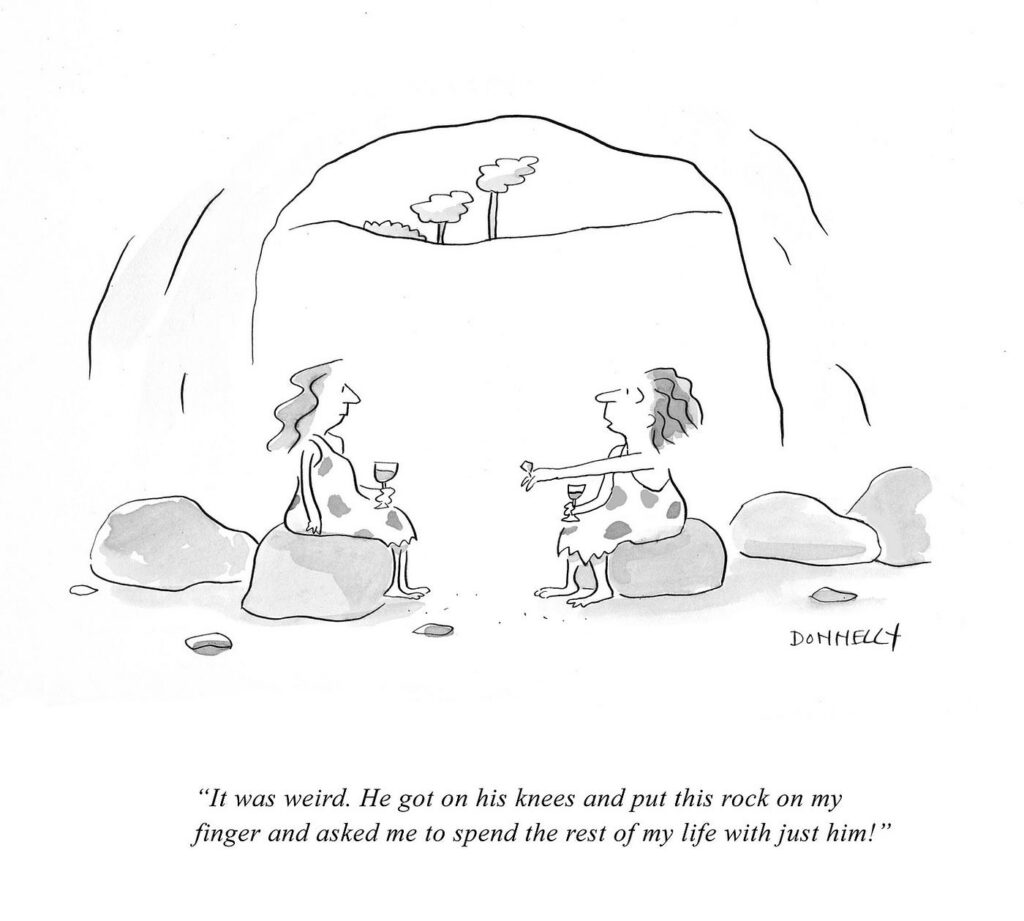
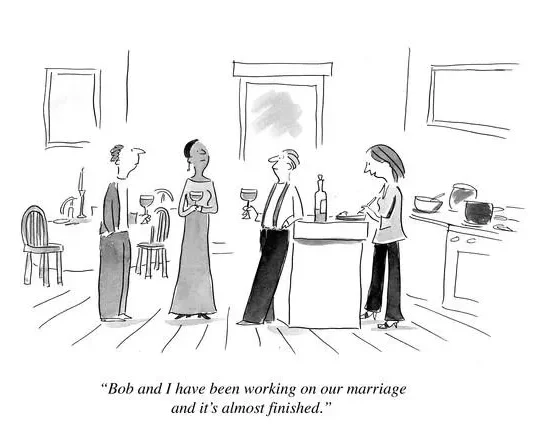
Editor’s Note: For background on Liza Donnelly, the wonderful heir to James Thurber whose work illustrates this column, read the wonderful, first-person essay titled, “How I Became a New Yorker Cartoonist,” in the 10 October 2019 issue of The New Yorker. (Michael Maslin’s cartoon, the last included here below, also derives from The New Yorker.)
I. “Falling in love is easy; staying in love is a choice.”—Various sources
 CLEMSON South Carolina—Hubris—July/August 2026—Imagine some new assistant rabbi serving in an orthodox temple assigned to preach on Deuteronomy 22:13-19. If you’ve forgotten how the Mosaic anecdote goes, let me refresh your memory. An Israelite “man” marries a nubile “girl” and soon decides he’s tired of her, so he accuses her of marrying him under false pretenses: she claimed to be a virgin but wasn’t.
The girl’s parents, perhaps suspecting something like this might happen, have preserved the wedding-night sheets, and they bring these “smoking guns,” to use a modern phrase, to prove to the court that their daughter wasn’t lying. Against all odds, the court decides in her favor, assigns someone to whip the slanderer, fines him 100 silver shekels, and orders him to take his wife back as if nothing has happened. Jesus would later allow a divorce under some narrow circumstances, but in this case, perhaps a thousand years before the Old Testament was “revised,” the lying husband is told he can “never divorce her as long as he lives.” (My emphasis.) If the bride objected to being handled like spoiled liver, her objections were not recorded. Had the court found in the husband’s favor, the bride would have been stoned to death.
Now, if I were this young rabbi, I’d burn the verses torn from my Torah, apologize to the faithful, and resign.
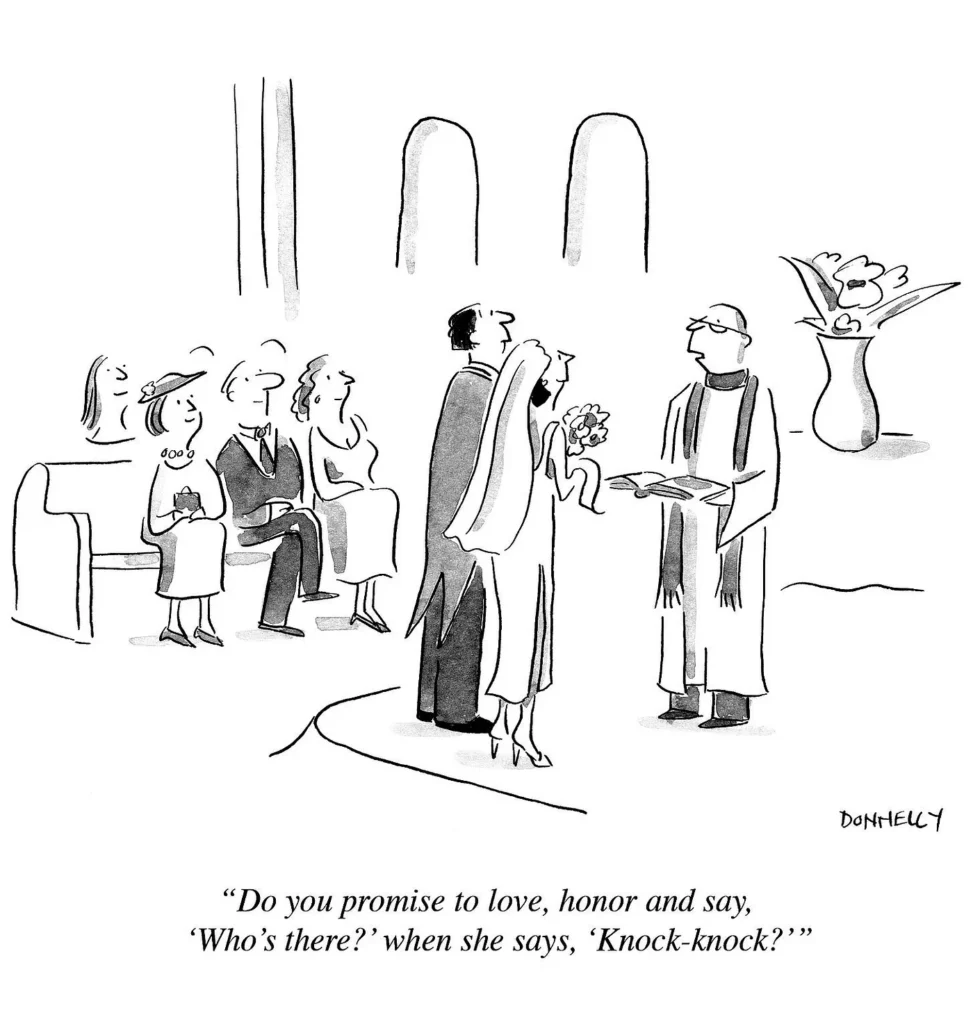
II. “Divorce is not always a doorway to happiness. The same can be said about marriage.”
―Mokokoma Mokhonoana
My wife and I recently celebrated our sixty-third wedding anniversary, and one reason I’ve never seriously considered divorcing her is that early on I was scared straight. Ingrid has no divorces in her family; I, however, grew up in a family that was often splintered by divorce. My parents never split, but my uncle Bob, who was like a father to me when my father was off fighting foreign wars, married the same woman twice, divorced her twice, and married a woman who was once his first and second wife’s best friend. I will say this for Bob, when Grace, his former wife, developed breast cancer, he was there for her. Bob’s brother Ted also divorced his first wife for a younger woman which turned many in the family against him. Two of my cousins divorced, as did one of my sisters, a nephew (twice), our son-in-law, another uncle on my father’s side, our son and daughter, and several friends and colleagues.
Before our children divorced, the closest I’d come to witnessing the pain of the process was that of a colleague I’ll call Fred. Fred was my appointed mentor when I arrived as a new English instructor at Clemson in 1968. Married for about ten years, Fred and his wife Judith were two of the most dedicated teachers I’ve ever known. They volunteered to share an office and typically spent several hours on most days at their desks facing each other while preparing lectures and grading papers. Each would read a student’s essay, mark it up in red and blue, and then roll the final page or a fresh page in some cases into a typewriter and type up a half page or more of suggestions for improvement and words of encouragement. When the workday ended, they walked Maximillian, their aging poodle, the same way they graded papers—together. Late one Friday afternoon during final exams, I went to consult with Fred about a grade I’d given and found him sitting on a folding cot fixing supper on a hot plate in his office. “What’s going on?” I asked.
“Judith’s divorcing me. She’s been offered a job as editor of the Eckankar Journal in Las Vegas. She’s leaving me, Max, and academe to be a soul traveler.” He then began sobbing in his shirt sleeve.
In the three years I knew Fred and Judith, I never heard a cross word pass between them. As for the Taubens, a German couple my wife and I once knew, we never visited their home in the 4 years we knew them when we didn’t hear a cross word, but divorce was seldom a serious motion on their table. To the best of my knowledge, Helmut never raised a hand against his wife, but then Gertrud, two inches taller, outweighed him by 40 pounds. Before they died, it was on that table that Gertrud buttered Helmut’s sour-dough rye and cut his meat, for the prospect of living alone was worse than living together. In a word, spite was their adhesive, and yet for all the acrimony, their lives were oddly satisfying.
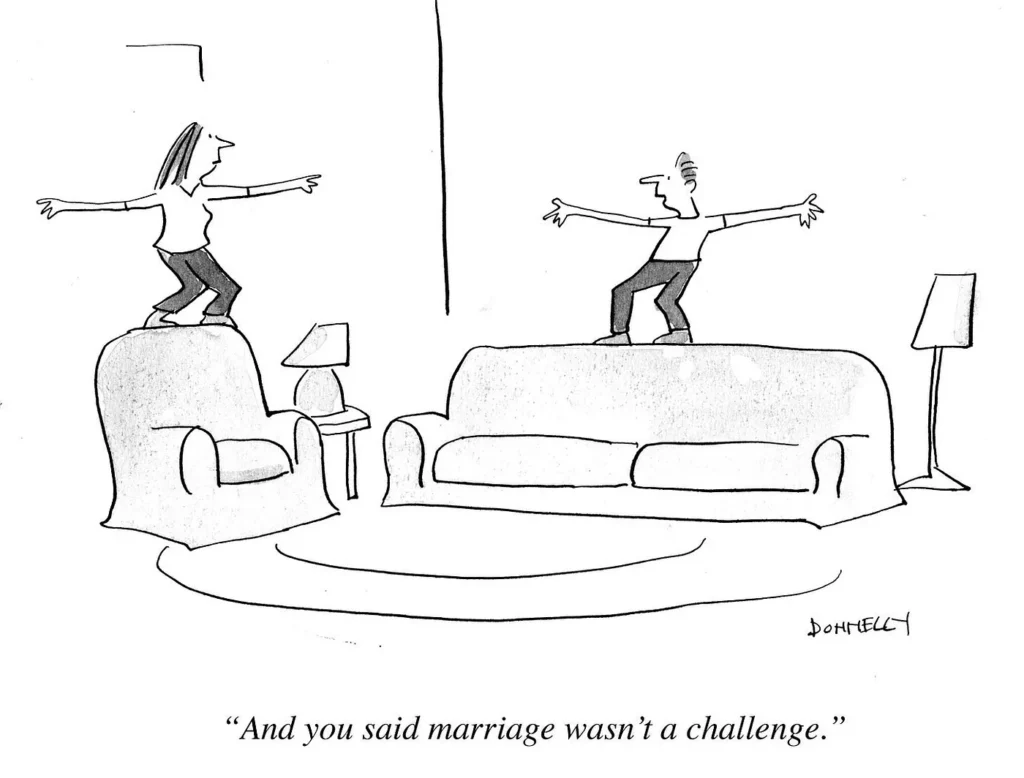
III. “Many a man in love with a dimple makes the mistake of marrying the whole girl.”—Stephen Leacock
Defending her extraordinary marital tolerance, Gertrud once told my wife, “There’s nothing funny about divorce; I take it very seriously and want no part of it.” Tell that to the American humorists of the last century, many of whom had an insider’s understanding of court-supervised terminations, and most of whom approached divorce from the ex-wife’s perspective perhaps because of that inescapable urge to root for the underdog. Dorothy Parker observed that divorce served her right “for putting all my eggs in one bastard.” Seven-times divorced and once annulled Zsa Zsa Gabor observed, “I am a marvelous housekeeper. Every time I leave a man, I keep his house.” And divorced New Yorker cartoonist Danny Shanahan drew two canine bitches drinking cocktails at a bar. Says one, “They’re all sons of bitches.”
Divorced men are perhaps best represented by Lewis Grizzard, a southern humorist who took Zsa Zsa’s words above to heart. Said thrice-divorced Grizzard, “I’ll never marry again. If I feel the old impulse, I’ll find a woman I don’t like and buy her a house.” Grizzard married four times and claimed to believe in the liberation of women. “I’ve set three women free already,” he said. After two divorces cost stand-up comic and amateur etymologist Robin Williams over twenty million dollars in settlements, he quipped that divorce came to English from the Latin for “rip a man’s heart out through his wallet.” Finally, there’s a wife in one of Zachary Kanin’s cartoons asking her nebbish husband, “We’re having the Petersons over for dinner—do you think you could run down to the store and stay a few hours?” Indeed, many perhaps most divorced men in comic literature resemble Caspar Milquetoast, a milksop we’d call a snowflake. In one of Barbara Smaller’s cartoons, a divorced man asks his ex, “I agree, we should see other people—do you know someone who would see me?” In another by Michael Maslin, a divorced wife says, “That’s right, Phil. A separation will mean—among other things—watching your own cholesterol.”
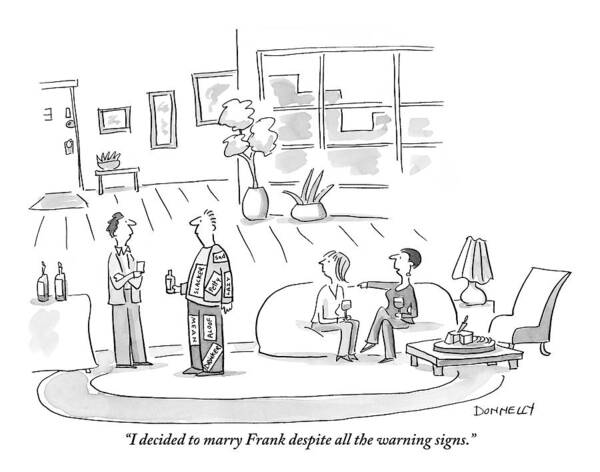
IV. “i wanted one life/you wanted another/we couldn’t have our cake/so we ate each other.”—Roger McGough
Divorce strikes me the way revenge struck Confucius: if you opt for either one, dig two graves. I’m thinking of Catherine Parr and Anne of Cleves, the only wives of Henry VIII to survive the monster. Remember that Henry annulled two unions after four years of marriage; grieved, I trust, the passing of the only wife to bear him a son and beheaded two for the “crime” of not bearing him a son. For all his possessions and power, Henry had to be an angry, unhappy man. As for America’s first “king,” court records show that he was accused of marital rape in a sworn divorce deposition by the first of his three wives. He denied it, and 26 years later she said she meant “violated,” not “raped.” She’s dead now, but if poor, violated women say it’s not the money, it’s usually the money.
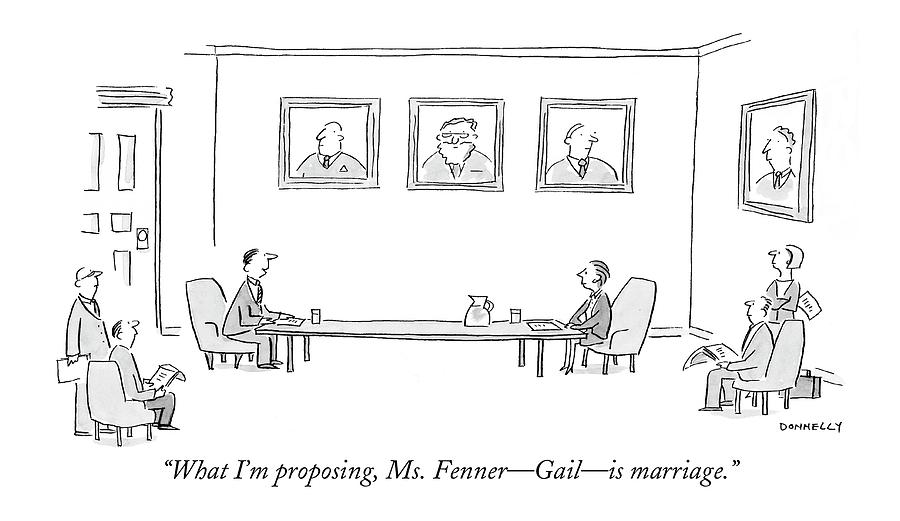
V. “The plural of grass is lea./For rain, it’s the sea,/and for God, it’s three,/but the plural of me is thee.”—The Wordspinner
Once after Ingrid and I had some blood drawn for a routine physical, we discovered that I’m a universal donor, and she’s a universal recipient. After 65 years together, you’d think we’d resemble two peas in a pod, but as a Yorkshire man in Singapore might say, we’re more like chalk and cheese in a wok. After giving birth to our second and last child, I facetiously suggested she get a hymen restoration to which she said, “Only after you have your rectum sewn shut, soldier boy.” It’s true she sometimes dills my pickle, but kosher dills are among my favorite cucumber impersonations.
Why do I love her? Let me count the ways: (Warning, the “Ingrid file” weighs 1.6 pounds:)
- She cooks and bakes largely by ear;
- virtue for her has the aroma of Lysol;
- she remembers the first and last names of all thirty of her high-school classmates;
- she called her sainted mother in Germany every Wednesday for eight years even when her mother had forgotten her only daughter’s name;
- she hospital-corners her sheets and string-draws her gardens;
- she often hopped across the ice floes on Wolsdorf’s Leech Pond;
- she rode Peter and Paul bareback, the family pigs, around the hof;
- she grew up on Tom Mix and Tom Prox westerns;
- she and her brother sneaked out of Nazi propaganda films;
- she estimates that she spent, all told, about a year in the family’s basement bomb shelter,
- she and her brother hooked their sleds behind the farmers’ horse-drawn sleds;
- she biked two miles, walked one, and rode a train for three years to reach her middle school;
- she stirred mouse blood drained by her brother to prevent its premature curdling;
- she drinks hot water with a squirt of lemon juice and calls it “white tea”;
- she loves Puccini, Mozart, Glenn Miller, and Elvis;
- she mashes her potatoes with a fork, never a knife, for knives disrespect the tuber;
- like Mother Mary, her flatulence is devoid of odor;
- she’s kept her sour-dough yeast alive since 1964;
- she refuses to place a loaf of bread on its back because the discreet don’t earn their living on their backs;
- she faces all her wallet bills, a habit she learned working as a teller in a German bank, which is where I met her;
- she paid off our thirty-year mortgage in twenty;
- she water jogs 30-60 minutes at a time;
- at 87, she walks faster and farther than I do at 84;
- she showed remarkable faith and courage in immigrating to a strange land with a man she’d known a scant two years;
- she gave up her beloved home and family for a land where she thought Al Capone held sway in “The Land of the Big PX and Round Doorknobs,” and she did it all for love. (The only money I had to my name at the time was $700 thanks to some Army leave I had not taken);
- she’s the pearls on my string, the vermouth in my martini,
- and she’s my tangible proof of the gods’ benevolence.
On one memorable date during our courtship, I suggested we drive downtown to watch a movie, and she said, “It’s so pretty, let’s go per pedis apostolorum (on the feet of the apostles). A movie (The World of Susie Wong?) she’d seen evoked a sense of sabishi in her, Japanese, she said, for “sad loneliness.” That night she told me bona sera; the following morning, she’d greeted me with bon jour, a Russian kartooschki (potato), and un peu words in Plattdeutsch I still don’t understand, but then I never had a course in Old English either. Nevertheless, German and its several dialects are our alternate universe. Given Ingrid’s German-accented English and Hoch-Deutsch German, as a future English major, I thought, what’s not to love?
Eventually her facility with language enlarged the entire Eisiminger word hoard: we all use “Tschüss,” which morphed into “juice,” for goodbye; Pinkelatorium for the bathroom; pico bello for spotless; Fiesteller for nasty plate (because every meal is a competition); Husche for a thunderstorm, and dozens more. Paraphrasing the words of the Appalachian poet Jonathan Williams, I made a livin’, but she made the livin’ worthwhile.
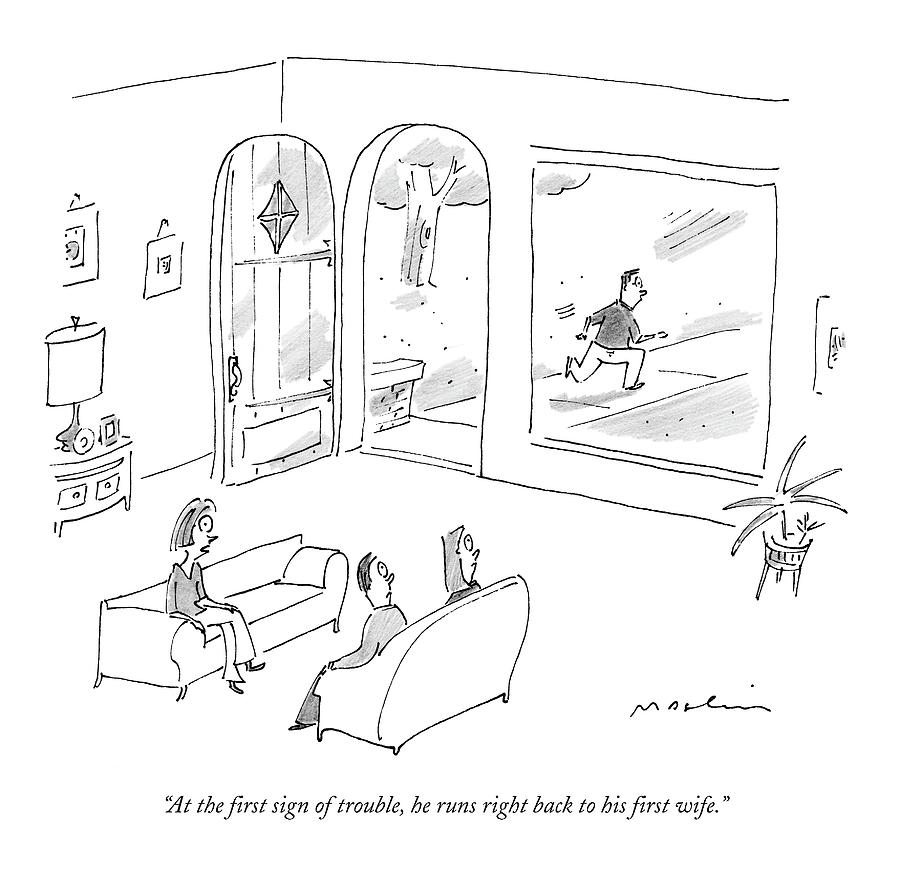
VI. “These . . . hours that we have spent,/walking here, two shadows went/along with us, which we ourselves produced.”—John Donn
Given that Ingrid has shared my shadow, primed my pump, and strung my bow, what is she to me?
- She’s my computer techie who never overlooks a critical update,
- our mattress walker (she smooths out the lumps),
- my Wookiee chef,
- my Zeitgeber (she regulates my circadian rhythms),
- the chocolate in my gorp,
- the ballast in my hot-air balloon,
- the wind behind my sails,
- the oven and light switch in every room I’ve left the power on,
- the Nazi in my oral grammar checker (I dare not confuse “fewer” and “lesser,” or say, “It’s me.”),
- and if you think there are no more blueberries in the woods, you haven’t met the Europicker.
Forty years ago, when she asked an ARA colleague where she got her pretty new sweater, she understood “Five-Finger Discount” as the shoplifter’s slangy reference to Seneca Good Will. Having lived in the US three times longer than she lived in Germany, today, she grins and calls her grandson’s philtrum his “snot gutter.” As Ingrid, Omi, Schatz, Maud, Maudie, etc., the family comedian, I never love her more than when she makes me laugh. Though she’ll deny it, she’s often unconscious of her wit. When confronted, she usually claims otherwise. Here are a few examples; I’ll leave to you, dear reader, to decide which of these were intentional:
- There was once a “Boston Oreo” for a Baltimore oriole,
- a “Dr. Zeus” for Dr. Seuss,
- some “crap grass” for some crab grass,
- a “kimono dragon” for a Komodo dragon,
- and most recently there was “a gratitude” for a gratuity.
Sadly, these happy infelicities are becoming less frequent as her tongue sharpens and she grows wiser.
VII. “I am the skipper/but she mans the ship—/she is my Gladys/and I am her pip.”—The Wordspinner
One summer morning after a long bike ride, Ingrid asked our grandson and me if we wanted anything to drink. Spencer asked for some orange juice, and I said water would be fine.
“With or without ice?”
“Without, please.”
While we were hosing off our bikes, Ingrid brought Spencer his juice and my water.
“Thanks, but why’d you put an ice cube in here?”
“The glass was hot; I just took it out of the dishwasher.”
That evening when I asked her about the origins of her selflessness, she reminded me of how after the war, her mother, the sainted Mutti, had volunteered to house seven refugees at different times fleeing the Russians over seven or eight years in a house with barely enough room for four. She also said her mother would warm her children’s freezing featherbeds with her body in an unheated bedroom with ice “flowers” on the windows. And that reminded me of the time I’d forgotten to bring my shoes inside on a cold night. Before I could locate them, Ingrid was warming them with her hair dryer. It seems her selflessness was inherited.
If she ever divorces me, I’m confident she’ll leave a year’s worth of “meals ready to eat” in the freezer. For these and all the rest, like Willie Yeats hopelessly entangled in Maud Gonne, I’m “looped in the loops of her hair.”

Sterling Eisiminger
Dr. Sterling (“Skip”) Eisiminger was born in Washington DC in 1941. The son of an Army officer, he traveled widely but often reluctantly with his family in the United States and Europe. After finishing a master’s degree at Auburn and taking a job at Clemson University in 1968, he promised himself that he would put down some deep roots. These roots now reach back through fifty years of Carolina clay. In 1974, Eisiminger received a Ph.D. from the University of South Carolina, where poet James Dickey “guided” his creative dissertation. His publications include Non-Prescription Medicine (poems), The Pleasures of Language: From Acropox to Word Clay (essays), Omi and the Christmas Candles (a children’s book), and Wordspinner (word games). He is married to the former Ingrid (“Omi”) Barmwater, a native of Germany, and is the proud father of a son, Shane, a daughter, Anja, and grandfather to four grandchildren, Edgar, Sterling, Spencer, and Lena. (Author Head Shot Augment: René Laanen.)