Two Tongues in One Mouth: Bilingualism

“We don’t nap, we take a Nickerchen; we don’t tidy our rooms, we eliminate the Schweinerei, the mess worthy of a pig; we don’t itch when we’re nervous, we get kribbelig; if we leave food on our plates, we win the Fiesteller, the nasty plate; we don’t pray for a summer thundershower, we look for a Huscha; we don’t excuse ourselves to use the bathroom, we use the Pinkellatorium (A German-Latin construction erected by Ingrid’s grandfather); we don’t tell people to “Keep your pecker up” like the British, we tell them to “Keep their ears stiff”; and when we bid friends farewell, we don’t say goodbye, we wave a clean handkerchief and say Lubadu, Tschüss (the latter of which emerges as Juice), and means, I love you. Goodbye.”—Skip Eisiminger
Skip the B.S.
By Skip Eisiminger
I. “You are the question/my heart was bold to ask/and the sunny answer/in which I bask.” —The Wordspinner
 CLEMSON South Carolina—(Hubris)—November/December 2026—In the lobby of the Columbus, Georgia DMV, in September of 1963, a crude sign instructed those renewing licenses to fill out a white form. First-time applicants like my German bride were to complete a pink form. After puzzling out the bureaucracy’s intent, and while I parked the car, Ingrid crossed the threshold of the office where she met two more signs overhead: “Colored,” and “White.” These had been professionally made and had nothing to do with the form she’d selected.
Glancing at her rosy application, she took her place in line behind an elderly Black man holding a white form between his thumb and forefinger. In Germany, Ingrid was one of the post-war generation who’d been taught to accord Jews and African Americans the same respect as extraterrestrials.
Shifting on her feet, she said, “I’m Sorry, sir. But I sink you are in sa wrong line.”
The elderly man turned slowly, surveyed Ingrid’s pinkness, and murmured, “I kin tell you ain’t from dese parts, Missy, but cain’t you read the signs?”
Ten years into a six-decade marriage, “Ingrid” became “Maudie,” and the story above became “Maudie-dote # 1.” It didn’t take Maudie long to learn to read the signs. In fact, today, if I say, “It’s me,” she’ll quickly correct me and say, “It’s I!” Same with “fewer” and “lesser.” I can’t keep them straight; thus, Maudie morphed into my Grammar Gestapo.
Like most bilinguals, I’ve had similar problems with German, my adopted language. I have a difficult time, for example, pronouncing Kaninchen, which is German for “rabbit,” in such a way that it doesn’t come out sounding like “canned chicken.” As far as that goes, I, a native English speaker and former English professor, often use “jive with the facts” when properly facts should jibe. “Duct tape” often emerges posing as “duck tape,” and I once gave a Barnes and Noble clerk a book’s “ICBM number.” My adolescent grandson, who was there, corrected me.
II. “The plural of grass is lea,/for rain, it’s the sea,/and for God it’s three,/but the plural of me is thee.” —The Wordspinner
In the Charleston, South Carolina consulate’s lobby, while cramming for her naturalization examination, Ingrid hastily constructed an Eselsbrücke, a “donkey bridge.” Her frail structure, a mnemonic spun out of “Betsy Ross” and Ross, a German nag, spanned a chasm in her mind that she trusted any sure-footed equine could negotiate.
I say “frail” because, minutes later, when her proctor asked, “Who fashioned America’s first flag?” Ingrid’s heart galloped and her mind reared. “The answer,” she said, rising from the metaphoric ground where she’d fallen, “has something to do with a woman riding a horse, but to be honest, sir, I cannot remember.”
“I’m sorry, but a horse had nothing to do with it. Elizabeth Griscom Ross fashioned our first flag.”
“Ach, ja, I remember her now. You wouldn’t understand, but I pictured her stitching the stars to the stripes seated on a horse. I mean no disrespect, sir, but my husband says that story of Miss Ross is an ‘embroidered fiction.’”
“Does he now—did he also tell you that George Washington never pitched a coin across the Potomac or felled his father’s fruit tree? Urge him to read your copy of the DAR’s leaflet. As a new citizen, I hope you’ll agree that we must preserve the past for more than our posteriors.”

III. Village Life: A German Dorf/is a Gothic clockwork/in a land without oil/and no room for guesswork. —The Wordspinner
Despite learning that a German maiden’s grammatical gender is neuter and her cheese is masculine, I fell in love with the language when in the second or third grade at the Heidelberg Dependents’ Elementary School, I learned some German compounds which I’ve translated here and which I still fondly collect:
Their “ink fish” is our squid,
- their “time word” is our verb,
- their “river horse” is our hippopotamus (which is what the Greeks also called the animal),
- their “tree wool” is our cotton,
- their “finger hat” is our thimble,
- their “cloud scratcher” is our skyscraper,
- their “bottle ghost” is our genie,
- their “parade step” is our goosestep,
- their “meat wolf” is our meat grinder,
- their “dust sucker” is our vacuum cleaner (My mother-in-law owned a Vampir.),
- their “naked snail” is our slug,
- their “seated urinators” are our hen-pecked husbands who sit to pee,
- their “monthly closet” is our jodhpurs (equestrian trousers roomy enough for a month’s worth of waste),
- their “plumps closet” is our outhouse (Plumps is the sound falling fecal matter makes striking water.),
- their “dragon food” is our surcey or gift for the fire-breathing wife,
- their “staircase joke” is the witticism that occurs to the untenured descending the dean’s steps on leaving his Christmas party,
- and their “earworm” is any tune in your head you cannot purge.
When I discover one of these memorable compounds, I’m reminded of the German exchange student who, when he drew a blank on “carrousel,” created a “horse tornado.” Worked for me the first time I saw it, and it still works.
IV. “I have always avoided Germany since discovering in the tenth grade that German has two dozen ways of saying ‘the.’”—Russell Baker
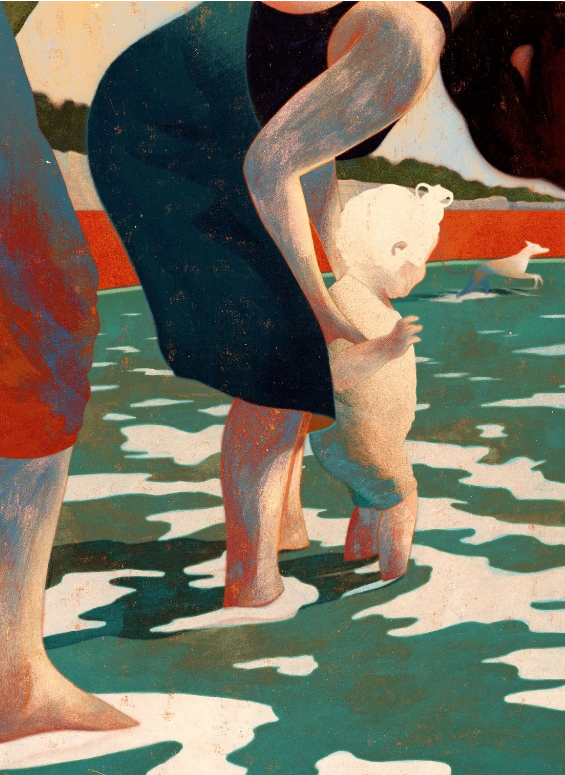
Lena (pron. LEH-na) Jewel Fraiser was born on November 23, 2008. Still in the womb, her heart rate quickened when her mother read aloud. I thought this was exceptional, but the doctor said it was normal. Her name, incidentally, honors three women in her gene pool: her great-great grandmother Lena (pron. LEE-na); her maternal grandmother, Ingrid, who is German (thus the German pronunciation), and Freddie Jewel Fraiser, her paternal grandmother.
Climbing up the carpeted steps at her grandparent’s home, Ingrid taught Lena to count in German: “Eins, zwei, drei . . . .” Then she turned and slid down the steps on her diaper-padded Popo.
With a pitch-perfect ear tuned to the rhythms of the South by her Carolina classmates, Lena, age seven, told her family one day after school, “Lillemor ate so many Tums, dag nab it, she pooped out a piece of chalk.” Then she presented us with her first illustrated book, Die Kleine Eule (The Little Owl), all eight pages in flawless German, and I’m not talking Gesundheit and kaput here.
At age 17, Lena made the highest score possible on the Deutsches Sprachdiplom II, a German proficiency exam for non-native speakers, proving the skills needed for German university entry with written parts graded in Germany and oral parts by German representatives. For my small part, if I had a peacock’s tail, I’d fan it.

V. “Whenever the literary German dives into a sentence, that is the last you’ll see of him till he emerges on the other side of the Atlantic [with the rest of his compound verb].” —Mark Twain
“Out of the feathers, Kinder. Get on the double!” Ingrid says while drawing an eyebrow with a hue and arc that nature had not bestowed on her while saying, “Mensch, I look like soup without salt.” Meanwhile, the oatmeal simmers . . . .
“Would you fix your own lunch today, Skip,” she asks, combing her hair. “It won’t knock a stone from your crown . . . .”
“Don’t kippel, Anja, and please stop stirring the Pfefferminz tea with your knife, Shane.”
We don’t nap, we take a Nickerchen; we don’t tidy our rooms, we eliminate the Schweinerei, the mess worthy of a pig; we don’t itch when we’re nervous, we get kribbelig; if we leave food on our plates, we win the Fiesteller, the nasty plate; we don’t pray for a summer thundershower, we look for a Huscha; we don’t excuse ourselves to use the bathroom, we use the Pinkellatorium (A German-Latin construction erected by Ingrid’s grandfather); we don’t tell people to “Keep your pecker up” like the British, we tell them to “Keep their ears stiff”; and when we bid friends farewell, we don’t say goodbye, we wave a clean handkerchief and say “Lubadu, Tschüss” (the latter of which emerges as “Juice”), and means, “I love you. Goodbye.”
VI. “To fall in love is to create a religion with a fallible god.”—Jorge Luis Borges
I grew up on the watch of a mother who thought the ASL church lady was there for the blind, every radio was a “Magnavox,” and her granddaughter’s stuffed bear was “Winnie the Poof.” My ears, therefore, were attuned from birth to the comically mal-appropriate.
The following conversation, overheard at a gathering of the Clemson Kaffeeklatsch, is a fiction, but believe me, it could have happened. The diction is true; the syntax is my own, and I’ve changed the names to shield the innocent.
Ida: Our waiter is slow as Moses today!
Erika: He’s certainly not gang ho. I hope I don’t get that squeezy feeling I got last time we were here . . . .
Anneliese: I’ve heard Dixie and Bill’s desserts are made from scraps, but then I heard it from a potential liar . . . . Is Bruce teaching another Elder Hospital this summer?
Erika: No, he’s finishing his book on Dr. Zeus, hoping to get tenure. What’s Otto up to?
Anneliese: When I left this morning, my country pumpkin was mowing the crap grass he calls a lawn. He thinks riding a mower is Arabic exercise. Meanwhile, the chipmounts are eating my tomatoes, and the squirrels are chewing on the scream door when we can’t afford ground beast . . . .
Ida: Did you see my new Toyota hunchback when you came in? Horst and I had a devil of a time with the dealer. Are all American car salesmen potential liars?
Anneliese (picking up her phone): I’m sorry, the relative humility is so bad today, I came straight in. Excuse me, I have a text from Doris. I called her earlier, but as usual she was screaming her calls. The only calls I get any more are from the tellymarketers. I tell them right off the ball, “I’m not interesting.”
Erika: Did either of you see Larry King Alive last night? Bruce was watching the Braves play the Boston Oreos downstairs. After the game, he joined me, but we soon tired of Larry’s guests, Jim and Tammy Faye Baker, two pods in a pea who warned of the coming Rupture. As you say, “You can’t get blood from a termite.” We then watched a PBS nature special on the behavior of the kimono dragon under the influence of a moonar eclipse. Most interesting.
As Borges warned above, the one you love, especially if she’s bilingual, is a fallible god, but she’s also proof of the other gods’ benevolence. “Not interesting?” Hardly. Maudie is the string my pearls are strung on even when she sours my Kraut.

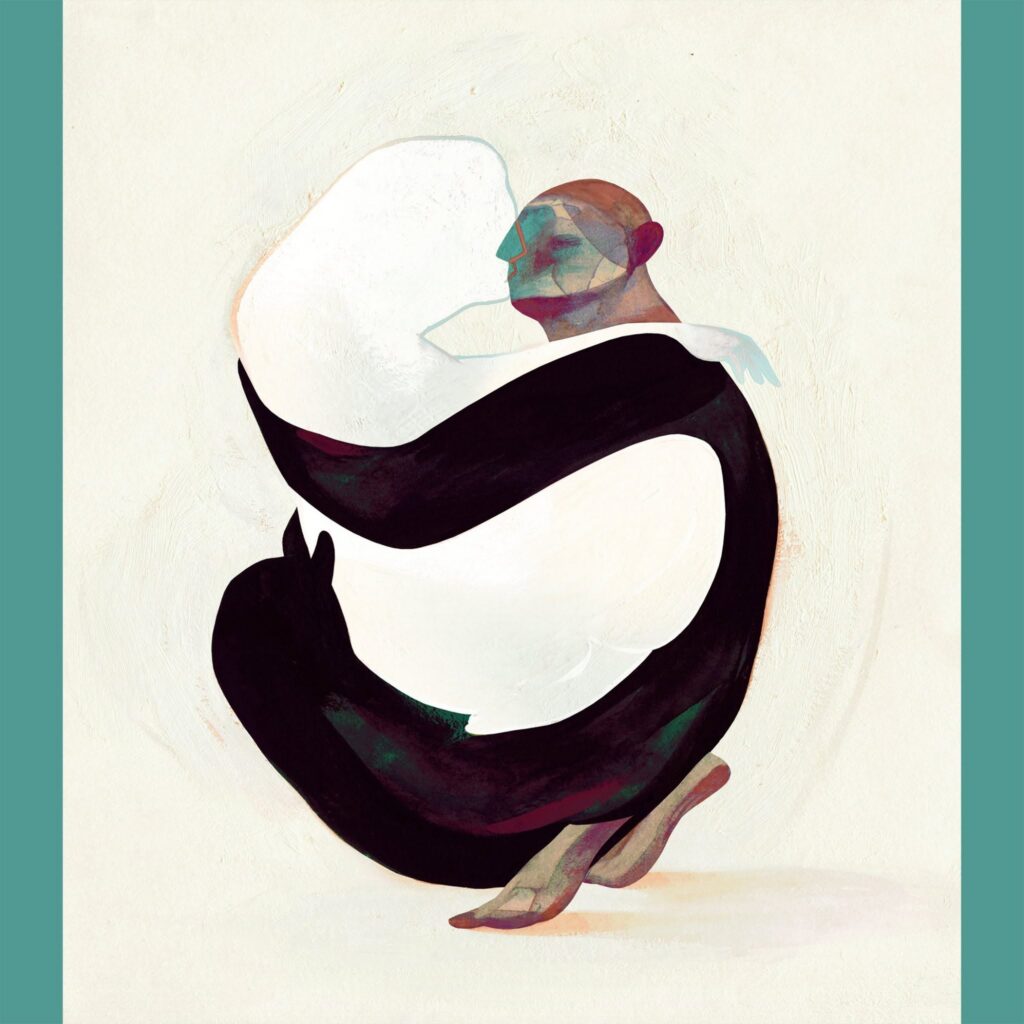
Editor’s Note: In the past, Owen Gent has served as our Home Page artist here at Hubris. A freelance artist and illustrator based in Bristol, England. Gent represents himself all over the world but is also represented non-exclusively by Garance in the US and by UsFolk in Ireland. That’s Nice, Love, Gent’s first book for children was published in 2022 by Book Island and is available to order here. Find his online Domestika course here: Book Cover Design: Illustrate Stories with Evocative Images. An interview with Owen is available here and you can listen to a recent podcast interview here. See more of Gent’s work at his website: https://www.owengent.com.

Sterling Eisiminger
Dr. Sterling (“Skip”) Eisiminger was born in Washington DC in 1941. The son of an Army officer, he traveled widely but often reluctantly with his family in the United States and Europe. After finishing a master’s degree at Auburn and taking a job at Clemson University in 1968, he promised himself that he would put down some deep roots. These roots now reach back through fifty years of Carolina clay. In 1974, Eisiminger received a Ph.D. from the University of South Carolina, where poet James Dickey “guided” his creative dissertation. His publications include Non-Prescription Medicine (poems), The Pleasures of Language: From Acropox to Word Clay (essays), Omi and the Christmas Candles (a children’s book), and Wordspinner (word games). He is married to the former Ingrid (“Omi”) Barmwater, a native of Germany, and is the proud father of a son, Shane, a daughter, Anja, and grandfather to four grandchildren, Edgar, Sterling, Spencer, and Lena. (Author Head Shot Augment: René Laanen.)