Bison Wool
“These were clearly wild bison, at home again in the wild. And they’ve already transformed the place—new trails winding through the woods, droppings everywhere, tufts of fine brown underfur tangled in trees, wallows in patches of soft soil. I’m used to seeing places I once knew and loved changed, but usually for the worse; this was a restoration of a wildness I had never known. It was as though the landscape’s forgotten memories had awakened and somehow found their way back into life: a dream come true, of a sort, but not our dream; the land’s dream.”—Kevin Van Tighem
While I Draw Breath
By Dr. Kevin Van Tighem

“Oh, give me a home where the Buffalo roam,/Where the Deer and the Antelope play;/Where seldom is heard a discouraging word,/And the sky is not cloudy all day.”―from “My Western Home,” by violinist Daniel Kelley and Dr. Brewster Higley (1876)
“General Phil Sheridan had urged the destruction of the bison herds, correctly predicting that when they disappeared the Indians would disappear along with them; by 1885 the bison were virtually extinct, and the Indians were starving to death on the plains.”―Peter Farb, from Man’s Rise to Civilization (1968)
 HIGH RIVER, ALBERTA Canada—(Hubris)—August 2025―I was so exhausted last night I couldn’t fall asleep, and then when I did I slept so hard that Gail wasn’t sure I was still alive. I am, and grateful, having just returned from three days of backpacking into the backcountry of Banff National Park.
One morning in 2009, I wakened to a phone call from the CEO of Parks Canada. “Is it true?” he asked. “We’re reintroducing bison to Banff?” He had just finished reading the draft management plan I’d sent him.
“There’s a lot to work out still,” I replied, “but I believe it’s time to commit to it in a management plan. We can definitely get it done within the next five years.”
I retired the year after we released that 2010 park management plan, burned out and depressed. So I was elsewhere, getting myself back together, while others did the hard work and heavy lifting. Bill Hunt, Karsten Heuer, Sheila Luey, and too many others to name figured out the details and found the funding to bring bison back to their former home in Canada’s first national park.
Still, I felt a tiny bit of ownership, even if all I’d done was given them some words to get the ball rolling. So it bothered me that I’d never actually seen the results.
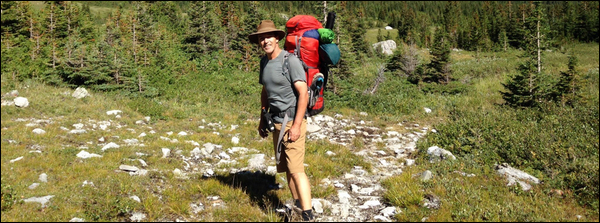
Last Sunday, I hoisted my backpack and started the long hike in from the Yaha Tinda, hoping to find some bison still on the alluvial fans along the Red Deer River before they made their annual shift to higher-elevation pastures.
Facing an un-bridged crossing of Scalp Creek, I worked my way upstream until I found a logjam that would either kill me or get me across with dry feet, and, as I studied it for the best way across I spotted a white line wavering just below the surface in a watery recess between the logs. It resolved itself into the leading edge of a huge bull trout’s lateral fin. The fish retreated out of sight beneath the logs as I picked a careful way overhead, but it left me feeling inspired and hopeful, as any sighting of so ancient and threatened a fish does nowadays.
It had been a late start after a long drive, so I made it only to the park boundary. After an unsatisfying sleep, I shook the morning frost off the tent fly, drank powdered coffee while things dried a little in the watery sun, and loaded up for the rest of the trip in to Scotch Camp.

On the Banff side of the now-formidable park boundary fence, the trail was instantly different: pockmarked with bison tracks and punctuated by their droppings. A few kilometers along, I glanced to my left through a gap in the wall of spruce that lines the old trail in many places—the product of disturbed soil and road runoff from back when this was still a fire road—and there was a bison! When I eased myself into position for a better photo, she noticed me and, to my surprise, broke into a run. Six cows and five carrot-colored youngsters fled into the timber as if all the hounds of hell were after them and not just a creaky old-timer trying to be invisible.
They were all like that. I saw about 20 more bison on the flats and in the wetland at the west side of Tyrell Creek fan and they all fled before me, filing up into the pine forests on the high benchlands to the north. When I arrived on the Snow Creek fan at Scotch Camp, there were another 15 there. They all ran like elk, too, rather than standing and watching like cattle. These were clearly wild bison, at home again in the wild.
And they’ve already transformed the place—new trails winding through the woods, droppings everywhere, tufts of fine brown underfur tangled in trees, wallows in patches of soft soil. I’m used to seeing places I once knew and loved changed, but usually for the worse; this was a restoration of a wildness I had never known. It was as though the landscape’s forgotten memories had awakened and somehow found their way back into life: a dream come true, of a sort, but not our dream; the land’s dream.
By the time I arrived at Scotch Camp, however, I had some seriously sore parts and was walking a bit like a zombie. My own memories had tricked me into thinking my old body could still do what my younger one had once done so painlessly. After two Tylenols and a good night’s sleep in my tent in the warden cabin yard, I was stiff but a lot happier. Looking at the grim weather clamping its grip on the valley and, contemplating my mortality, however, I decided to head out. Back at Tyrrell flats, a mature bull with a younger buddy were mucking around in the sedgy wetland again, proving that it’s not just domestic cattle that trample wet places. They let me approach more closely on the trail before they, too, finally loped away into the woods to safety.
After a 20-kilometer hike that had become a weary, plodding march, I heard a vehicle behind me. It was a beat-up looking truck coming out from the Outpost at Warden Rock, a wildland tourism operation near the park boundary. The driver, a weathered-looking outdoorsman older than I, rolled down the window and said the magic words: “Wanna lift?”
So, for the last few kilometers, I had a great visit with Tim Barton, who has outfitted, guided and wrangled in the valley for almost half a century. He said the bison weren’t always so wild, but the Indigenous hunts that are now part of the management regime for that growing herd of bison have changed things; they now see us as predators in the same way as they understand the bears and wolves, whose tracks I’d seen but who kept themselves out of sight.

He also said the bison were changing the way those predators use the land, because unlike other native herbivores whose trails lead down to water and back again, bison wear new trails that follow rivers. The predators now use those trails, too. So, the newcomers have brought back old ways long forgotten, not just for the land but for its denizens.
I went to visit bison, but one of the sights that left the deepest impression was of one of the bear rubbing trees I found on my way in, with the deeply worn ritual-approach imprints of countless bears who had stopped long enough to leave their scent on an old lodgepole pine used by wild animals to communicate among themselves.
No bison appeared to have used the tree yet, but the deep indentations where each bear had placed its feet in the same place as every other bear who had preceded it spoke of ceremony and tradition among the valley’s community. It was a gift to be in a place where other, older traditions are awakening among an enlarged community, and where change offers hope rather than despair.
We really should do more of this sort of thing.
Swan Valley Connections video showcasing different individuals visiting an active bear rub tree in the Swan Valley in Montana. Bear rubs are often found along popular game trails, and due to their interesting scents, they attract many other species who come to investigate and sometimes leave their own scent behind, such as the mountain lion who urinated on site. The animals that visit the tree are (in order of appearance): Grizzly bears, bobcat, grizzly bear, mountain lion, grizzly bear, wolf, grizzly bear, mountain lion, grizzly bears, bobcat, grizzly bear, black bear, whitetail deer, and grizzly bear.

Kevin Van Tighem
Kevin Van Tighem, an Alberta naturalist and environmentalist, has written more than 200 articles, stories, and essays on conservation and wildlife which have garnered him many awards, including Western Magazine awards, Outdoor Writers of Canada book and magazine awards, and the Journey Award for Fiction. He is the author of Bears Without Fear, The Homeward Wolf, Heart Waters: Sources of the Bow River, Our Place: Changing the Nature of Alberta, and Wild Roses Are Worth It: Alberta Reconsidered. He was born and reared in Calgary, his family roots in what is now Alberta going back to 1875. Van Tighem graduated with a degree in plant ecology from the University of Calgary in 1977 and went on to work as a biologist with the Canadian Wildlife Service. In 1985, he joined Parks Canada and subsequently worked in various national parks before retiring as a park superintendent in 2011. Van Tighem is the author of 14 books on wildlife and conservation. In 2022 he was awarded an honorary Doctor of Science from the University of Lethbridge, and a Blackfoot name that translates to “Rough Rapid Water” from the Kainai First Nation. He lives with his wife, Gail, in High River, Alberta. Read more about the author here. Find Van Tighem’s books here. (Author Head Shot Augment: René Laanen.)