The Hubris Interview: Nin Andrews
“Writing is magic. I have no idea how I go about it, or why it sometimes flows and other times doesn’t. But I do know I was given a lot of gifts, including two brilliant parents, one who studied Ancient Greek with Richard Lattimore and raised me on Greek mythology, and the other who was an architect and a Southern raconteur. Their influence is present in my work.” —Nin Andrews
The Hubris Interview
By Claire Bateman

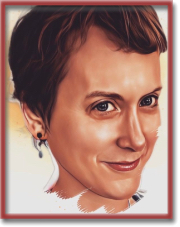 GREENVILLE South Carolina—(Hubris)—August 2025—Nin Andrews is the author of 15 poetry collections including The Last Orgasm (2020), Miss August (2017), and Why God is a Woman (2015). She is the recipient of two Ohio individual artists grants, the Pearl Chapbook prize, The Wick Chapbook contest, and the Gerald Cable Award. Her poetry has been featured in numerous journals and anthologies including Ploughshares, Agni, The Paris Review, four editions of Best American Poetry, Great American Prose Poems from Poe to the Present, and The Best American Erotic Poems. Her poetry has been translated into Turkish, performed in Prague, and anthologized in England, Australia, and Mongolia.
Son of a Bird (2025, Etruscan Press) is a memoir-in-prose by Andrews, who has been described as “the greatest living technician of the prose poem in America.” A lyrical and unflinching exploration of memory, the collection portrays Andrews’ childhood on a farm in rural Virginia. “Once upon a time, there was a girl who didn’t want to be born. She was the last daughter of a gay man and an autistic woman.” “‘There are things we don’t talk about,’ my father said . . .” How does the imagination develop amidst family secrets? And how is it that this book is so vibrant and full of life despite the territory it covers, which includes suicidality and parental neglect? I was delighted to have the opportunity to explore this territory with Nin.
Claire Bateman: After the epistolary poem “Dear Past Self” on page 1, you open your collection with this prose poem:
It all started when I was in college after I left the family farm, this habit I have of keeping a book inside my chest—an illustrated text, complete with drawings, photos, fantasies, memories, poems, old letters, but no one has ever read it. (I suspect everyone has one, that they’re as common as prayer books left in churches with black moleskin covers.) In dreams I find myself turning the pages, folding the corners, underlining passages. I can still see it in the mirror when I wake up, but of course all the words are backwards.
Even after several readings, it still gives me chills! In Prose Poetry: An Introduction, Paul Hetherington and Cassandra Atherton describe prose poetry as “a hybrid form that celebrates the blurring of boundaries” and claim that it is “well suited to registering the kinds of experiences that are neither complete nor fully coherent—not entirely resolvable” (190). How did working in this genre help you to present your autobiographical narrative while simultaneously disrupting it through absences, memory gaps, etc., just as you disrupt conventional mythologies of family farm life as bucolic/nurturing and the self as a cohesive, consistently agential presence in linear time?

Nin Andrews: Thank you so much! Your questions are poems in themselves! As to the question of genre, of why or how did the prose poem work for me in this memoir . . . The prose poem replicates how my mind works, thinks, remembers. When I talk or think about my past, I recall certain moments well. They light up like slides in an old-fashioned slide show. They are, in other words, already like little prose poems, ready to be written down. As between slides in a show, there are slivers of darkness, gaps in memory and time. I might put them in the wrong order, but that is the beauty of poetry. It allows for some disorder, gaps in memory, and spaces where the mind and memory go offline or out of this realm before lighting up again for the next slide.
Bateman: That’s a beautiful set of images! And it strikes me that the gaps are more than spaces between memories—they provide dimensionality, room for the imagination to move. It seems that this collection is energized/inspired by two very different fascinations. The first has to do with various kinds of hauntings. The bird-figure of Death serves as both a nemesis and a kind of muse or threshold figure connecting you with the imaginal world. Sometimes Death is a threatening external presence:
When I looked up, I saw Death on the windowsill. “Go away,” I whispered. He cocked his head and looked at me with one eye, then the other. There’s no need to worry, I told myself, He can’t come into the room. As if by invitation, he glided through the glass and began circling. It’s okay. I’m dreaming, I thought. Mother says I can’t die in my sleep. He swooped down and pressed his great weight into my chest. I tried to scream, but no words came out. I tried to move, but my body turned to stone. I tried to breathe, but my mind went black. I’m dead, I thought after a while. It’s not so bad being dead. When I opened my eyes, my pajamas were soaked with sweat. There was no music playing. The only sound was my heart racing. A pale light filled the room. I walked to the window and saw the full moon flooding the fields and hills as if everything were dressed in a bridal veil. I shivered. The fever, I realized, had broken.
Other times, Death is located within the narrator, though the reason for this is left open:
I was born with a death wish that hovered like a bird in the windowsill of my childhood. Where it flew in from or why, I never knew. “Maybe it’s a gene,” my mother said. “Maybe it was caused by all the eye surgeries,” my doctor suggested. “It’s just a consequence of parental neglect,” a therapist asserted. “You were abandoned so often, you abandoned yourself.” “Therapists always blame the parents,” my father said. My mother, a fan of the famous “L’Enfant Sauvage,” wanted us to grow up wild. She bragged that we were farm children, raised by the animals, the wind, the stars, the rain. Sometimes I’d think, I like being alone. I don’t need anyone else. I wandered down the dirt road and lay beneath the peach trees, smoked my brother’s dope, let the shadows crawl over my arms and legs as my dreams turned to ashes and blew away.
In the opening poem, your childhood-self invokes your current self as though summoning a ghost, and your current-self obliges, brooding over her. And after your caregiver, Miss Mary, dies, you commune with her (either psychically or imaginatively) as a child and also later as an adult, when you consult her about concerns having to do with race and class that would have been beyond your childhood understanding. What would you like to say about this first fascination?

Andrews: I did my best in writing about Death to describe what I experienced, which is not entirely possible. I sometimes felt as if I wasn’t all here when I was born, as if I still had one foot in another world, a world that wasn’t visible when awake. Death, in the early years, appeared as a giant bird. I have read that this is a common image in Irish mythology. But why I saw the bird, I don’t know.
I also don’t why I thought I would die young, why I had a death wish as a girl, or rather, felt as if I were calling out to Death, or maybe it was vice versa. We had conversations back then, Death and I. I was dazzled by Death, his immensity, his darkness, his lack of ethics—he was neither good nor bad—he simply was. I wanted to keep him at bay, or better yet, make him leave forever. It’s possible that Death is a part of us all, that I needed to merge with him, accept him. Life is, after all, a dialectic. And after years of seeing Death, I did merge with him. Or rather, he killed me. He moved inside me.
But I also think the I of the writer, like Death, is always both inside and outside. It is the composer and editor. We move in and out of ourselves, in and out of our lives, line by line, breath by breath. Always leaving ourselves and coming back again, until we don’t.
Bateman: The other fascination is with the richly teeming yet often brutal sensory world—for instance, there’s your cherished red bull, Melvin, fated to end up on your family’s dinner plates, and the story of the farmhand’s detached prosthetic arm that becomes your toy, and passages like this:
I followed Dr. Flynn, the vet, whenever he visited the barn, asking a stream of questions, catching cats that needed to be neutered, soothing dogs when he gave them shots, corralling calves into the chute with the head-lock gate for dehorning—blood squirting from the heifers’ heads like a fountain. He taught me to dust their wounds with styptic powder, spray them with fly and maggot repellent, and observe them for days after for signs of infection. One spring my yellow tabby kitten, Lorna Doone, caught distemper, one eye oozing pus, the other sealed shut. He said to ice the closed eye twice a day. I held the kitten on my lap with a bag of frozen peas pressed to her head at dawn and dusk until one afternoon her cornea fell out and rolled in the sawdust—a tiny ball of transparent Jell-O.
Have you developed techniques for portraying the two different kinds of images, the mythic/imaginal and the naturalistic, so seamlessly? Or as a Southerner/storyteller, do you achieve this more by instinct?
Andrews: Writing is magic. I have no idea how I go about it, or why it sometimes flows and other times doesn’t. But I do know I was given a lot of gifts, including two brilliant parents, one who studied Ancient Greek with Richard Lattimore and raised me on Greek mythology, and the other who was an architect and a Southern raconteur. Their influence is present in my work.
Bateman: Are there particular authors of prose poems and/or of memoirs whose work informed the process of writing this collection? You’ve mentioned elsewhere that you haven’t found much in the way of prose poetry memoirs—what was it like for you breaking new ground with Son of a Bird, which is so notably confident and vulnerable?
Andrews: I did try but failed to find other memoirs to lean on, to give me a hint as to how to write this book. There are writers who I consider kindred or guiding spirits, writers like Dorothy Alison and Nickole Brown and Li-Young Lee, who inspired me, who made me want to tell my stories, but they didn’t offer me a roadmap. I couldn’t find a book of prose poems in which the poems worked together to tell one story, which was my goal in writing this collection.

Bateman: How do you feel writing this book has changed you?
Andrews: I felt a surprising admiration and gratitude for my parents after writing the book. I didn’t expect that. I love my parents as people, but they were lousy parents. My father and I drank whiskey together when I was a child, and my mother dropped me off at the hospital for surgeries and medical tests and didn’t look back. They weren’t very present in much of my life. But they taught me to love art and literature and music and black humor, and they raised me on a farm with so many siblings and animals and farmhands and mountains and, I don’t know, wildness, pure and magical wildness. I think I was lucky to grow up feral.
Bateman: And your readers are even luckier! Can you speak at all to the question of how this book changed your writing process itself? Or is it too early to tell? It’s certainly a departure from your previous books, which were not autobiographical. I’m struck by the paradox of how you’ve found a way to move deeper into the imagination while writing about real things!
Andrews: I don’t know if it has changed my writing process. I’ve often see-sawed back and forth between a desire to write a surreal book, which I imagine as one beginning in pure invention, and writing from experience. It’s strange because if I start with invention, I end up in experience. And if I start in experience, I end up with what feels like invention, or poetry that has a surreal quality to it.
In the case of the former, I might write about an orgasm (as I did in The Book of Orgasms) and give the orgasm a voice or a character. Or imagine it is as a goddess or angel that has insights into the world. And pretty soon, the orgasm starts saying all kinds of things, informing me about life and offering me insights. Talk about fun! But when one writes about gods and angels, one gives them human characteristics, almost by default. Thus, invention merges with reality.
In the case of the latter, I decide to tell the story of my childhood. And I think I will tell you how my life was. But just by putting my story on the page, it turns into a creation. And it takes on a life of its own, has its own will, and travels in whatever direction it wants to, refusing to be guided by me. I had planned to write a funny story, and look what came out? I would sit down to write, thinking, I am going to talk about X, and instead write pages and pages about Y. In the end, aspects of the story landed squarely in the domain of the surreal.
Maybe the real and the surreal are not so far apart.

Bateman: The prose poem has been compared to the photograph in that each incorporates “fragments of memory and a sense of mortality or transience.” The prose poems in Son of a Bird have ekphrastic resonance with the photos you’ve included even as the photos illuminate the text. What was your selection process like with the photos, and how did it inform your writing?
Andrews: The photos were a last-minute addition. My sister was cleaning out some of my mother’s things and came across them just when I was closing in on my final draft. I showed them to Amanda Rabadeux at Etruscan, who suggested we include them. I’m glad they illuminate the text!
Bateman: One of the most marvelous things about this book is that you write with both such uncertainty and great authority. The uncertainty is in the gaps, secrets, and memory lapses and of course, in the mystery of the Death bird and the two sudden healings. The authority is in your voice and your confidence about the truths you’re revealing. Do you think you could have written this, say, 15 years ago, if the project had occurred to you, or was it that you had to reach a certain point in your writing journey to be able to pull this off? If the latter is the case, what was it that prepared/equipped you for this work?
Andrews: I’ve had this book inside me forever, so I think, yes, I could have written a memoir 15 years ago. But it would not be this one. That’s the thing about writing. It changes as dreams change, as perspectives change, as the mind changes. And if you don’t catch what is there in the morning, it’s not there in the afternoon. Something is there, but it’s not what was there. For me, words flow in the morning. They are stickier in the afternoon, slower to emerge, and they carry more sediment. But I digress.
I avoided writing this memoir because I was afraid of hurting my parents’ feelings. I began writing this book despite myself. And writing it badly and excessively. I thought, no one wants to read this. But then, my friend and poet Rick Bursky suggested I just keep writing. He said the book would keep bothering me until I wrote it down. And so, I did. And Rick, poor guy, read pages and pages that I have since thrown away. So many awful pages. I always write a lot of awful pages, no matter what book I’m working on. But this one began with a mountain of them.
Bateman: Thank you, Nin, for this insightful conversation! You’ve given us a lot to ponder, and what you’ve said will stay with me. Last question, I promise: how do you recoup your energies after a big project like this—or does it refresh you so that you don’t need recovery time? And do you have a sense of what’s next for you with your writing? (Yes, that’s two questions—but they’re connected!)
Andrews: As I said, I go back and forth between the real and the surreal. As soon as I finished this book, I began writing surreal poems about a woman who sees colors and hears music when she eats. Every flavor is a symphony. I know, it sounds absurd, especially when she leaves her husband for a plate of shrimp linguini. But she is inspiring/refreshing me. She might just be a little pause in between books, but for now, I am having fun.


Claire Bateman
Claire Bateman’s books include The Pillow Museum: Stories (Fiction Collective 2); Wonders of the Invisible World (42 Miles Press); Scape (New Issues Poetry & Prose); Locals (Serving House Books), The Bicycle Slow Race (Wesleyan University Press), Friction (Eighth Mountain Poetry Prize), At The Funeral Of The Ether (Ninety-Six Press, Furman University), Clumsy (New Issues Poetry & Prose), Leap (New Issues), and Coronology (Etruscan Press). She has been awarded Individual Artist Fellowships from the National Endowment for the Arts, the Tennessee Arts Commission, and the Surdna Foundation, as well as two Pushcart Prizes and the New Millennium Writings 40th Anniversary Poetry Prize. She has taught at Clemson University, the Greenville Fine Arts Center, and various workshops and conferences such as Bread Loaf and Mount Holyoke. She lives in Greenville, South Carolina. (Please see Bateman’s amazon.com Author’s Page for links to all her publications, and go here for further information about the poet and her work.) (Author Head Shot Augment: René Laanen.)