The Theology of Tools: Builders
Skip the B.S.
By Skip Eisiminger
“Sarah, the mother of a friend, loves to gather the clan, drive with them to the beach, and spend a week each summer in ‘The Blue House,’ a five-bedroom, clapboard rental at Cherry Grove, one block from the ocean. Once ensconced and chores assigned, she packs her beach umbrella, a lounge chair, her latest beach read, a ball of twine, scissors, and a bag of chicken necks her butcher is happy to give her. After scouting a good location along the Intercoastal, she pulls off three yards of twine as if she were measuring fabric at Swirl Boutique. She then ties five or six of her rotting necks about a foot apart to that twine, secures one end to her big toe, and tosses the rest in the water. By the time the sun reaches the tree line, she usually has enough crabs for a mess of crab cakes. Do-it-yourselfers like Sarah are a special breed, and I count myself fortunate to be among them.”—Skip Eisiminger

I “Can-do Cecil/dried the ear of a sow/and lined it with silk/just to show the world how.”—The Wordspinner
 PENDLETON South Carolina—(Hubris)—September/October 2025—“Poet,” a Greek borrowing, was first used in Middle English in about 1200 as an occupational surname for an anonymous builder, probably a mason. The authorial sense of “poet” was not used until about 1325. Of course, this first poet was still a builder. Like the author of this paragraph, he just built with words instead of stones. I have long admired builders whether they build cathedrals or epics, homes or haiku. I feel certain my admiration comes from the long line of proud builders and creators in my own ancestry. (Sadly, I’m the only “word spinner.”)
Allow me to call your attention to my German surname, originally spelled “Eisenmenger,” or “iron mixer.” In about 1250 in Bad Wimpfen, self-employed (I think) Andreas Eisenmenger, at the trunk of our family tree, mixed iron and other metals to make tougher alloys. Though my first college major was civil engineering, I’ve never come close to the technical skill Andreas possessed, but I am the inventor of the “Gutter Declutter,” an eight-foot pole with a tong-and-spring apparatus at one end that allowed me to clean my gutters standing on terra firma. I should say that this was the case before the spring broke, and we invested in “leaf filters.” Scattered about our home of 40 years are a variety of my innovations, nothing patent-worthy, mostly extra shelving, but like anything, if it’s worshipped long enough, it does become holy in the eyes of its owners.
But I’m getting ahead of myself. My maternal great grandfather, a Civil war orphan, was renowned for the covered bridges he built across central Georgia. His adopted son built a successful coal and ice company in Columbus, Georgia. Proudly, he ran the only coal-delivery company in town that gave away free kindling with every order. Papa, as he was known, had three sons, all of whom became wealthy home builders in South Georgia though not one had a college degree.
On my father’s side, Grandfather Eisiminger overcame the loss of two fingers in a farm accident to become a semi-pro baseball pitcher. (He was widely known for his three-finger curve.) His son, my father, built temporary bridges across Germany in World War II, blew up German bridges, and returned to rebuild them after the war. After my mother died, Dad had two photographs on the wall opposite the head of his bed: one of my mother and the other of Cougar Dam, a project in Oregon he oversaw, which at the time of its completion, was the largest rock-fill embankment dam in the world.
I would be remiss if I didn’t mention my spinster Aunt Norma, my father’s older sister. When she was about 90, she decided she needed to chip the ice from her sidewalk lest the paper boy slip and fall. Thus, she walked out a short distance one afternoon, slipped, fell, broke no bones but was unable to crawl or rise. Knowing the cross-street neighbor would be home in about an hour, she did not panic; instead, she chipped ice as far as she could reach. Unconventional as this was, most of us, I believe, have a compulsion to feel useful.
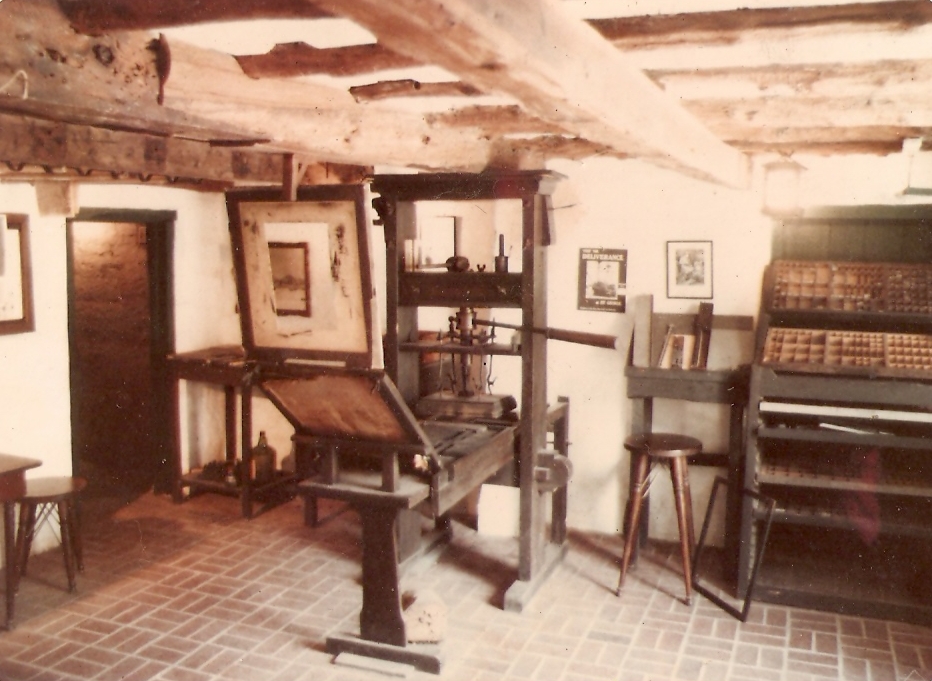
Finally, there’s my wife’s family, most of whom are or were as self-sufficient as my Aunt Norma. The Barmwaters (Middle German, “yeast water”), originally beer brewers in northern Germany, survived the second world war thanks largely to their independence. This self-imposed virtue was mandated across Europe when there was only family to call on. If Otto, my father-in-law, needed a tool for a job, he often made it. I inherited four of these including a silver table knife he made into a chisel and a 6 cm screwdriver he turned into a 3 cm screwdriver. During the war, his wife, Ilse, sewed dresses and shirts for her children from the torn parachute silk her husband sent her from the front.
II “When the sheep are eaten/and wool is scant,/unwind the bedspread/and knit what gold can’t.”—The Wordspinner
Sarah, the mother of a friend, loves to gather the clan, drive with them to the beach, and spend a week each summer in “The Blue House,” a five-bedroom, clapboard rental at Cherry Grove, one block from the ocean. Once ensconced and chores assigned, she packs her beach umbrella, a lounge chair, her latest beach read, a ball of twine, scissors, and a bag of chicken necks her butcher is happy to give her. After scouting a good location along the Intercoastal, she pulls off three yards of twine as if she were measuring fabric at Swirl Boutique. She then ties five or six of her rotting necks about a foot apart to that twine, secures one end to her big toe, and tosses the rest in the water. By the time the sun reaches the tree line, she usually has enough crabs for a mess of crab cakes.
Do-it-yourselfers like Sarah are a special breed, and I count myself fortunate to be among them. In the army, I once accompanied Robert, a good friend, to the American consulate in Hamburg to get some documents for the woman he hoped to wed. It was winter, Robert’s heater was broken, and the snow on the Autobahn’s shoulders was at least a foot high. To compound the dicey situation, Robert’s accelerator pedal suddenly snapped off. His boots were so large that he had difficulty operating the gas, so I had no choice but to drop to the floor, all 6’ 4” of me, and step in for Robert’s right foot for the last hour of our trip.
When Robert and I were ordered to participate in the Wintershield war games in Baumholder, our team of four ELINT operators scarfed a propane heater, enough old mattresses to line the floor of the deuce-and-half we planned to sleep in, enough old blankets to cover the tarp roof of the truck, and another tarp to cover the blankets. Thus, we were well insulated from the sub-zero temperatures. Meanwhile, the infantry slept in the snow.
Other great DIY moments, not my own, include Chet Atkins’ stealing a wire from his mother’s screen door to “fix” a broken banjo string; Barry Hannah’s draining the water from his convertible by punching a hole in the floorboard with his .38, and our Hubris editor’s stitching up Leonard Cohen’s split-up-the-back-seam trousers just minutes before he walked on stage in Athens.
Several years ago, our son called and asked if I could come down to Columbia and help him with some two-man home repairs. I said, “Of course,” and Shane said, “Don’t forget to bring your tools.” After three trips to Lowes and the renovation of his porch roof, I gathered my tools and went to place them in the trunk of the car. On the way, my heart sank when I stumbled on two tools I’d given him when he left home. Evidently, they’d been in the grass quite a while, for they were badly rusted. I’m not a god, as I told Shane, but I am the righteous sexton of my church.
III “Cindy stapled her hems/and pinned her zippers/‘cause self-reliance/wears no glass slippers.”—The Wordspinner
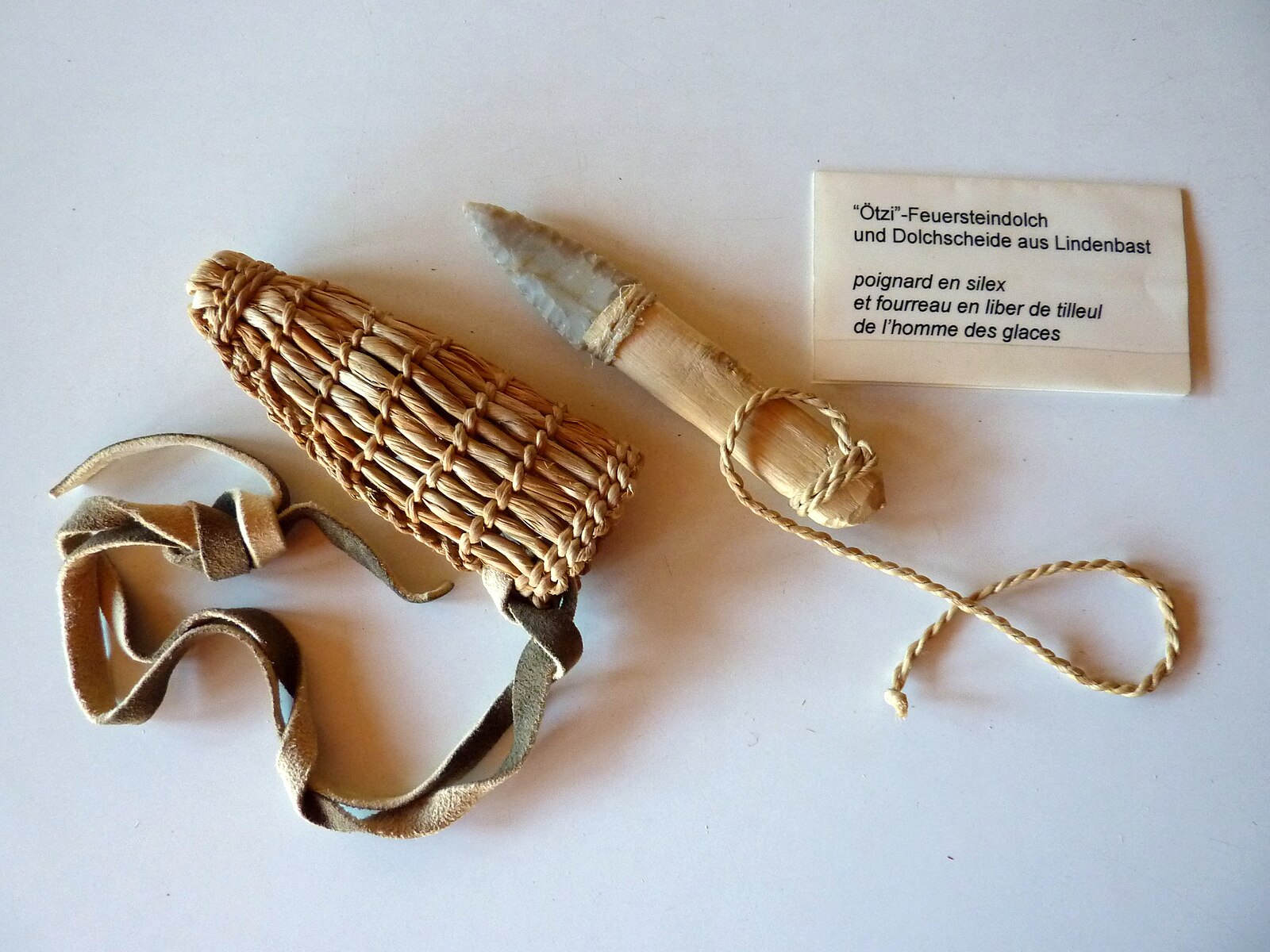
One of the strangest commandments in the Bible is found at Exodus 20: 25 when Yahweh tells Moses: “If you make me an altar of stone, you shall not build it of hewn stones, for if you wield your tool upon it, you profane it.” Clearly, this restriction applies only to the altar, not the temple proper, but I wonder if anyone called this verse to the attention of the altar sculptors, painters, and goldsmiths at Chartres and Salisbury?
When I think of tools and the prodigies they make possible, I’m reminded of that magnificent but ominous scene in 2001: A Space Odyssey, when a hairy hominid discovers that if he picks up a bone and strikes the parched skeleton of some once-meaty wildebeest the lions have left, he in fact has a tool, a weapon that will allow him to hunt on a par with the other carnivores of East Africa. Rejoicing, he hurls his new-found tool skyward where, in the most stunning cinematic ellipsis I know of, the wildebeest femur morphs into the International Space Station. Mesmerized by its stately revolutions, we listen as Thus Spake Zarathustra, the soundtrack, fades into On the Beautiful Blue Danube.
IV “Is a coping saw an epigram for survival?”—The Wordspinner
Whether it’s built of ice, mammoth bones, stones, logs, or wattle and mud, wisdom is born in the realization that before anything else, humans need shelter, especially a roof, as the West African proverb puts it. Indeed, a roof, especially one built by the occupant, and a mess of potage, precedes the fear of the Lord.
Millard and Linda Fuller, founders of Habitat for Humanity, an organization that has built 70,000+ new homes and renovated 100,000+ older homes, often spoke of “the theology of the hammer.” But hammers are crude tools compared to coping saws, and that’s why I’ve titled this column “The Theology of Tools.” My uncle Ted built hundreds of homes for his clients including his own hillside split-level, once featured in Home and Garden. But years of drinking and womanizing brought him stooped and submissive to his minister for a consultation shortly before his death. After that meeting, he told my wife and me, “Looks like my home, be it ever so humble, is as close to heaven as I’m likely to get.”
The novelist Anna Quinlen defines “home” as a place whose image winds up in a girl’s cross-stitched sampler. That’s also the way our roofer and friend Bobby Scruggs would define it. After his ancestral home burned a few years ago, Bobby rented a Bobcat and hauled it to the pile of ashes where a dozen or more Scruggs children had played tag, chased fireflies, and eaten watermelon in the shade of the white oaks that ringed the homestead. Driving the tractor, Bobby pushed aside the charred timbers until he located the granite steps his great-grandfather had carved from Six-Mile Mountain and four generations had worn into long, shallow troughs going up and down to supper. When Bobby had rescued the antique steps for the home he was building a few miles away, he sat on one, fingering the initials of every Scruggs who’d ever climbed these steps, and wept.
2001: A Space Odyssey, 1968: From Bone to Satellite.

Sterling Eisiminger
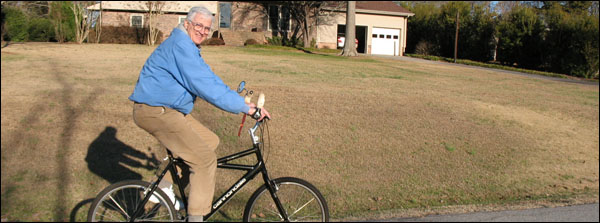
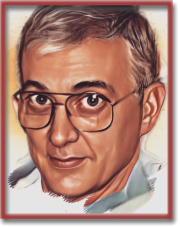
Dr. Sterling (“Skip”) Eisiminger was born in Washington DC in 1941. The son of an Army officer, he traveled widely but often reluctantly with his family in the United States and Europe. After finishing a master’s degree at Auburn and taking a job at Clemson University in 1968, he promised himself that he would put down some deep roots. These roots now reach back through fifty years of Carolina clay. In 1974, Eisiminger received a Ph.D. from the University of South Carolina, where poet James Dickey “guided” his creative dissertation. His publications include Non-Prescription Medicine (poems), The Pleasures of Language: From Acropox to Word Clay (essays), Omi and the Christmas Candles (a children’s book), and Wordspinner (word games). He is married to the former Ingrid (“Omi”) Barmwater, a native of Germany, and is the proud father of a son, Shane, a daughter, Anja, and grandfather to four grandchildren, Edgar, Sterling, Spencer, and Lena. (Author Head Shot Augment: René Laanen.)
4 Comments
judy
“…or the armadillo shells that Southwestern American aboriginals once occupied,…” Inapt comparison. Pithouses are neither hard nor made of plates. The descendants of the pre European contact peoples don’t consider them “aboriginals. Just sayin…..
Skip Eisiminger
Sorry, how about, “indigenous people”?
My source said some lived in the shells; there was no mention of pits.
Skip
Eguru B-H
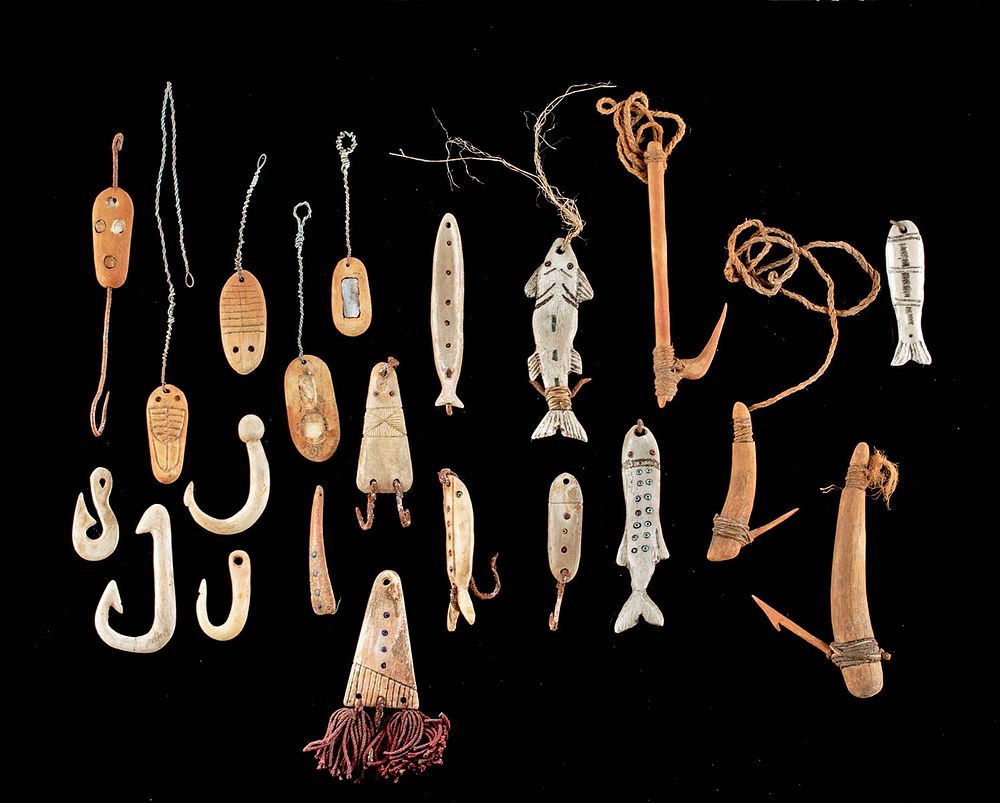
Editor’s Response: Dear Judy, you are correct, and the armadillo-shell-as-building-tool reference in Skip’s essay was incorrect, and I missed fact-checking it. In fact, the Native Americans of the Southwest did NOT use armadillo shells in any way. My cursory search just now yielded this: “Indigenous peoples of the American Southwest did not traditionally use armadillo shells for crafts, tools, or other purposes, largely because armadillos were not native to the region. The use of armadillo shells is much more common among Indigenous cultures in Mexico and Central and South America, where the animals are native. The common nine-banded armadillo did not expand its range into the southern United States until the late 19th and early 20th centuries.”
Daniel James Dodson
Dr. Skip,
Thanks for spinning yarns for weaving stories. (And for reminding me of Elizabeth’s familairity with Leonard…)
My Mom, as a pre-schooler, even though too young to pull the bag behind her in the cotton fields East of 1930s Waco, Texas,
…my Mom was close to the ground and could better pluck the (adjectival phrase) “high cotton” that loomed in her face.
For your toolbox:
From Erica L. Rex’s
“Redefinition: How I unglued my adjectives”
{{{Stesichorus came after Homer but before the Apostles. Before Stesichorus started writing in about 600 B.C., all adjectives were firmly affixed to nouns. Poet and scholar Anne Carson who translated the work of Stesichorus wrote: “Homer’s epithets are a fixed diction with which Homer fastens every substance in the world to its aptest attribute…” In the Iliad, the battlefield is empurpled with blood. Dawn is rosy fingered. It is never anything but rosy fingered. Anyone else who cared to describe the dawn in his or her epic poetry was rhetorically compelled to describe it as rosy fingered. Likewise, Helen of Troy was firmly attached to an adjectival tradition of whoredom. Then along came Stesichorus, who, for reasons no one really understands, applied poetic solvent to the super-glue affixing adjectives to nouns. Writes Carson: “Stesichorus released being. All the substances in the world went floating up. Suddenly there was nothing to interfere with horses being hollow hooved. Or a river being root silver…. Or hell as deep as the sun is high….”)))
—–8+++++8∞∞∞∞∞
https://www.poetryfoundation.org/poets/anne-carson
Grace & Peace
Mr. Daniel