High Fives & Fist Bumps: Greetings
“Someone said that civilization began when the first hominid said, ‘Welcome’ instead of braining a traveler with his club. I used to remind my Humanities classes of that when I entered the classroom, said, ‘Good morning,’ and was greeted by silence. When this happened, I sometimes said, ‘I’m sorry, I thought I was in a place where your elders are respected. Let me try that again, ‘Good morning!’ Some would disagree, but for me, shaming students into greeting me beats cell-phone indifference.”—Skip Eisiminger
Skip the B. S.
By Skip Eisiminger

I. “Talk in the parlor/is dry and small—/thoughtful speech blossoms/when tossing a ball.”—The Wordspinner
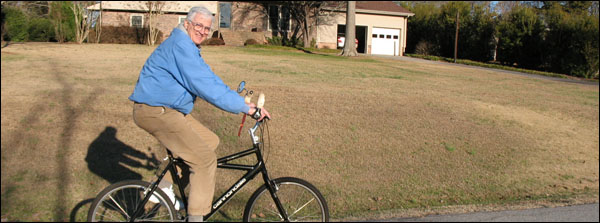
CLEMSON South Carolina—(Hubris)—December 2025—One Sunday evening this April, I yelled downstairs, “I’m going for a quick ride, Maudie.”
“Be careful, Yoda,” she said.
“Do I will!”
Turning off Blue Ridge onto Karen, I see Tommy ahead, weaving his way home on his bike. I think I’ll teach him a lesson, but he hears me coming, stands on his pedals, and beats me to his mailbox.
“You win!” I yell. He smiles back and rings his bell.
On Clemson Elementary’s softball field, I see an angler practicing his fly casting.
“Are they biting?” I yell.
“Just grass,” he says.
Going down Berkeley, a woman and her pitbull tug on a slender leash in equal but opposite directions.
“Easy, boy; easy, boy,” I say, swinging wide in light traffic.
In Ashley Estates, a car cuts me close despite my flashing butt light. As he passes, his beagle barks ten feet from my left ear, but I bark back even louder.
In Monaco Estates, a young girl is shooting layups in her driveway.
“Let’s see a three-pointer!” I say.
She gathers her rebound, and smiling shyly, says, “Hey.”
Around the bend, I see a young, tanned family. In their driveway, the wife is playing pickleball with their daughter. In the yard, the husband is playing catch with their other daughter.
“Play together, stay together!” I say.
They look puzzled until I ring my “Good Humor” bell.
At the top of Monaco’s hill, a woman walking her dog is approaching on my side of the street. I think, “Move left, but you might spook the dog.” As a truck approaches, I’m forced to cut both tight. I apologize, but she’s wearing those white plastic earphones, and the dog never raises its head.
Coasting down Berkeley, I meet a woman on a Harley. I give her a palm-down wave, and she nods back.
Heading home, I’m on the left-hand sidewalk—I know it’s wrong, but it’s Sunday.
Suddenly, a kid on an electric scooter turns into my path. As I jump the curb, he says, “Thanks, mister!”
“Welcome you are,” I say.

II. “Whether you are Muslim/Christian, or Jew,/the gods in me/greet the gods in you.”—The Wordspinner
The neighborhood bike ride described above unfolded in real time as I outlined it. Except for the pitbull encounter a few days earlier, it all happened on one exceptional ride. I say exceptional because on most rides through the same neighborhoods, I don’t speak to or see a soul. Rich or poor neighborhood, Black or White, old or new, I seldom see anyone outside, even on evenings like the one above when the temperature was 76 degrees, and the sky was blue. Perhaps it was always that way, but I seem to recall people in the evening working in their yards and gardens, kids playing tag, and the elderly sitting on their porches. Concrete stoops have replaced many of the old porches, but in one up-scale neighborhood where every faux-Charleston row house has a porch, I can’t recall ever seeing anyone sitting on those porches. They all have rockers, and many have large signs saying, “Welcome,” but no one rocks.
Someone said that civilization began when the first hominid said, “Welcome” instead of braining a traveler with his club. I used to remind my Humanities classes of that when I entered the classroom, said, “Good morning,” and was greeted by silence. When this happened, I sometimes said, “I’m sorry, I thought I was in a place where your elders are respected. Let me try that again, ‘Good morning!’” Some would disagree, but for me, shaming students into greeting me beats cell-phone indifference.
When our children were in grades “K” through six, I sometimes finagled an invitation to speak where silence was not a problem. I attribute much of the warm, noisy welcome to my favorite greeting ploy: walking into a classroom festooned with colorful paper chains, origami swans, and a hamster cage, I’d say, “Give me some hungry chicken!” I’d then lower and cup my hands as if I were holding some corn meal and invite my “chickens” to peck. It never failed.
At home, my German wife and I have several morning rituals, but it’s usually a “shave-and-a-haircut” knock on the bathroom door or a sleepy-eyed “Guten Morgen.” Before our children married, I usually told our daughter, “Good morning, Schnookie,” while our son got a, “Halachas from calaches.” Neither of us has any idea where that originated. If he was visiting and had just stepped from his car, we gave each other a leaping pectoral thrust. I think that started when we saw some footballers on TV celebrating a touchdown, but it ceased when I couldn’t get airborne.
Then there are what I call “specialty greetings.” I’ll never forget how early one Sunday morning when I was riding my bike on SC 93 parallel to the Southern Crescent’s tracks. I raised my right arm and mimed pulling the airhorn, and the engineer complied with the real thing, waking folks, I’m sure, for miles around. Then there was the drill sergeant who woke me and perhaps 20 other fresh-faced recruits in our basic-training squad with, “Drop your cocks, maggots, and grab your socks.” But my favorite specialty was my old track coach’s greeting, “Remember boys, it’s side by side for comfort, but front-to-back for speed. Now git!”

III. “Here they are—Jayne Mansfield.”—Dick Cavett
Cavett’s introduction of the buxom Mansfield on Jack Parr’s late-night television show is one of the unkindest greetings I’m aware of. There’s no record of how she felt on being reduced to her 46-D breasts, but I imagine it was the way some vice baron at Versailles felt when Louis XIV nonchalantly grazed his tricorne with his left hand, “without heat” as the Italians say. Louis is reported to have had six ways to tip his hat: the fewer flourishes Louis used, the lower the recipient was on the royal totem pole. Woe betide the poor baron who didn’t qualify for gesticular fanfare.
If you think that “gm” text you received from your ungrateful child was rude, imagine living at the Fruitlands commune in 1843 and hearing one of the colonists who believed that swearing elevated the spirit say, “Good morning, damn you.” Though Dorothy Parker never resided at Fruitlands, her “What-fresh-hell-is-this?” greeting would have fit right in.
One of my favorite episodes of The Big Bang Theory featured an embittered Judd Hirsch greeting his ex-wife. Said Hirsch, “Hello, my hateful shrew.” To which an equally embittered Christine Baranski said, “Hello to you, you wrinkled old bastard.” It wouldn’t surprise me if both characters had a bear trap repurposed as a doorbell beside his and/or her front door.

IV. “Who you is?”—Anonymous six-grader wecloming journalist Leonard Pitts to his classroom
In Luke 4:10, Jesus cautions his missionaries, “Don’t . . . stop to schmooze with people on the road.” [Complete Jewish Bible] This order not to schmooze is just one of the reasons I lost faith in the absolute truth of the Bible. As my story about Yoda’s bike ride should illustrate, I enjoy speaking to people “on the road,” searching for a story or a smile. But the ambiguous greeting is a story in itself.
Shortly before I retired, a colleague stopped at my open office door. When I noticed him, I started to rise, which led him to say, “Don’t get up.” Which led me to say, “Well, then, don’t sit down.” My reply may sound rude, but we had known each other long enough to understand my intentions. In a somewhat similar way, I once greeted a new hire with a “Good morning, Rick.” When I remembered his name was Nic, not Rick, I apologized and corrected myself. Said Nic with a wink, “Well at least you got the -ick right.” That was gracious of him.
My point is that many greetings are neither rude nor cordial, they’re just out there like the old Groucho Marx lyric, “Hello, I must be going” or the welcome mat that reads, “Not unwelcome.” I recall asking a friend who’d recently had surgery how he was faring. “I’ve lost a hubcap,” my friend who taught automotive engineering said, “but the wheels are fine.” I received a similar reply from a fundamentalist Christian neighbor. When I asked how the world was treating him following his heart surgery, he answered, “Better than I deserve.”
Finally, there’s “Heil Hitler.” In the late 1930s and early 40s, the failure to use that greeting was a crime of omission. Say it aloud in public today in Germany, and it’s a crime of commission.

V. “Now beyond our solar system, Voyager I carries a recording of ‘hello’ spoken in 55 languages.”—NASA spokesperson
A good friend, now deceased, volunteered that he and his wife had used the same break-of-day greeting for over 40 years. On weekends, John, a student of 17th-century British poetry, would usually rise first, make breakfast, and say, “Arouse yourself, my love, from your pastoral slumber.” During the week, if John woke first, he’d tell his sleeping wife, “Up and at ‘em, Madam.” If Marge woke first, she’d say, “Up and at ‘em, Adam.” For the person trying to sleep, I imagine this only produced a groan, but the important thing, as John told me, was to patch the void, say yes to life, repair the social fabric, and keep the conversation going.
I’ve mentioned the unvoiced “shave-and-a-haircut” greeting my wife and I use every morning, but my memory has created a composite family greeting that I also cherish: Son Shane sits waiting by the road a quarter mile from our home. As I turn onto the street where he waits on his ape-hanger Schwinn, I pass him and then slow so he can beat me home. Inside, Anja, our daughter says, “Daddy’s home, release the doves!” To temper the high spirits, my wife asks, “Is that your phone in your pocket, or are just glad to see me?” Individually or as a composite, when all I did was show up, those three greetings lifted me like a rock star in a stadium filled with waving lighters.
Finally, when my father turned 95, Ingrid and I flew to Tucson for his birthday. After I said, “It’s good to see you, Dad,” he replied, “It’s good to be seen. Are you hungry?” A final greeting is always the most poignant.

Sterling Eisiminger
Dr. Sterling (“Skip”) Eisiminger was born in Washington DC in 1941. The son of an Army officer, he traveled widely but often reluctantly with his family in the United States and Europe. After finishing a master’s degree at Auburn and taking a job at Clemson University in 1968, he promised himself that he would put down some deep roots. These roots now reach back through fifty years of Carolina clay. In 1974, Eisiminger received a Ph.D. from the University of South Carolina, where poet James Dickey “guided” his creative dissertation. His publications include Non-Prescription Medicine (poems), The Pleasures of Language: From Acropox to Word Clay (essays), Omi and the Christmas Candles (a children’s book), and Wordspinner (word games). He is married to the former Ingrid (“Omi”) Barmwater, a native of Germany, and is the proud father of a son, Shane, a daughter, Anja, and grandfather to four grandchildren, Edgar, Sterling, Spencer, and Lena. (Author Head Shot Augment: René Laanen.)
3 Comments
Daniel Dodson
Grüß Gott!!
(Doves released.)
Thanks for the humor.
Skip Eisiminger
Gruss Daniel and thank you!
Skip
Jenks Farmer
I’m encouraging my young crew members to speak to strangers and make conversation. We have a short story club and this will be our next read. Thanks